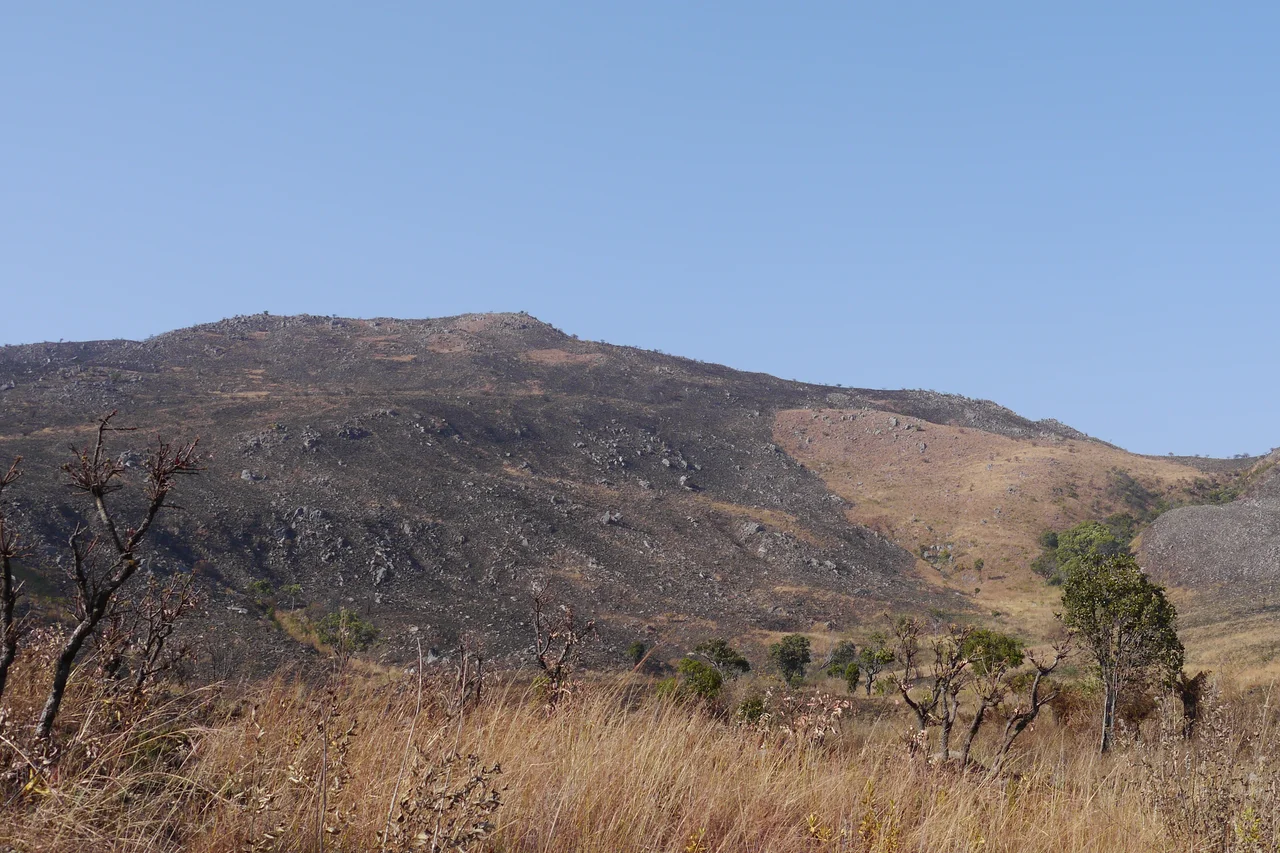

Mount Moco
A bird the size of a chicken creeps through the undergrowth of a forest patch that could fit inside a small farm, and its survival has become the measure of an entire mountain. Swierstra's francolin lives only in the western highlands of Angola, and Mount Moco holds one of its last strongholds. At 2,620 meters this is the highest point in the country, a great hump of grassland rising from Huambo Province, but its true treasure is not the summit. It is the handful of green valleys folded into the slopes, where a sliver of ancient cloud forest hangs on against fire, axe, and time.
The Roof of Angola
Mount Moco stands about 70 kilometers west of the city of Huambo, the tallest peak in a country better known for its coastline and its plateau than its mountains. In 2014 it was named one of Angola's seven wonders, and it draws a steady trickle of hikers, birdwatchers, and the occasional paraglider or rappeller testing themselves against its flanks. From a distance the mountain reads as open grassland, rolling and golden, climbing toward 2,620 meters. The drama hides in the creases. Steep, moist valleys drain the upper slopes, and it is there, sheltered from the dry highland wind, that the forest survives.
Islands in the Sky
These pockets of woodland are Afromontane forest, part of the Angolan montane forest-grassland mosaic, and they behave like islands. Isolated on a few mountaintops for thousands of years, separated from other African highland forests by oceans of grassland and savanna, they evolved their own residents in seclusion. Mount Moco has logged around 233 bird species and is recognized as an Important Bird Area within the Western Angola Endemic Bird Area. Alongside Swierstra's francolin live the Angola cave chat, the Angola slaty flycatcher, and Ludwig's double-collared sunbird, birds whose ranges shrink to a scatter of Angolan highlands. Lose the forest and you lose them entirely, because there is nowhere else for them to go. The mountain has also been barely touched by botanists, its slopes home to several species of Protea and other flowering plants that few researchers have ever catalogued in detail. Much of what grows here may still be waiting to be properly described.
The Village and the Forest
At the mountain's foot sits Kanjonde, a village without electricity, where families live by subsistence farming. For generations that has meant burning vegetation and felling trees to clear ground for crops, and gathering wood to cook by, pressures that steadily ate into the forest. This is not a story of villains. These are people meeting the ordinary needs of daily life on land that offers few alternatives, and the forest happened to stand in the way. By the early part of this century only a few dozen hectares remained, down from a few hundred half a century earlier. The forest's decline was the francolin's decline. But the story did not end there. Since 2011 the ornithologist Michael Mills has worked alongside Kanjonde's residents, with the blessing of the village soba, or chief, to turn the trend around, treating the people who live here not as a problem to be removed but as the partners any lasting recovery would depend on.
Growing It Back
What began as a small native tree nursery in 2010 grew into something larger. Working through the Mount Moco project, villagers and conservationists have planted more than 8,000 native trees from nine species across three separate valleys, nursing forest back into ground that had lost it. The replanted patches are already drawing life: Cabanis's greenbul, a bird not previously recorded at the restoration sites, has moved in and made itself at home. In 2026 the effort reached a milestone when Angola declared a conservation area around the mountain, the Serra do Moco reserve, placing roughly 22,000 hectares under formal protection. For a handful of birds clinging to a vanishing forest, and for the village that chose to grow it back, it was hard-won recognition that the roof of Angola is worth saving.
From the Air
Mount Moco rises to 2,620 m (about 8,600 ft) at roughly 12.467 S, 15.183 E in Huambo Province, west-central Angola, the highest point in the country and an ultra-prominent peak. From the air it appears as a broad grassland massif standing above the surrounding highland plateau, with darker forested clefts in the moist upper valleys. Approach at safe terrain clearance and expect highland weather: morning mist, rapid cloud buildup, and gusty winds over the summit grasslands. The village of Kanjonde sits at the mountain's foot. Nearest major airport is Albano Machado (Huambo) Airport (ICAO FNHU / IATA NOV), roughly 70 km east near the city of Huambo.
Nearby Stories
- Okavango River 44 km away
- Huambo 49 km away
- Lobito 133 km away
- Battle of Cassinga 275 km away
- Tundavala Gap 283 km away
- Quilamba 385 km away
- Atlantic Slave Trade 426 km away
- Kisenge 818 km away