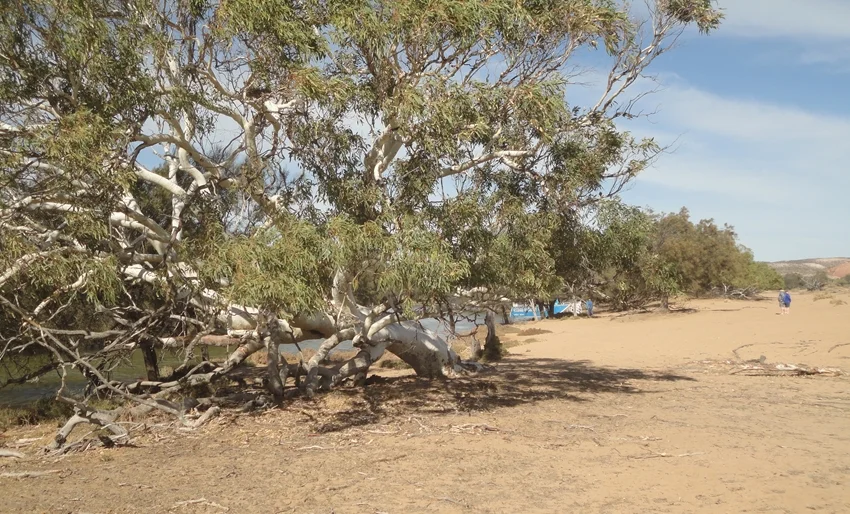

Murchison House Station
In 1972 an Indian prince walked into a sheep station on the Western Australian coast and decided to stay. Mukarram Jah had been the 8th Nizam of Hyderabad, born to a dynasty so wealthy its rulers were once counted among the richest men alive. By the time he reached the Murchison, India had stripped away his titles, and he was looking for somewhere to disappear into. He found it here, at Murchison House Station - 350,000 acres of red earth, salt scrub and ocean frontage near the mouth of the Murchison River, one of the oldest working pastoral leases in the whole of Western Australia.
Built by Convict Hands
The station was founded in 1858 by Charles von Bibra, who set out to supply meat and wheat to the lead miners at nearby Galena, beef to a growing Perth, and remount horses for the British army in India. The first homestead, still known as von Bibra's cottage, was raised by convict labourers out of whatever the land offered: mud bricks and blocks of the local Tumblagooda sandstone, the same banded rock that the Murchison River carves into gorges a little upstream. It is a building made of the country it stands on - the deep geological past of the region quarried straight into the walls of a colonial cottage.
Death From a Clear Sky
On 5 December 1921, the station witnessed a grim first. Sir Norman Brearley's West Australian Airways had just begun the country's first regular airmail run, and on one of those early flights a Bristol Tourer biplane got into trouble over the property. The pilot, Bob Fawcett, and his mechanic, Edward Broad, were both killed when the aircraft came down - Western Australia's first civil aviation fatalities. The inquest into the crash was held at the station itself. The two airmen were buried here, and they lie alongside Andrew James Ogilvie, an earlier owner who had died in 1906 - a small graveyard binding together the pioneers of pastoral life and the pioneers of flight.
The Reluctant Nizam
Mukarram Jah's chapter reads like a fable about the limits of inherited fortune. He had lost his royal titles and privileges in 1971 when India amended its constitution, and the following year he sank himself into station life on the far side of the Indian Ocean, more at home tinkering with machinery than presiding over a court. But while he was away, his vast holdings in India were drained, mismanaged and misappropriated. In 1996 the Murchison House Station was placed in liquidation. Jah eventually left Australia and settled quietly in Turkey - a man who had owned palaces ending up, for a time, as a cattleman on a remote Australian lease.
Goats, Guns and a Working Future
The station never stopped being a working property. Earlier in its life it ran on a grand pastoral scale - around twenty thousand sheep and a hundred and fifty horses by the mid-1930s - before the long shift away from wool. The shearing shed, derelict by the late twentieth century, was patched up in the 1990s and turned over to tourist accommodation. By 2018 the run carried a couple of hundred shorthorn-cross cattle and some seven thousand rangeland goats across its paddocks. It also keeps surrendering surprises. In 2017 a group of schoolchildren clambering over a rock formation on the property opened a metal box stashed in a cave and found a roughly century-old Browning machine gun lying beside a far younger shotgun - a cache no one has fully explained, waiting in the dark of a Murchison cave for a curious child to find. The land here holds its history close, and it does not give it up all at once.
From the Air
Murchison House Station spreads across the country near 27.65 degrees south, 114.24 degrees east, just inland of the Murchison River mouth and the town of Kalbarri on Western Australia's Mid West coast. From the air the property reads as a vast working landscape between the dark slot of the lower Murchison gorge to the east and roughly 60 km of Indian Ocean frontage to the west; the homestead cluster sits a short distance up the river from its mouth. Nearest light-aircraft field is Kalbarri Airport (YKBR / KAX), about 10 km east of town with no fuel; the principal regional airport is Geraldton (YGEL), roughly 160 km south. A viewing altitude of 2,000-4,000 ft AGL shows the river, the homestead and the coast together; expect clear, dry conditions and brisk afternoon sea breezes, with cyclone-season weather possible from November to April.
Nearby Stories
- Eurardy Reserve 17 km away
- Zuytdorp 30 km away
- Principality of Hutt River 42 km away
- Heirisson Prong 131 km away
- Woodleigh Impact Structure 153 km away
- Useless Loop, Western Australia 173 km away
- Mount Magnet, Western Australia 318 km away
- Chatham Islands 6355 km away