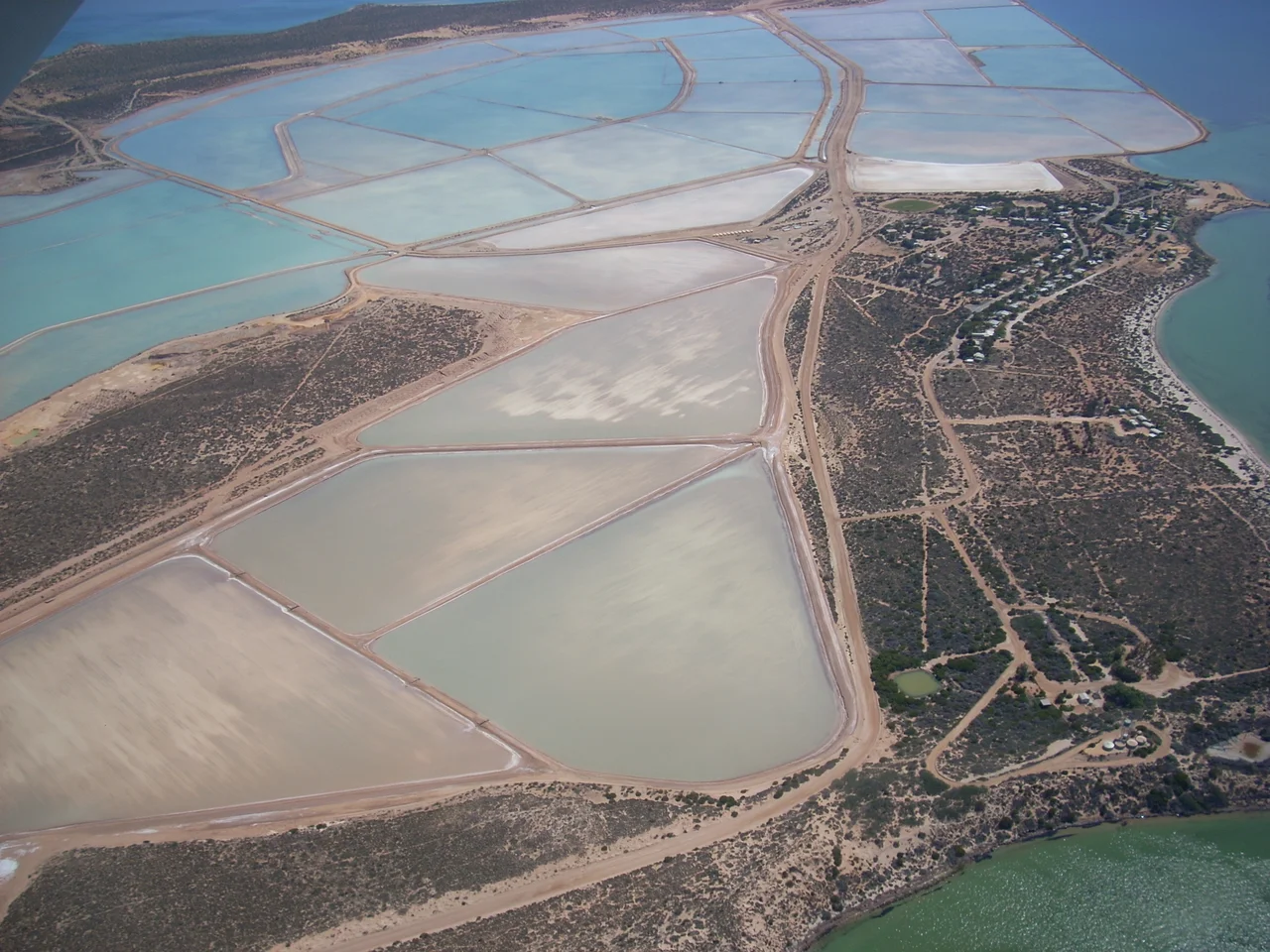

Useless Loop, Western Australia
The name was an insult, and it stuck. In the early 1800s a young French officer named Henri-Louis de Saulces de Freycinet looked at this curving inlet on the southern edge of Shark Bay, saw a sandbar he believed blocked the harbour entirely, and wrote it off in two dismissive words: Havre Inutile, the useless harbour. He was charting the coast for one of history's great scientific voyages, and he could not have guessed that the place he judged worthless for shipping would one day load more than a million tonnes of cargo a year. The harbour was useless only for the things he came looking for. For sunlight and seawater, it was perfect.
The Verdict of a Sailor
Henri-Louis sailed with the Baudin expedition, the ambitious French survey of the Australian coast that ran from 1800 to 1803 aboard the ships Geographe and Naturaliste. His older brother Louis de Freycinet, who would later complete the expedition's official charts, became the more famous of the two. But it was Henri-Louis who left this corner of Western Australia its strange and self-deprecating name. To a navigator, an inlet you cannot enter under sail is worse than no inlet at all. Havre Inutile was a warning to other captains: do not waste your time here. The English translation that eventually settled onto maps, Useless Loop, kept both the dismissal and the shape of the looping inlet that prompted it.
Harvesting the Sun
What the French could not use, industry could. In 1962 a solar salt operation took root here, and Useless Loop found its purpose. The principle is ancient and almost absurdly simple: pump shallow seawater into vast ponds, let the relentless Gascoyne sun and dry wind do the evaporating, and rake up the salt left glittering behind. Shark Bay's already-salty water and reliable sunshine make it one of the finest natural salt factories on Earth. A joint venture formed with the Japanese trading house Mitsui in 1973, the partnership taking full ownership in 2005 under the name Shark Bay Salt, and by 2015 the operation was exporting around 1.4 million tonnes of salt a year, most of it bound for Asian industry. The looping inlet the navigator scorned turned out to be ideal harbour after all, just for barges of salt rather than ships of exploration.
A Closed Town at the End of the Road
Useless Loop is a company town in the fullest sense, a closed settlement where roughly seventy employees and their families live to run the salt works and little else. There is no passing through. Outsiders cannot simply drive in; the town exists for the operation and the operation for the town. Across Denham Sound, about 25 kilometres northeast, sits the small tourist town of Denham, and beyond it the dolphins of Monkey Mia draw visitors from around the world. But Useless Loop keeps to itself on its remote peninsula, one of the most isolated settlements in Western Australia, reached only by a long unsealed road across the salt-flat country. It is one of those rare Australian places defined entirely by a single industry, where the rhythm of life follows the slow crystallization of salt under an enormous sky, and where the nearest supermarket or hospital is hours away across the spinifex.
Geometry from the Air
Seen from above, Useless Loop is one of the most visually arresting industrial landscapes in Australia. The evaporation ponds spread across the land in enormous geometric blocks, their colours shifting from pale green to deep rose depending on the salinity and the microscopic, salt-loving algae that thrive in the brine. Mounds of harvested salt gleam white against the red desert earth. The straight engineered lines of the ponds sit in startling contrast to the soft curves of the natural coastline that gave the place its name. It is a reminder that this strange, ironic outpost sits inside a UNESCO World Heritage Area, where human ingenuity and one of the planet's most remarkable marine wildernesses share the same shore.
From the Air
Useless Loop lies on the western shore of Shark Bay's southern reaches at about 26.13 degrees south, 113.42 degrees east, on the Heirisson Prong peninsula. The defining landmark from the air is the sprawling grid of solar salt evaporation ponds, vivid green-to-pink rectangles that are visible from 5,000 to 10,000 feet and unmistakable in satellite imagery. Denham Sound separates the town from Denham, about 25 km northeast. The nearest passenger airfield is Shark Bay (Monkey Mia) Airport (ICAO YSHK) near Denham; Carnarvon Airport (ICAO YCAR) lies roughly 140 km north. The arid climate delivers reliable clear skies; midday sun makes the coloured ponds glow most intensely.
Nearby Stories
- French Western Australia 3.3 km away
- Shark Bay 6.5 km away
- Francois Peron National Park 23 km away
- Hamelin Pool Marine Nature Reserve 26 km away
- Zuytdorp Cliffs 106 km away
- The Silent Wave: Java's 1994 Tsunami Earthquake 1738 km away
- Chatham Islands 6516 km away