.jpg)
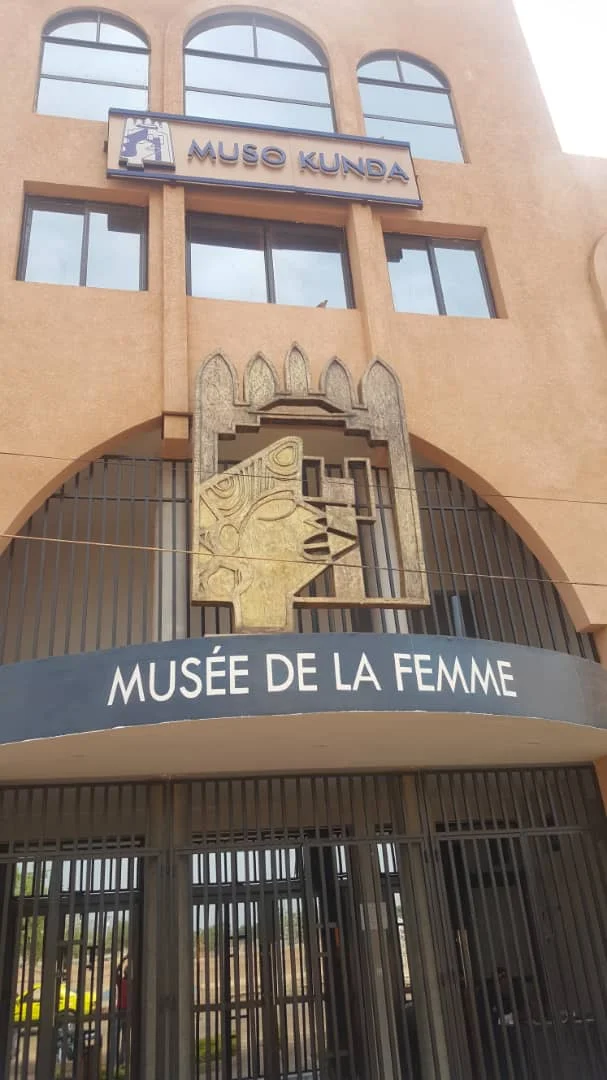
Muso Kunda Museum of Women
The name means "the house of women" in Bambara, and the museum delivers on the promise the moment you step inside. A wall of faces greets you at the entrance - portraits of the women who marched in the streets of Bamako in March 1991, when Malians rose against a military dictatorship and forced the country toward democracy. Most museums of national struggle would have filled that wall with generals. This one chose the women. That choice is the whole point of Muso Kunda.
A Historian's House
Muso Kunda opened in 1995, founded by Adame Ba Konaré - a Malian historian who happened, at that moment, to also be the country's First Lady, married to President Alpha Oumar Konaré. She had spent her career arguing that Malian women had been written out of the record, their work treated as background noise to the deeds of men. So she built a place to put them back in. The museum sits in the Korofina Nord district of Bamako, on the north bank of the Niger, and its stated mission reads like a manifesto: break the stereotypes, celebrate the contributions, defend the rights, and keep the memory. That last word matters most. Memory, for a historian, is not nostalgia. It is evidence.
The Wall of 1991
The democracy gallery is where the museum's argument becomes personal. Among the figures honored is Aoua Kéita, a midwife who became the first woman to reach the upper ranks of the US-RDA, the party that led Mali to independence - a politician at a time when politics was understood to be men's work. There is Fanta Damba, a celebrated griot whose voice carried the praise-songs and genealogies that are themselves a form of history in this part of West Africa. The displays reach across Mali's peoples - the Fulani of Mopti, the Bambara of Ségou - and mannequins dressed in their distinct traditions stand in for the women who never sat for a portrait. The effect is a deliberate reversal: ordinary women rendered monumental.
Then and Now
Not every gallery is about heroines. One room is filled with the ordinary tools of a Malian woman's day - implements for cooking, for grinding grain, for fishing, for collecting and selling milk - arranged to show how each has changed across generations. The point is quietly radical. By placing a hand-grinding stone beside its modern replacement, the museum frames women not as keepers of unchanging tradition but as the people who actually adapted households to new technology, year after year. It is labor that rarely makes it into national histories, and here it occupies a gallery of its own.
Faro's Journal
The museum publishes a cultural journal called Faro, named for the goddess of the Niger River - the great water that defines Bamako and gives the city its life. Alongside the journal, Muso Kunda runs a film showcase, screening the work of young Malian filmmakers chosen by competition for their films on women's rights, and keeps a research center and library for those who come to dig deeper. It is a small institution in a country that has faced hard years, and it survives on conviction more than money. But its founding wager has held: that a nation which forgets its women has forgotten half of itself, and that the cure is simply to build them a house and let people in.
From the Air
Muso Kunda sits in the Korofina Nord district on the north side of Bamako, Mali, near 12.67°N, 7.95°W, on the north bank of the Niger River. The international airport at Bamako-Sénou (ICAO: GABS) lies roughly 15 km south of the city center. From the air, look for the broad ribbon of the Niger curving through the sprawling capital; the museum is in the dense urban grid north of the river. Best visibility comes in the dry season from November to February, when Sahelian haze and harmattan dust are lightest.
Nearby Stories
- Narena 35 km away
- Siby, Mali 48 km away
- Nyamina 55 km away
- Niagassola 88 km away
- Morila Gold Mine 106 km away
- Boucle du Baoulé National Park 129 km away
- Tukulor Empire 143 km away
- Ségou 185 km away