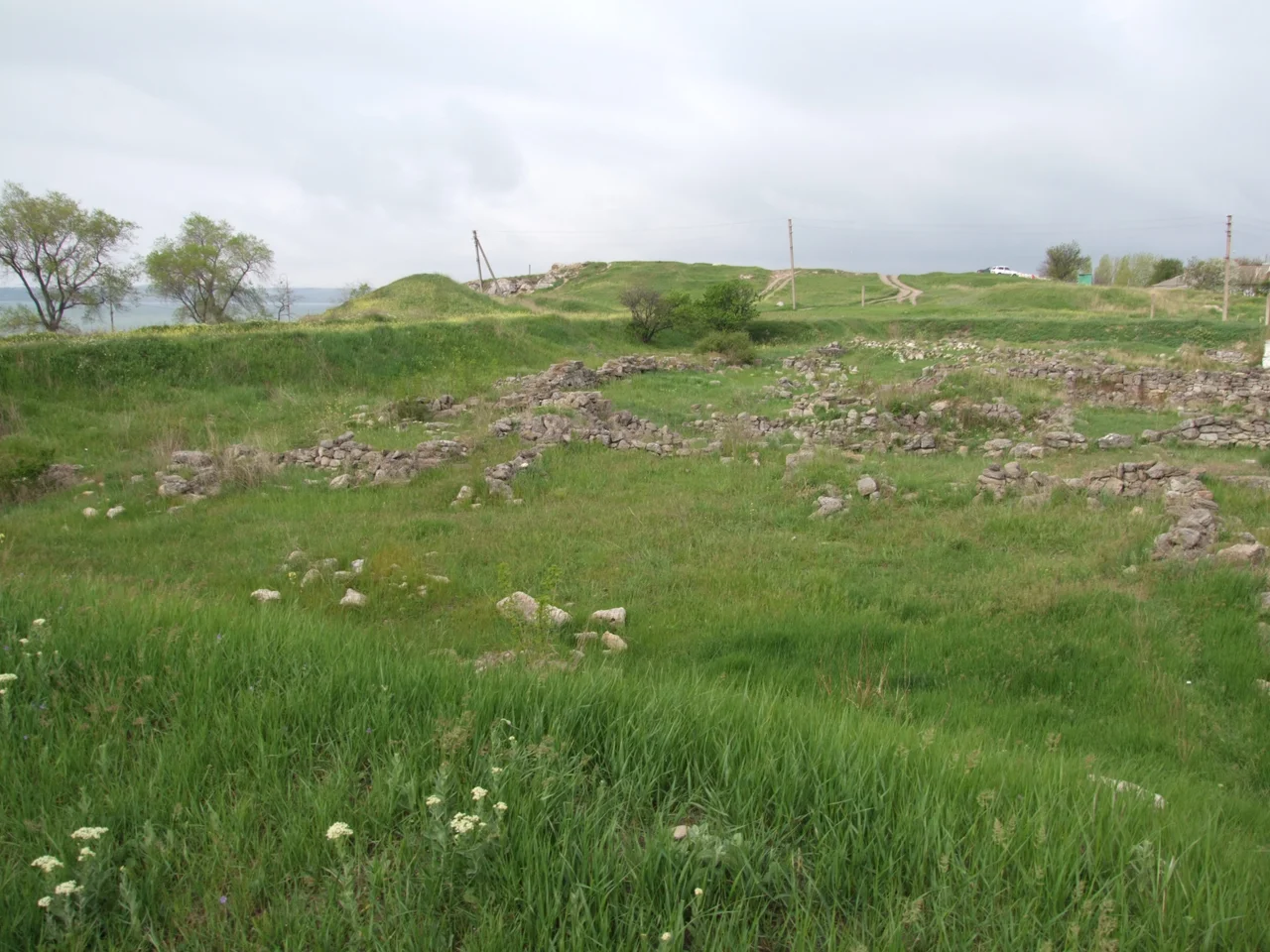

Myrmekion
In 1834, sailors on quarantine duty near Kerch set about raising a flagpole and struck stone that would not move. Digging around it, they found tombs cut into the rock of an ancient acropolis - and inside, two marble sarcophagi. One was like nothing else on earth: a great coffin carved with scenes from the life of Achilles, a masterpiece from an Athenian workshop of the second century AD, now among the treasures of the Hermitage. The sailors had stumbled into Myrmekion, a small Greek colony whose modest ruins have been yielding extraordinary things for nearly two hundred years.
The Town of Ants
Milesian colonists founded Myrmekion in the first half of the sixth century BC, a few kilometers northeast of Pantikapaion on the bank of the Kerch bay. Even its name is a small mystery. Some derive it from the Greek word for ant - myrmex - imagining a town as busy and crowded as an anthill; others link it to a word for an underwater reef, for the rocks that jut into the strait nearby. The earliest inhabitants lived in half-dugout huts roofed with dried seaweed, huddled on a small rocky cape. Fire, that constant terror of ancient towns, swept through more than once, and each time the people rebuilt, ringing their acropolis with defensive walls. Twice, most likely, Scythian raids battered the settlement, and each time it revived, reaching its height in the first half of the fourth century BC.
A Coast That Ran on Wine
From the Hellenistic age onward, Myrmekion was known for one thing above all: wine. Its wineries were serious industrial operations, with platforms where workers trod the grapes underfoot and stone presses to squeeze the last juice from the pulp. The liquid drained into cisterns whose capacity ran to seven or eight thousand liters - not the output of a village but of a place shipping its vintage far and wide. Later, in the Roman period, the town added vats for salting fish, the other great export of this coast. Yet Myrmekion never escaped the shadow of its powerful neighbor. It fell under the Bosporan kings in the fourth century BC and remained, for much of its life, a modest holding of the royal family - a working town, not a capital, its prosperity measured in amphorae rather than monuments.
Layer Upon Layer
Few places pack so many centuries into so little ground. After the Greek town faded, the Huns swept through in the 380s and its people withdrew to Pantikapaion for safety. Later a settlement of the Saltovo-Mayaki culture rose and fell here; later still, after the Mongols folded Crimea into the Golden Horde, the strait became a link in the Silk Road, and a small trading post the Genoese called Pondico grew on the old site, complete with a little fortress that, like so much here, burned. Systematic excavation began in 1934, and the work continues today under the Hermitage. The rewards keep coming: in 2018 archaeologists uncovered the first large statue ever found here, a headless, legless figure of Asclepius, the Greek god of healing. Beneath the quiet grass by the strait, Myrmekion is still handing up its past.
From the Air
Myrmekion lies at 45.353 N, 36.522 E, on the shore of the Kerch bay in the northeastern part of Kerch, near the historic Yeni-Kale area. The low coastal excavation is difficult to spot from altitude; approach at 1,500-2,500 feet using the Kerch waterfront and the arc of the Crimean Bridge to the southeast as references. The nearest airfield is Kerch, with Anapa (URKA) across the strait to the east.
Nearby Stories
- Kazantyp Nature Reserve 2.8 km away
- Akra, Crimea 5.7 km away
- Kepoi 16 km away
- Battle of Kerch Strait (1790) 31 km away
- Battle of Kaffa (1616) 40 km away
- Byriuchyi Island 75 km away
- Henichesk 134 km away
- Meotyda National Nature Park 164 km away