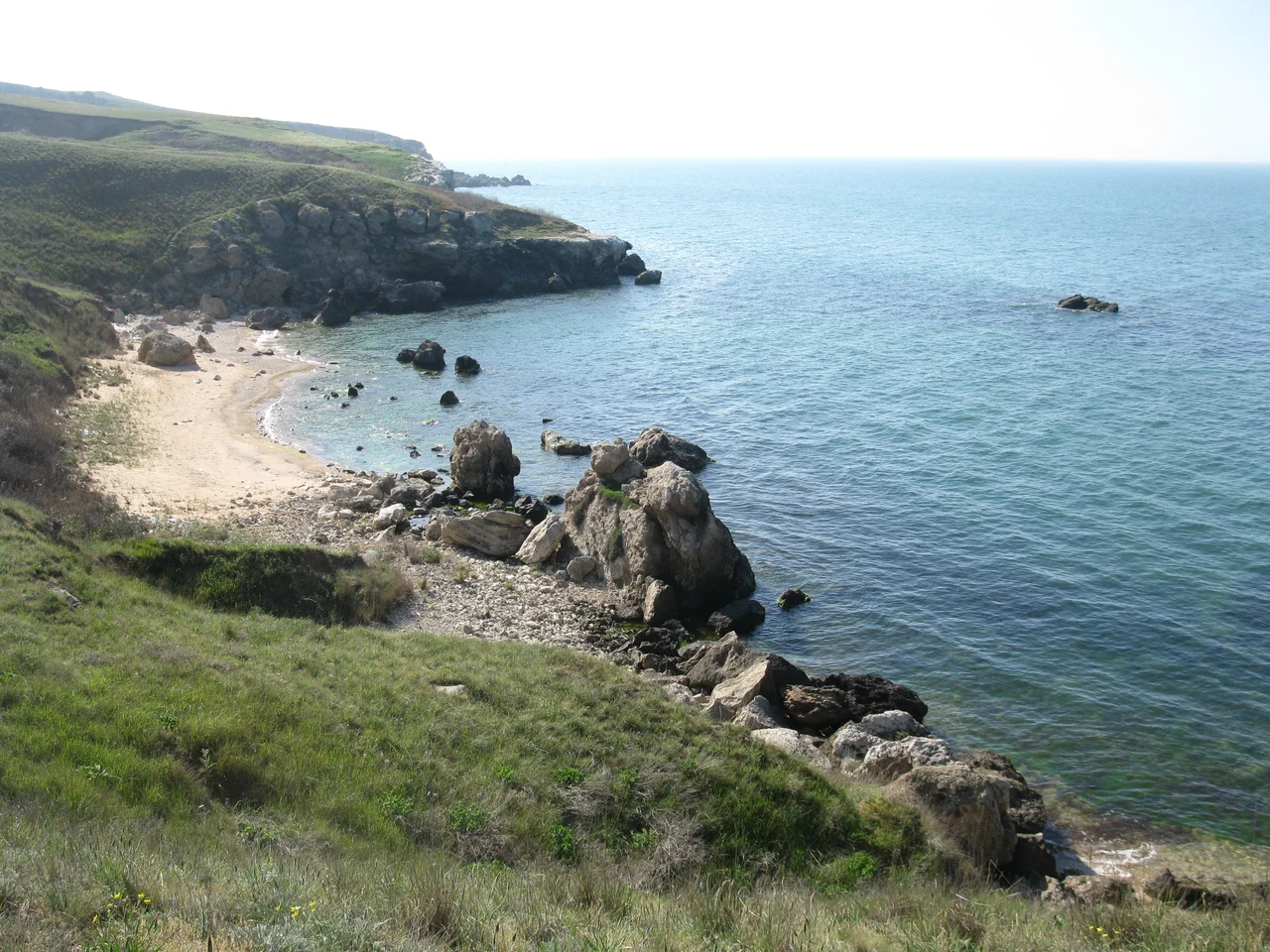

Kazantyp Nature Reserve
Some of the richest places are the smallest. Kazantyp Nature Reserve covers just four and a half square kilometers, a scrap of land wrapped around a limestone cape that pushes out into the shallow, warm Sea of Azov near the northeastern corner of Crimea. You could walk across it in an afternoon. Yet within that tiny footprint grow 486 kinds of vascular plants, more than half of every species found on the entire Kerch Peninsula. It is a reminder that biodiversity does not always announce itself with vast horizons; sometimes it hides in a single dry, wind-scoured headland that most travelers pass without a second glance.
A Cape Full of Life
The reserve was established in 1998 to protect the intertwined ecosystems of Cape Kazantyp and the coastal waters that surround it. This is steppe country, and the plant communities reflect it: hardy, low-growing species adapted to hot summers, thin soils, and salt-laden wind. Offshore, near-coastal algae communities carpet the shallow seabed, an underwater meadow that most visitors never see. The cape's fringing reef of ancient limestone gives the shoreline its distinctive shape, a series of coves and rocky spurs that trap pockets of habitat. It is precisely this variety within a small area that lets so many species coexist here, each finding its own niche in the folds of the land. A dry, salt-laced climate rules the cape, and the plants that thrive are the tough survivors of the steppe, low and wiry, adapted to wring life from thin soil and scant rain. What looks at a glance like empty scrubland is in fact a densely packed community, every square meter contested and occupied.
A Stop on the Great Migrations
The reserve's greatest fame belongs to its birds. It ranks among the 138 most valuable sites identified in the region under the Important Bird Area Programme, a network of places critical to birds across a continent. Sitting where land narrows and sea beckons, the cape becomes a natural waypoint, a place to rest and feed. UNESCO has recognized Cape Kazantyp as a reserve of international significance, an acknowledgment that what happens on this small headland matters far beyond its borders. Rare and threatened species, some listed in international red lists of endangered wildlife, depend on these few square kilometers remaining undisturbed.
Wild by Design
The reserve exists to protect virgin ecosystems, tracts of coast that have never been plowed, drained, or built over. That distinction matters enormously on a peninsula where so much of the flat interior has been given over to agriculture and settlement over the centuries. The cape's rugged terrain, too broken and stony to be useful farmland, is exactly what saved it. Where the surrounding plains were tamed, this headland stayed feral. Today the reserve stands as a small, stubborn archive of what the whole coastline once looked like, kept deliberately wild so that its rare plants and the creatures that depend on them have somewhere left to belong.
A Cape of Many Names
The name Kazantyp attaches to more than this quiet reserve, and the confusion is worth untangling. The same cape lent its name to a famous electronic music festival that once raged nearby, and to the unfinished nuclear power station whose ruins stood a few kilometers to the southwest until their demolition in the mid-2020s. But the reserve is a world apart from that noise, a place of silence, salt wind, and slow-growing steppe. Established under the regional environment ministry, it protects not spectacle but subtlety: the ordinary-looking grasses and coastal herbs that turn out, on close inspection, to be some of the rarest plants of the Crimean coast. It rewards the patient visitor rather than the loud one. In a landscape better known for a rave and a ruin, the reserve keeps its own steadier kind of fame, the sort measured in species counts and nesting birds rather than headlines.
From the Air
Kazantyp Nature Reserve occupies Cape Kazantyp at roughly 45.46°N, 35.84°E, on Crimea's Sea of Azov coast. From 3,000 feet the rounded, cliff-edged cape stands out clearly against the flat surrounding shoreline, with the town of Shcholkine and the former nuclear plant site nearby to the southwest. Nearest major airfield is Simferopol (UKFF), about 130 km to the southwest.
Nearby Stories
- Kimmerikon 15 km away
- Kul-Oba 17 km away
- Ozbek Han Mosque 17 km away
- Feodosiya 28 km away
- Arabat Spit 31 km away
- Byriuchyi Island 47 km away
- Henichesk 86 km away
- Meotyda National Nature Park 174 km away