
Kul-Oba
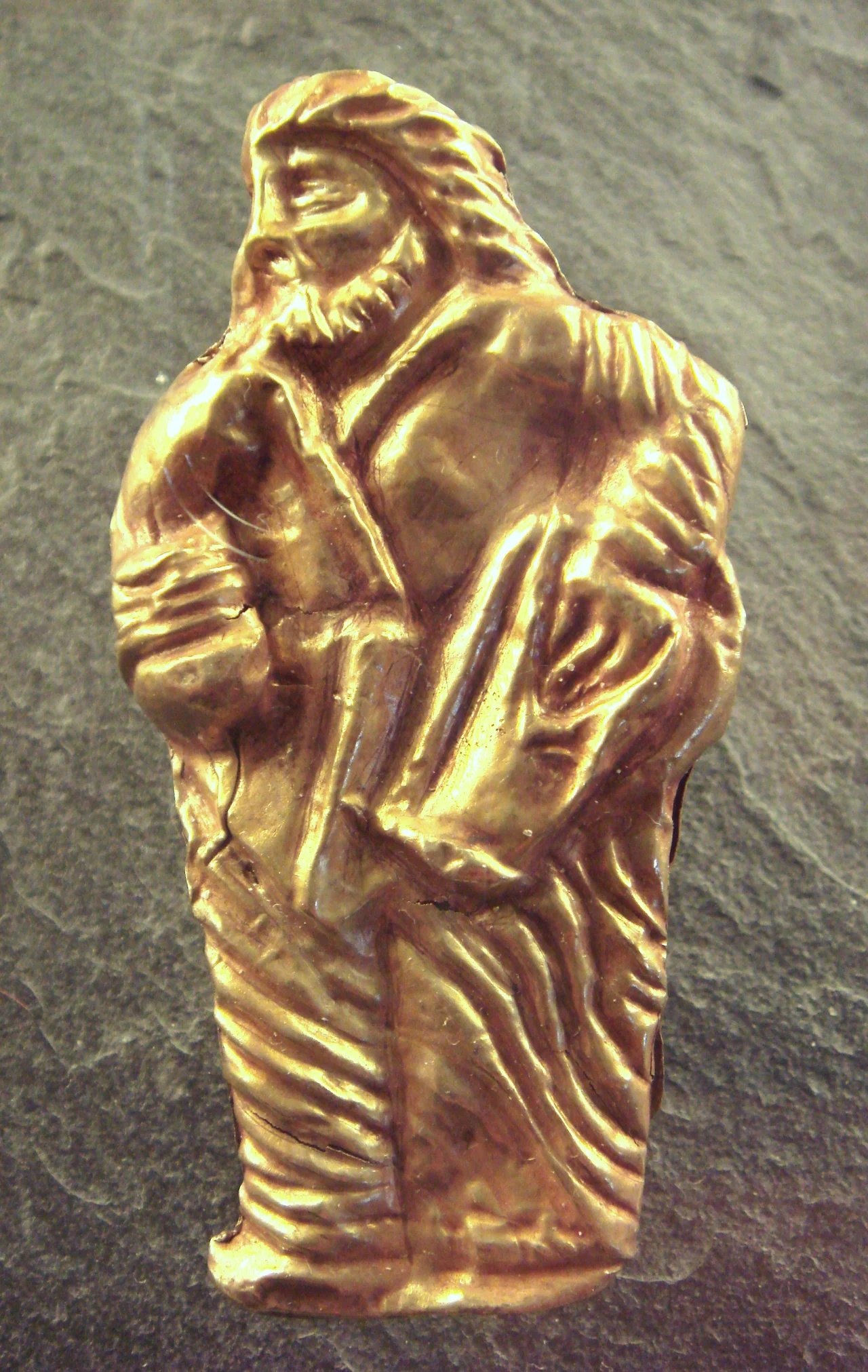
The Crimean Tatars called it Kul-Oba, the hill of ash. In 1830, workers quarrying the mound for building stone broke through into a chamber no living person had entered in more than two thousand years. Inside, by lamplight, lay a Scythian king on a couch of carved wood, a heavy gold disk at his throat, a pointed felt cap trimmed with gold above his brow. This was the first royal barrow of the Scythians ever opened in modern times, and what emerged from the darkness that season would rewrite how Europe imagined the horse-lords of the steppe.
A Tent of Stone for a King of the Steppe
The Scythians were nomads who lived in wagons and felt tents, and their masons - probably Greeks hired from nearby Pantikapaion - built the dead king a tent of stone. The chamber is almost square, its walls stepping inward and upward into a vault more than five meters high, the ceiling shaped to echo the timber roof of a chieftain's tent. Against the east wall the king lay in state. A gold disk weighing 461 grams hung at his neck; bracelets ringed each wrist; beside him were laid a whip, a knife, a phial, and a quiver, everything inlaid with gold or precious stone. He had been a rider of the open grasslands, and his people had furnished his afterlife with the trappings of rank a Scythian would recognize.
The Woman and the Golden Cup
To the left of the king stood a sarcophagus of cypress wood and ivory, and in it lay a woman - his wife, perhaps, or a companion who followed him into death. Her body was arrayed with an electrum diadem and great gold pendants, open-work earrings, a necklace, bracelets, a gold disk over her brocaded dress. A bronze mirror with a gilded handle lay at her side. Between her feet rested the object that made Kul-Oba famous: a small electrum vessel worked with scenes of Scythian men - stringing a bow, tending a wounded leg, binding a comrade's jaw - tiny figures that let us glimpse faces and gestures from a world with no written history of its own. Near the south wall lay a third body, a servant, likely a charioteer, buried with the horse bones and weapons of his trade.
The Room Beneath the Room
The archaeologists thought they had found everything. They had not. Beneath the burial chamber lay a second, secret cavity - and the diggers never suspected it. Word of the treasure spread through Kerch, and treasure hunters found what the scholars had missed, emptying the hidden room before anyone in authority could act. Some of the stolen valuables were later recovered by the Russian government, but no one will ever know all that vanished in the night. The great pieces that survived - the gold, the electrum cup, the diadems - traveled to the Hermitage in St. Petersburg, where they remain among the treasures of the Scythian world. The mound itself still rises near Kerch, an empty hill of ash that once held a king.
From the Air
Kul-Oba lies at 45.349 N, 36.382 E, on the high ground west of Kerch near the road toward Feodosia. The bare rounded mound is hard to distinguish from altitude; approach at 1,500-2,500 feet using the western edge of Kerch and Mount Mithridat as references. The nearest airfield is Kerch, with Simferopol (UKFF) roughly 200 km to the west.
Nearby Stories
- Phanagoria 5 km away
- Battle of Kerch Strait (1790) 13 km away
- Crimean Nuclear Power Station 15 km away
- Soviet Destroyer Smyshlyony 43 km away
- Koktebel 49 km away
- Arabat Spit 70 km away
- Byriuchyi Island 120 km away
- Meotyda National Nature Park 184 km away