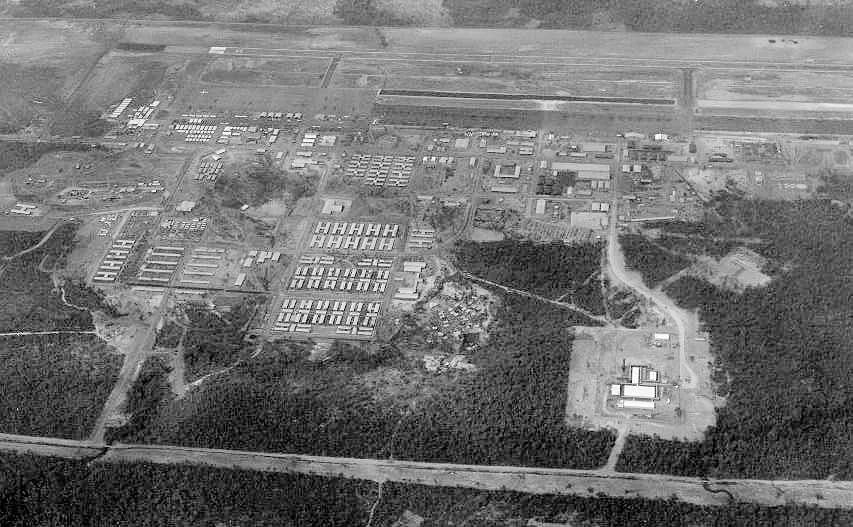

Nakhon Phanom Royal Thai Navy Base
Nine miles west of Nakhon Phanom city, on ground that had been rice paddy a few years earlier, the United States Air Force put up a windowless, air-conditioned building of some 200,000 square feet and filled it with computers. Construction started on 6 July 1967 and took three months. Inside were two IBM 360/40 mainframes — later replaced by 360/65s — and rows of analysts at video displays, watching signals come in from sensors scattered by the tens of thousands across the mountains of Laos. A war was being fought by machine from a room in Thailand, and Thailand was not at war.
The Gentleman's Agreement
Thailand had built the airfield in the 1950s for its own air force. What changed everything was the civil war across the river in Laos, and Bangkok's fear that it would come over. From 1961 the Thai government quietly let the United States operate from five Thai bases, and the arrangement came with rules. Under what both sides called a gentleman's agreement, these remained Royal Thai Air Force bases under Thai command. Thai air police controlled the gates, with American security police helping out with sentry dogs, watchtowers and machine-gun bunkers. American personnel were not fully armed, and before going off base they were briefed on how not to answer a reporter's questions. The first Americans on the ground, in 1962, were Navy Seabees of Mobile Construction Battalion Three, who laid a 6,000-foot runway of pierced steel planking. It opened on 1 June 1963.
Mud River
The building west of town was the Infiltration Surveillance Center, the brain of Operation Igloo White, run by Task Force Alpha under Brigadier General William P. McBride. The idea was to seed the Ho Chi Minh Trail with sensors — seismic detectors that registered footfalls at thirty to a hundred metres, acoustic units adapted from Navy sonobuoys — then let the computers at Nakhon Phanom predict where the trucks would be. Some 20,000 sensors went out over five years. Navy Observation Squadron 67 flew the low, slow, dangerous sowing missions in OP-2E Neptunes from February 1967 to July 1968, wearing the tail code MR for Mud River. The system cost between one and 1.7 billion dollars to build and roughly a billion a year to run. Whether it worked is still argued; it did not see the 1972 North Vietnamese buildup coming.
Sandy, Nimrod, Nail and Jolly Green
The Americans called the place Naked Fanny, a joke about the initials, and the flying there had a distinctly unmodern character. While jets screamed out of other Thai bases, Nakhon Phanom ran a propeller air force: A-1 Skyraiders of the 602nd, call sign Sandy, orbiting for hours over downed airmen; A-26 Invaders of the 609th flying night interdiction as Nimrod; C-123 flareships as Candlestick; O-1s, O-2s and OV-10 Broncos of the 23rd Tactical Air Support Squadron working as forward air controllers under the call sign Nail. From July 1965 the helicopters were there too, the CH-3s and later HH-53s whose crews answered to Jolly Green and whose entire job was to go and get people. In November 1970 the base was one of the staging fields for the Son Tay raid, mounted to free roughly ninety American prisoners from a camp near Hanoi. The raiders got in and out. The prisoners had been moved months before.
Knife 13
On 13 May 1975, with Saigon and Phnom Penh already fallen, planners drew up a scheme to retake the merchant ship SS Mayaguez from Khmer Rouge forces using seventy-five volunteers from the base's own 56th Security Police Squadron — men whose ordinary work was guarding a fence line. Twelve helicopters were ordered to U-Tapao to stage. At around 21:30, one of them, a 21st Special Operations Squadron CH-53 with the call sign Knife 13, went down. Eighteen security policemen and the five-man flight crew were killed, twenty-three men in all, before the operation they had volunteered for had begun. They are not the only names the field claimed: on 21 November 1972 an EC-47Q of the 361st Tactical Electronic Warfare Squadron bounced on landing, ran off the runway, tried to go around and struck trees, killing two of the ten aboard.
Palace Lightning
The end came quickly. After the fall of South Vietnam and Cambodia, and after American forces used Thai bases during the Mayaguez affair without Thai permission, Bangkok told Washington to take its people home by the end of the year. The withdrawal was named Palace Lightning. USSAG and Seventh Air Force, which had moved their headquarters here from Tan Son Nhut in early 1973 and run American air operations across Southeast Asia from Thai soil, were disestablished at 17:00 on 30 June 1975. The 56th Special Operations Wing stood down the same day. The last USAF units flew out on 1 October 1975. The airfield never closed — it is now a Royal Thai Navy base supporting riverine patrols on the Mekong, sharing its 2,500-metre runway with civil airline traffic. Bob Hope played his Christmas show here in 1966. The same strip of asphalt now brings visitors in from Bangkok.
From the Air
The field sits at 17.3839°N, 104.6431°E, roughly 14.5 km west of Nakhon Phanom town and about 587 km northeast of Bangkok, with the Mekong River — the Lao border — running past a few kilometres to the east. It operates as Nakhon Phanom Airport (KOP / VTUW), field elevation 587 ft, single asphalt runway of 2,500 m (8,203 ft). Nearby alternates: Sakon Nakhon (SNO / VTUI) about 55 km west, Udon Thani (UTH / VTUD) further northwest. Terrain is flat on the Thai side; the karst ridges of Khammouane rise on the Lao bank to the east, which is the visual cue that you have reached the border. Note that Lao airspace begins at the river — do not drift east without clearance. Best viewing is 2,000 to 4,000 ft AGL, where the runway, the surviving revetments and the sprawling old base footprint are all legible at once. Cool-season mornings (November to February) give the cleanest air; agricultural haze thickens from March, and afternoon thunderstorms are routine from May through September.
Nearby Stories
- Songkhram River 16 km away
- Wat Phra That Phanom 19 km away
- Khammouane Province 31 km away
- Arem language 71 km away
- National Route 9 (Vietnam) 74 km away
- Ban Chiang 79 km away
- Vientiane 158 km away
- Si Thep Historical Park 357 km away