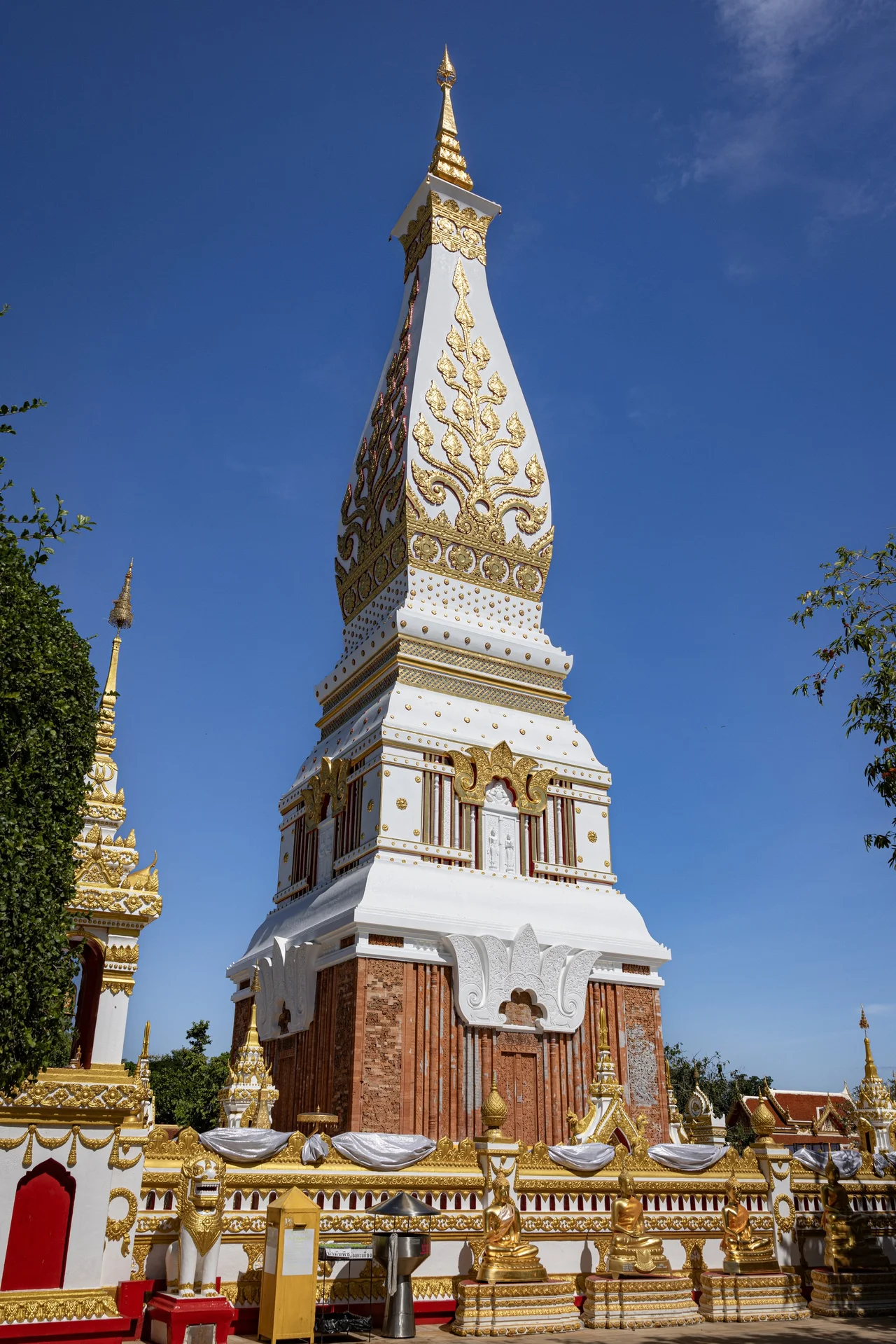

Wat Phra That Phanom
At 7:38 on the evening of 11 August 1975, the great stupa of That Phanom came down. It had been failing since March, when an earthquake opened cracks in the fabric, and then several days of heavy rain finished the argument. What went over was not a monument in the museum sense. Buddhists across northeastern Thailand and across the river in Laos believed, and still believe, that the tower held the Phra Uranghathat, the breast bone of the Buddha, carried here from India. A whole region woke up the next morning to find the centre of its religious world lying in a heap beside the Mekong.
Four Years and a Kilo Count of Gold
Rebuilding began almost immediately, paid for partly by the Royal Thai Government and partly by public subscription, which is the polite phrase for hundreds of thousands of ordinary people sending what they could. The work was finished on 23 March 1979. King Bhumibol Adulyadej and Queen Sirikit came with other members of the royal family for the reinstallation of the relics. Into the new structure went a great inventory of valuables, and onto the summit went a gold spire weighing 110 kilograms. Buddhists from Laos contributed too, sending treasures across the water from Vientiane, among them a seven-tiered golden umbrella in the Lan Xang style. The border ran down the middle of the river. The devotion did not.
The Chronicle and the Trowel
Two accounts of this place sit side by side and neither has displaced the other. The That Phanom Chronicle records that the stupa was raised eight years after the Buddha's passing by five kings of the Mon kingdom known as Sri Gotupura. In the fuller legend the Buddha instructs his disciple Mahakasyapa to bring his breast bones to the hill called Phu Kampra; in 525 BC Mahakasyapa arrives with five hundred arhats and five phrayas, and together they build in clay before the relics are brought from India and sealed inside. Archaeology tells a shorter and no less impressive story. The earliest structure found on the site dates to the seventh or eighth century CE, which still makes this one of the oldest continuously venerated places in mainland Southeast Asia.
Four Styles in One Tower
Look at the stupa and you are looking at a committee of centuries. The fabric combines Dvaravati, Khmer and Cham elements; the original tower went up in Khmer style before the twelfth century and was later reworked toward the Lao pagoda form that dominates its silhouette today. It has been heightened more than once. A restoration in 1690 took it to roughly 47 metres, work in 1940 raised it again, and the rebuilt stupa stands a little over 53 metres. When the French artist Louis Delaporte drew it in the early 1870s for Francis Garnier's Indochina expedition volumes, he recorded a tower already recognisable as the one standing now. The design proved contagious, and copies of it were raised at temples across the northeast.
Nine Days and Nine Nights
The annual festival runs from the eighth waxing day of the third lunar month to the first waning day, nine days and nine nights, and it fills the small riverside town of That Phanom past capacity. Pilgrims arrive from both banks. In Thai folk Buddhism the stupa has a particular claim on anyone born in the year of the Monkey, who is expected to come here at least once, and the monkey-year cohort turns up accordingly. The temple holds the rank of a first-class royal monastery, and its precincts carry painted panels illustrating traditional Thai proverbs. Between festivals the place is quieter than its status suggests, a white and gold spike above tamarind trees and tin roofs, with the Mekong sliding past a few hundred metres away.
The View From the Water
That Phanom is a border district. The Mekong forms its eastern edge, and the Lao province of Khammouane begins on the far bank, close enough that the two sides have shared this shrine for as long as anyone can document. Thailand has placed the stupa and its associated buildings and landscape on the UNESCO tentative list for World Heritage status, an application that reads oddly against the fact that most of what a visitor sees is younger than the moon landings. But the case is not really about the stone. It is about a site that has been rebuilt, re-crowned and re-consecrated for well over a thousand years by people who never once considered letting it go.
From the Air
Wat Phra That Phanom stands at 16.943 N, 104.724 E, on the Thai bank of the Mekong in southern Nakhon Phanom province. The river is the navigational anchor here: the stupa sits a few hundred metres inland from a broad, braided reach of the Mekong, with the Lao province of Khammouane immediately across the water and the karst ridges of central Laos on the eastern horizon. The gold-tipped white spire is conspicuous from 3,000 to 5,000 ft AGL, particularly in low morning light. Nakhon Phanom Airport (VTUW) lies about 50 km north, Sakon Nakhon (VTUI) about 90 km northwest, and Savannakhet in Laos (VLSK) roughly 100 km southeast. Note that the Mekong is an international boundary and Lao airspace begins mid-channel. Best visibility runs November to February; the May-to-October monsoon brings heavy afternoon convection and the river itself runs high and silt-brown.
Nearby Stories
- Nakhon Phanom Royal Thai Navy Base 18 km away
- Second Thai–Lao Friendship Bridge 19 km away
- Khammouane Province 38 km away
- National Route 9 (Vietnam) 59 km away
- Nguồn Language 69 km away
- Ban Chiang 83 km away
- Vientiane 189 km away
- Si Thep Historical Park 340 km away