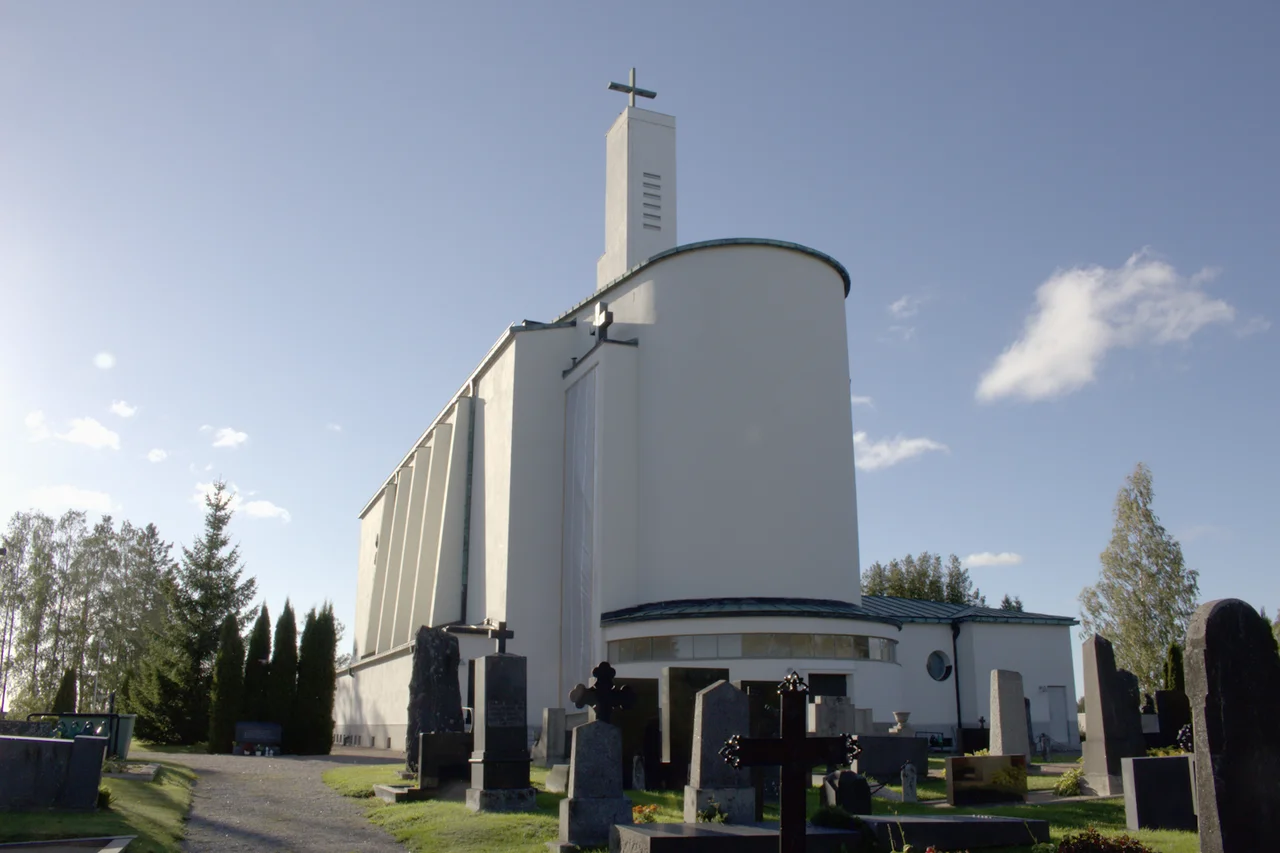

Nakkila Church
J. W. Suominen intended to give his parish a church for his sixtieth birthday. He had the money and the plan, and two years to arrange it. Then, in August 1935, a shooting accident left him badly injured, and the gift became a deathbed dictation: lying in his own house, the tanner talked through the terms with the vicar, Antti Perheentupa, and left the parish of Nakkila three million marks. He asked for one thing in return. Beneath the new church there was to be a crypt — an idea he had picked up from churches he had seen abroad — where his family would be buried, and the parish's vicars after them.
A Will Dictated in a Hurry
Suominen was born in 1877 and had built his fortune out of hides. On 16 April 1898, at twenty-one, he opened a tanner's workshop on the Tattaranjoki, making leather by hand for the local shoemakers. The site suited the trade: Pori was twenty kilometres away, the Tampere–Pori railway had opened three years earlier, and the river supplied the water that tanning devours. He married Emma, the daughter of the shoemaker who owned the buildings. The workshop grew into a steam-powered factory, then a company; today Suominen Oyj is one of the world's larger makers of nonwoven fabrics. The parish council's first instinct on receiving his three million marks was cautious — put it in the bank for ten years and see. Instead they decided to build at once, so that the church could open on the day Suominen would have turned sixty. Emma, who died in 1953, was later laid beside him in the crypt.
It Must Look Like a Church
Six architects were invited to compete: Elsi Borg, Erkki Huttunen, Carolus Lindberg, Yrjö Lindegren, Bertel Liljequist and Jalmari Peltonen. The brief was almost comic in its caution — the entries had to look like churches, but they were not to be cruciform. Huttunen's answer took the basilica, the oldest church plan in Christendom, and stripped it of every ornament. The jury thought it too modern and chose it anyway, judging it the most artistically successful of the six. It was Huttunen's first church; until then he had designed industrial buildings and a pair of town halls. Uuno Helminen of Pori took the construction contract at 1.9 million marks, the cornerstone was laid on Midsummer Day 1936, and on 26 June 1937 — Suominen's sixtieth birthday — Archbishop Erkki Kaila consecrated the finished building.
The Grain Silo Argument
Not everyone was pleased. The church was called strange, unchurchlike, a factory in disguise; the rounded end of the chancel, in particular, was said to look like a grain silo. Others saw exactly what Huttunen intended, a form language that belonged to the present rather than to a borrowed Gothic past. The argument was worth having, because this was the first functionalist church in Finland, and everything that followed at Kannonkoski, Rajamäki and Varkaus followed from here. The old church did not survive the transition. A chapel parish had been formed in Nakkila in 1764 and a single-nave wooden church built the same year; C. J. von Heideken enlarged it into a cross church in 1887, raising the tower to thirty-five metres and dressing the whole thing in neo-Gothic. It was never heated, and it was bitterly cold. The antiquities board saw no historical value in it, so it came down — over the loud objections of parishioners who had been baptised in it. Two of the three bells in the new tower came from the old one.
White Walls, Oak Cross
Huttunen's nave runs forty-five metres long, sixteen wide and thirteen high, seating about a thousand with another hundred and eighty in the gallery and a chapel for a hundred in the basement. The walls are brick, fifteen metres tall, rendered and whitewashed, carried on reinforced concrete pillars under a copper saddle roof. The free-standing tower is concrete, fifty-six metres high, topped by an eight-metre copper cross that catches the light from far down highway 2. Inside there is no altarpiece and there are no paintings. A single large oak cross stands at the altar; light falling across it throws shadows that read as three crosses rather than one. Pendant lamps by Paavo Tynell's Taito workshop hang over green-stained pews, the panelled ceiling undulates to soften the acoustics, and the Rieger Orgelbau organ of 1937 speaks with thirty-four stops.
What Came After
The church has aged into consensus. Docomomo, the international body for documenting modern architecture, lists it among the landmark works of Finnish modernism, and in 2004 it was formally protected, along with its surroundings, as part of a nationally significant built cultural environment. Juha Leiviskä — himself one of the great church architects of the century — added a parish centre alongside in 1970, and it defers to Huttunen without imitating him. In the churchyard, a 1941 memorial carries a bronze relief by the sculptor Emil Cedercreutz, put up for the men of a small farming parish who did not come home from a war that was then still being fought. Huttunen designed grave monuments here too. The building he was told was too modern has now stood for the better part of a century on its hill, doing what Suominen paid for.
From the Air
61.3678° N, 22.0039° E, at Kirkkokatu 4 on a hill above central Nakkila, roughly 20 km southeast of Pori on the Kokemäenjoki. Pori Airport (EFPO) is about 21 km northwest; Tampere-Pirkkala (EFTP) about 85 km east. The church is the most conspicuous man-made landmark between Pori and Harjavalta and is deliberately visible from highway 2 — from 2,000–4,000 ft the white nave and its detached 56-metre tower stand out sharply against the dark spruce and the river plain, especially in low sun. Use the Kokemäenjoki as the running fix and Villilä Manor's long red barn, a kilometre and a half west, as a secondary marker. Coastal Satakunta gives clear, long-range summer visibility; winter and early spring bring persistent low stratus with no terrain to help.
Nearby Stories
- Säppi 6.8 km away
- Kylmäpihlaja Lighthouse 8.2 km away
- Sammallahdenmäki: Graves Built for a Shoreline That Left 12 km away
- Oura Archipelago 16 km away
- Sastamala 24 km away
- Ikaalinen 31 km away
- Tibet Art Center 36 km away
- Finnish War 62 km away