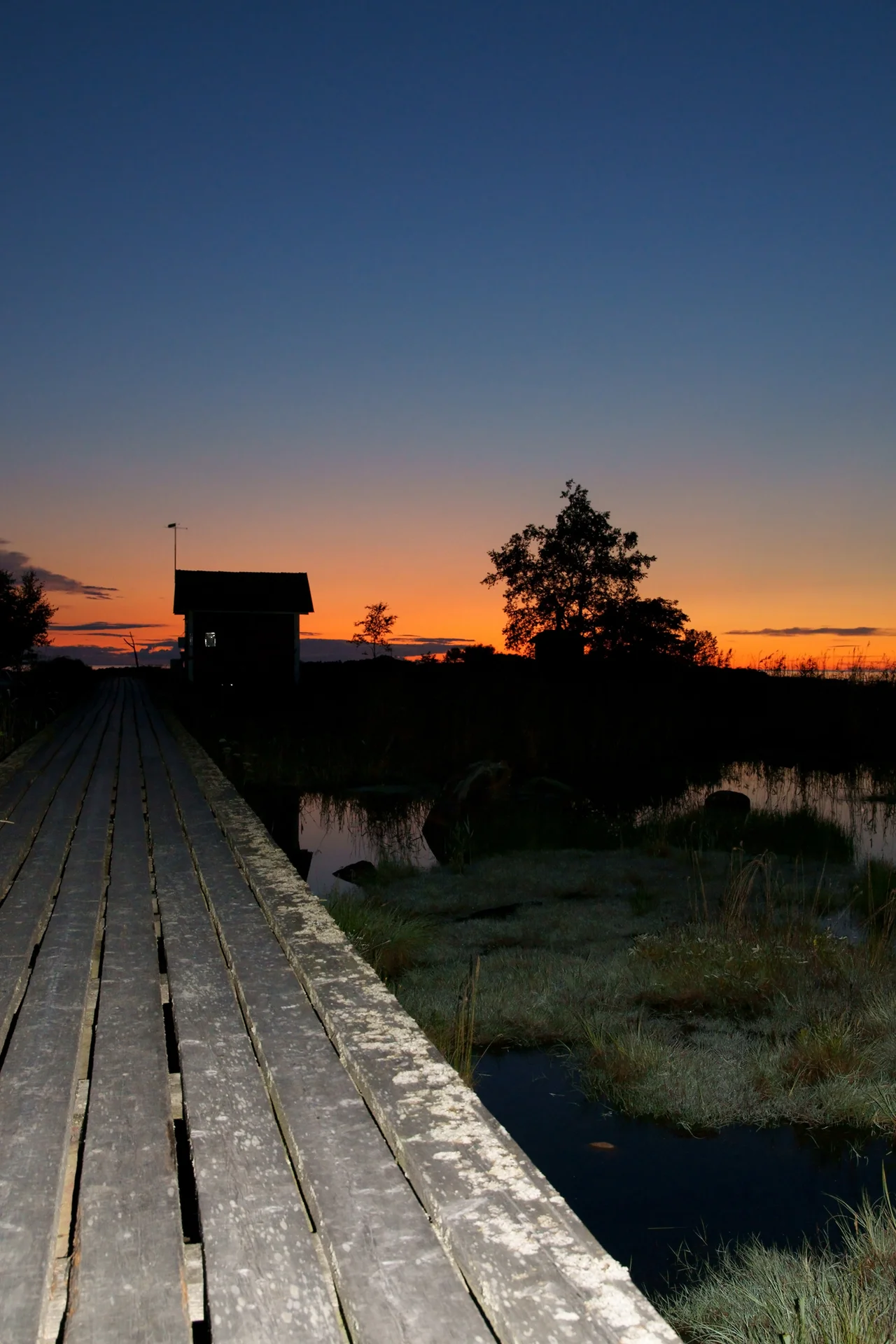

Säppi
Mouflon belong to Mediterranean hillsides — Corsica, Sardinia, dry slopes above a warm sea. So it takes a moment to absorb what has been grazing the island of Säppi since 1949, when a hunting club from Reposaari carried a few of the wild sheep out across the Bothnian Sea and let them loose. They stayed. Several dozen now move through the spruce on 150 hectares of forest and rock, in a sea that freezes most winters. Säppi is one of only seven Finnish islands carrying an introduced mouflon population, and the sheep are not even the most surprising thing here.
Merchants First, Then a Light
Pori's merchants put up the first marker in 1779, a wooden daymark meant to keep their ships off the rocks, and a hexagonal replacement followed in 1852. Neither carried a flame. That came in September 1873, when a brick tower designed by Axel Hampus Dalström was lit for the first time: a two-stage tapered cylinder rising 28.21 metres, its lamp burning 34.8 metres above the water behind a Fresnel lens. Keepers and their families lived at its foot for nearly a century. Automation arrived in 1962 and emptied the houses, though the light itself has never stopped. It still marks the approach to Pori, running now on solar panels and looked after by a local association rather than a crew.
Wool at the Wrong Latitude
The Reposaari hunters have leased the old pilot cottage since the late 1950s, and the mouflon are their doing. Introduced sheep on a small island cannot simply be abandoned to themselves, so the club has managed the herd ever since, taking a few animals each autumn. It is an odd arrangement to explain and a remarkably durable one — more than seventy-five years of Mediterranean wild sheep wintering at sixty-one degrees north. Visitors who come out for the lighthouse often meet them first, standing at the edge of the trees with those heavy curled horns, entirely unbothered by the arrival of a boat.
The Second-Oldest Watch
In 1959 the lighthouse keeper's dwelling took on a second life. A bird observatory opened inside it and is still running today, the second-oldest in Finland after Signilskär out in the Åland Sea, kept going by the Pori Ornithological Society. Autumn is the season that matters. Säppi lies far enough offshore that migrating birds funnel past it, and ringers work through the early hours while the weather does whatever it intends to do that week. Birdwatchers have made the island a fixture of the Finnish autumn, which is part of why roughly four thousand people a year make the crossing.
Fifteen Cows and a National Park
Every spring about fifteen Highland cattle are ferried out to graze. Shaggy and unhurried, they are working animals: conservation grazing keeps the shore meadows open for the plants and insects that depend on them, a job scythes did for centuries and nobody wants to do by hand now. The whole island sits inside the Luvian saaristo Natura 2000 area, holds nature reserves of its own, and part of it belongs to the Bothnian Sea National Park, established in early 2011 and composed almost entirely of water — around 98 per cent of its surface. The Finnish Heritage Agency has separately designated the lighthouse community and pilot station a built cultural environment of national significance, drawing the boundary around the entire island. Säppi belonged to Luvia's outer archipelago until that municipality merged into Eurajoki at the start of 2017.
The Dolphin on the North Shore
In August 1997 someone walking the north shore found a dead dolphin. Not a porpoise — a common dolphin, Delphinus delphis, a male between five and seven years old, and only the second of its species ever recorded in Finnish waters. It emerged afterwards that a sea captain had seen the animal alive south of Säppi earlier that month, working its way up a cold brackish inland sea toward a coast where nothing about the salinity or the temperature made any sense for it. Säppi has that quality. Things arrive here with no business arriving, and the island quietly takes them in.
From the Air
61.4767N, 21.3517E, in the Bothnian Sea roughly 5.5 kilometres off the Finnish mainland and about 20 kilometres west of Pori. The island is small and low — 150 hectares of forest, its high point Kirkkoharju reaching only about eight metres above sea level — so the brick lighthouse tower, 28.21 metres tall with its light 34.8 metres above the water, is the primary visual reference from the air. Pori Airport (EFPO) lies about 24 kilometres east; Turku (EFTU) is roughly 115 kilometres southeast and Tampere-Pirkkala (EFTP) about 120 kilometres east. Best viewed between 1,500 and 3,000 feet, which frames the lighthouse, the small harbour on the eastern side and the open national-park water together. Sea fog is common in spring and early summer, and winter pack ice redraws the island's outline week by week.
Nearby Stories
- Kylmäpihlaja Lighthouse 3.5 km away
- St. Olaf's Church, Ulvila 4.6 km away
- Oura Archipelago 15 km away
- Kirkkokari 29 km away
- Ikaalinen 67 km away
- Battle of Bomarsund 110 km away
- Kastelholm Castle 138 km away
- Härnösand Cathedral 179 km away