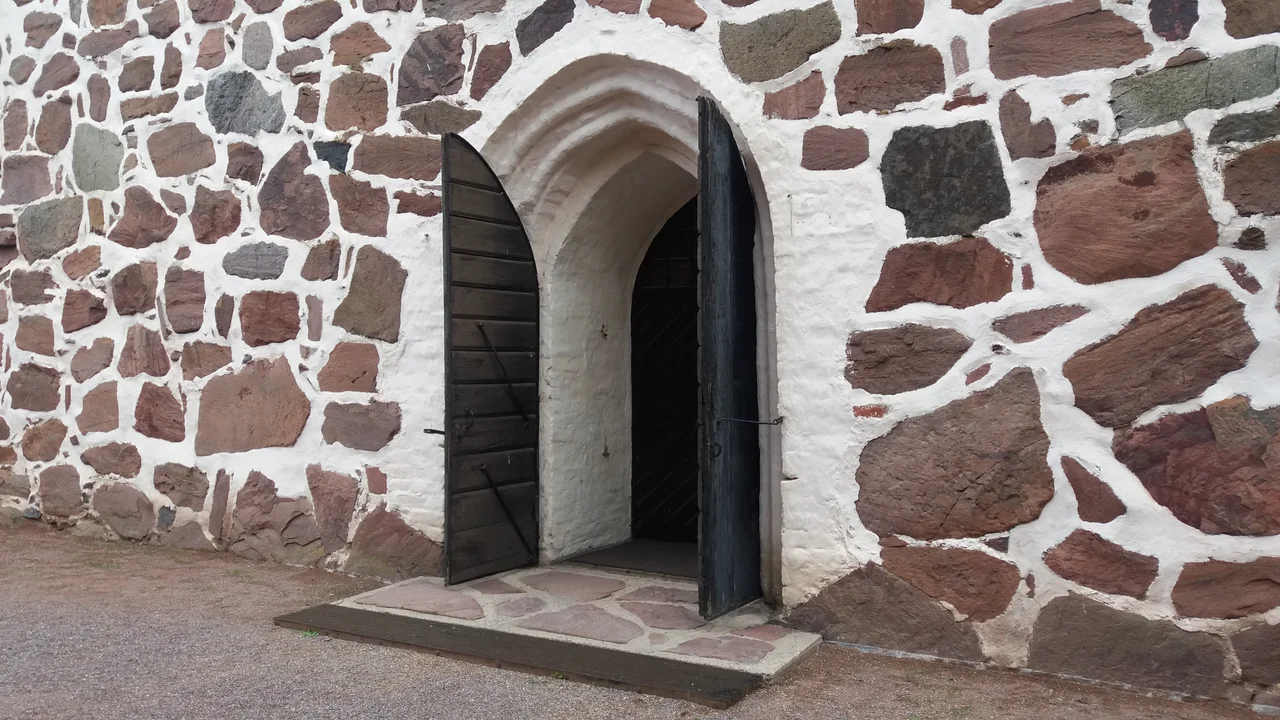

St. Olaf's Church, Ulvila
In 1932 the parish of Ulvila threw a party for its church's six hundredth birthday. Fifty years later it threw another one for the six hundred and fiftieth. On the best current evidence, the building was not yet five hundred years old on either occasion. Few churches in Finland have had their age revised so often, so publicly, or so painfully, and the argument says as much about Finnish archaeology as it does about the low grey building standing among the birches two kilometres outside modern Ulvila.
A Birthday Nobody Can Agree On
The trouble began with a plan to celebrate. In the 1920s the archaeologist Juhani Rinne dated the stone church to just after a fire that destroyed its wooden predecessor in 1429, and the parish set about organising five-hundredth-anniversary festivities for 1929. Iikka Kronqvist was sent to do supporting research and came back with the opposite answer: the church, he argued, had gone up between 1332 and 1337. So the parish celebrated a six-hundredth anniversary in 1932 instead, and a six-hundred-and-fiftieth in 1982. Then Markus Hiekkanen's 1994 dissertation moved the building forward again, to 1485–1490, and his 2007 survey of Finland's medieval stone churches narrowed it further: every part of it raised between 1495 and 1510, on the evidence of the masonry, the written record and tree-ring dating. Heikki Huhtala, a former vicar of Ulvila who had studied church history himself, refused to accept it. Professor Unto Salo, who had spent decades on Satakunta's past, thought Hiekkanen had it right.
The Town That Isn't There
King Albert of Sweden granted Ulvila a town charter on 7 February 1365, making it one of only six medieval towns in Finland and the third oldest. The Kokemäenjoki still reached the sea here then, and the trading post at its mouth was one of the two most important markets in the region. Land uplift did what no rival could: the river shallowed, the estuary crept west, and in 1558 Ulvila's privileges were handed to the newly founded Pori downstream. Everything the town had built eventually went. The church did not. It stands today as the only surviving structure of medieval Ulvila, on the Kirkkojuopa, a minor arm of the river, its churchyard consecrated by Bishop Hemming in 1347. That consecration remains the single firmly dated event in the parish's early history.
The Master from Dalarna
Around 1495 Olof Drake, who owned the nearby Isokartano farm, hired a master builder thought to have come from Dalarna in Sweden. The sacristy went up first, the nave either side of 1500, the porch last at about 1510 — a single coherent plan carried through in one campaign, which is why the church survives so nearly complete. The nave measures roughly 37 by 15 metres and seats 450. Grey fieldstone walls carry brick decoration in the gables, in the manner typical of Satakunta. Inside, the star vaults are unlike anything else in the country. Look up in the porch, though, and you can see the springers waiting for vaults that were never built: whoever paid the masons stopped paying. The master left no other building in Finland, but an apprentice of his went on to raise the region's later stone churches, and Ulvila's design shaped the churches at Lempäälä and Rauma.
Fourteen Hundred and Seventy-Four Silver Coins
In October 2004, workers laying new drainage along the north wall dug into a lidded pewter tankard. Inside was a leather pouch weighing close to 1.2 kilograms, and inside the pouch were 1,474 silver coins of eleven different types — the largest medieval hoard ever found in Finland. Most had been struck in Sweden, at Stockholm, Kalmar, Söderköping and Västerås, but the pouch also held coins from Visby on Gotland, from Tallinn and Tartu, from Norway, and a single witten from Hamburg. The newest dates to 1390. Tuukka Talvio of the National Museum's coin cabinet reckoned the sum at about 28 marks, at a time when the town of Ulvila paid the crown just 20 marks a year in tax. Nobody knows who buried it. One suggestion is that it was hidden from the Victual Brothers, the pirates then working the Baltic. The hoard also sharpened the dating fight: the pouch lay directly on the church's foundation footing, which Huhtala argued was impossible if the footing came a century later.
Under the Floor
Two men of consequence lie here. Axel Kurck, born 1555, was named commander-in-chief of Finland by King Sigismund in 1598, was beaten at Marttila the following year, and survived first the Turku bloodbath and then the one at Linköping before spending two years in Gripsholm Castle. Released in 1602, he died in 1630 at Anola in Nakkila, a short ride upriver. Gödik Fincke, stadtholder of the Savonlinna castle province, is buried with his wife Elisabeth Boije; their grave slabs stand in the porch among some of the finest seventeenth-century memorial stones in Finland. Fincke was at home in Lammi in 1596 when the Cudgel War broke out and farmers across Ostrobothnia and Savo took up flails and clubs against the soldiers billeted on them. He could not put the rising down with his own small force. The relief column from Viipuri and Käkisalmi did, and carried out the executions afterwards. Between two and three thousand people died that winter, most of them farmers with wooden weapons facing armoured professionals. The pulpit above them, given in 1659 by Barbro Kurck, arrived a generation later; the bell tower west of the church followed in the 1750s. The church was restored in 1930, in 1970, and again in 2004–2005, and each summer it opens as a road church.
From the Air
61.4435° N, 21.8825° E, on the Kirkkojuopa channel about 8 km southeast of Pori and 2 km from Ulvila's centre at Friitala. Pori Airport (EFPO) lies roughly 6 km northwest — the church sits almost directly under approaches to the field, so 1,500–2,500 ft AGL gives the best look without conflicting with circuit traffic. Navigate on the Kokemäenjoki itself: the river's braided lower course and the pale roofs of Ulvila are unmistakable, and the church reads as a small grey rectangle with a separate white bell tower just west of it, ringed by cemetery trees. Summer visibility over Satakunta is usually generous; autumn and spring bring low stratus off the Gulf of Bothnia, and the flat coastal plain offers few terrain references when the ceiling drops.
Nearby Stories
- Säppi 6.8 km away
- Kylmäpihlaja Lighthouse 8.2 km away
- Sammallahdenmäki: Graves Built for a Shoreline That Left 12 km away
- Oura Archipelago 16 km away
- Sastamala 24 km away
- Ikaalinen 31 km away
- Tibet Art Center 36 km away
- Finnish War 62 km away