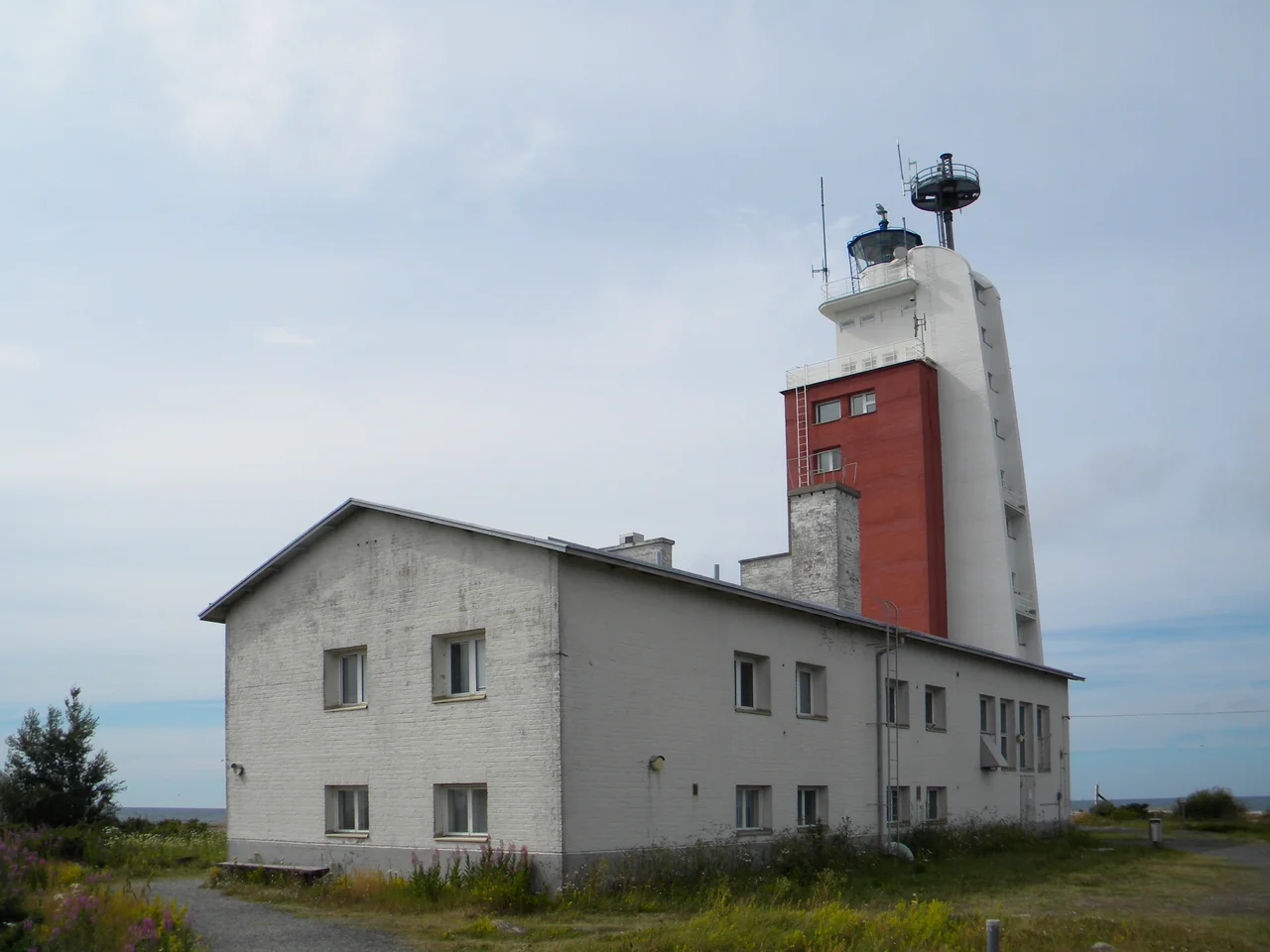

Kylmäpihlaja Lighthouse
It looks less like a lighthouse than an apartment block that lost an argument with the sea. Twelve storeys of concrete and brick rise straight off a bare skerry ten kilometres out from Rauma, with the lantern at the top and 104 steps between. When the tower opened in 1953 it was home to twenty-two men: twelve maritime pilots, eight pilot-boat crew and two lighthouse keepers. For months at a stretch in winter, with the Bothnian Sea frozen solid in every direction, that stairwell and the rooms hanging off it were more or less the whole world.
A Tower With a Day Job
Kylmäpihlaja is the outermost of the larger islands in the Rauma archipelago, which is precisely why the state put a building on it. Antero Pernaja and Kaarina Tamminen of the Finnish building administration designed the tower, and it went up in 1953 as a combined lighthouse and pilot station guarding the southern approach to the Port of Rauma.
That port earns the attention. Rauma ships out the produce of the Finnish forest — paper, board, pulp, sawn timber, together roughly four-fifths of its tonnage — and handled some 5.8 million tonnes of international cargo in 2018, nearly three-quarters of it outbound. The vessels carrying it have to thread a fairway through scattered granite before they reach open water. The tower stands 32 metres, its light 36 metres above the sea, flashing four times every forty-five seconds. In its first configuration that flash reached roughly 27 nautical miles; a major overhaul in 1988 cut it back to about 15.
What the Pilots Did
A maritime pilot's work is unglamorous and genuinely dangerous. A ship inbound for Rauma stops offshore, a small boat comes alongside in whatever the weather happens to be doing, and a pilot climbs a rope ladder up a moving steel hull to take the conn through waters no visiting captain can be expected to know. Then he does it again in reverse for the outbound. The eight boat drivers on Kylmäpihlaja existed to put those men on and off ships in the dark, in fog, in ice.
The island supplied nothing on its own. Power came from large diesel generators. A fog signal, long since silent, once carried its warning something like fifty kilometres across the water. Somewhere inside the tower the men fitted out a small chapel with an altar — a room to be quiet in, on a rock where there was nowhere else to go.
The Job Comes Ashore
Electronics eventually made a manned rock unnecessary. Radar, radio and satellite positioning could do from the mainland what once required people living on the water, and in the 1990s the pilot operations were relocated. The City of Rauma took over the property. The navigation and radar equipment stayed with the state — the light is still working infrastructure, not a museum piece, and the ships it serves are real ships.
What happened next is the part that would have astonished the 1953 crew. The building where twenty-two men worked shifts became a seasonal hotel with fifteen rooms, a restaurant and a guest marina. The exterior was restored in 2010, work that earned the city recognition from the Finnish Lighthouse Society.
Fifteen Rooms and a Working Light
Staying here is a peculiar kind of hospitality. The rooms are small because they were built for men on rotation, not for holidays. The stairs are the stairs. Outside, there is granite, a helipad, some low scrub and then the Bothnian Sea, and the season is short because in winter the boats stop and the ice takes over.
The reward is what the pilots had without asking for it. At this latitude midsummer light barely leaves the sky, and the sun sets into open water somewhere north of west, throwing the whole horizon orange for hours. Ships slide past on the fairway all night. The light above your head keeps flashing four times every forty-five seconds, exactly as it has since 1953, and there is no possibility of forgetting what the building is actually for.
Why It Is Still Here
Finland has a great many lighthouses and a habit of losing them. Automation emptied the towers, maintenance budgets shrank, and more than one of them has crumbled quietly on a rock nobody visits. Kylmäpihlaja avoided that by being useful twice over: the state kept what it needed at the top, and the city found paying guests for everything underneath.
It is not a preservation strategy that works everywhere. It requires a lighthouse big enough to sleep in, close enough to a town for a boat trip, and interesting enough that people will pay for a narrow bed and a long walk up. Kylmäpihlaja happens to be all three.
From the Air
Kylmäpihlaja sits at 61.1446°N, 21.3028°E, about 10 km (5.4 nm) west of Rauma in the Bothnian Sea, marking the southern shipping lane into the Port of Rauma. The white 32-metre tower on an otherwise bare island is unmistakable from 1,500–3,000 feet and shows up well against dark water; in clear air the buoyed fairway running east toward the port is traceable from the air. Rauma's cranes and the shipyard cluster lie roughly 6 nm east. Nearest controlled fields are Pori (EFPO) about 24 nm northeast and Turku (EFTU) about 47 nm southeast. Sea fog is common in spring and early summer and can hide the island entirely while the mainland stays clear. In hard winters the surrounding sea ices over and the island loses its outline against the pack.
Nearby Stories
- Uusikaupunki 7.9 km away
- Villilä Manor 11 km away
- Säppi 15 km away
- Louhisaari Manor 28 km away
- Köyliönjärvi 29 km away
- Battle of Bomarsund 73 km away
- Kastelholm Castle 101 km away
- Härnösand Cathedral 204 km away