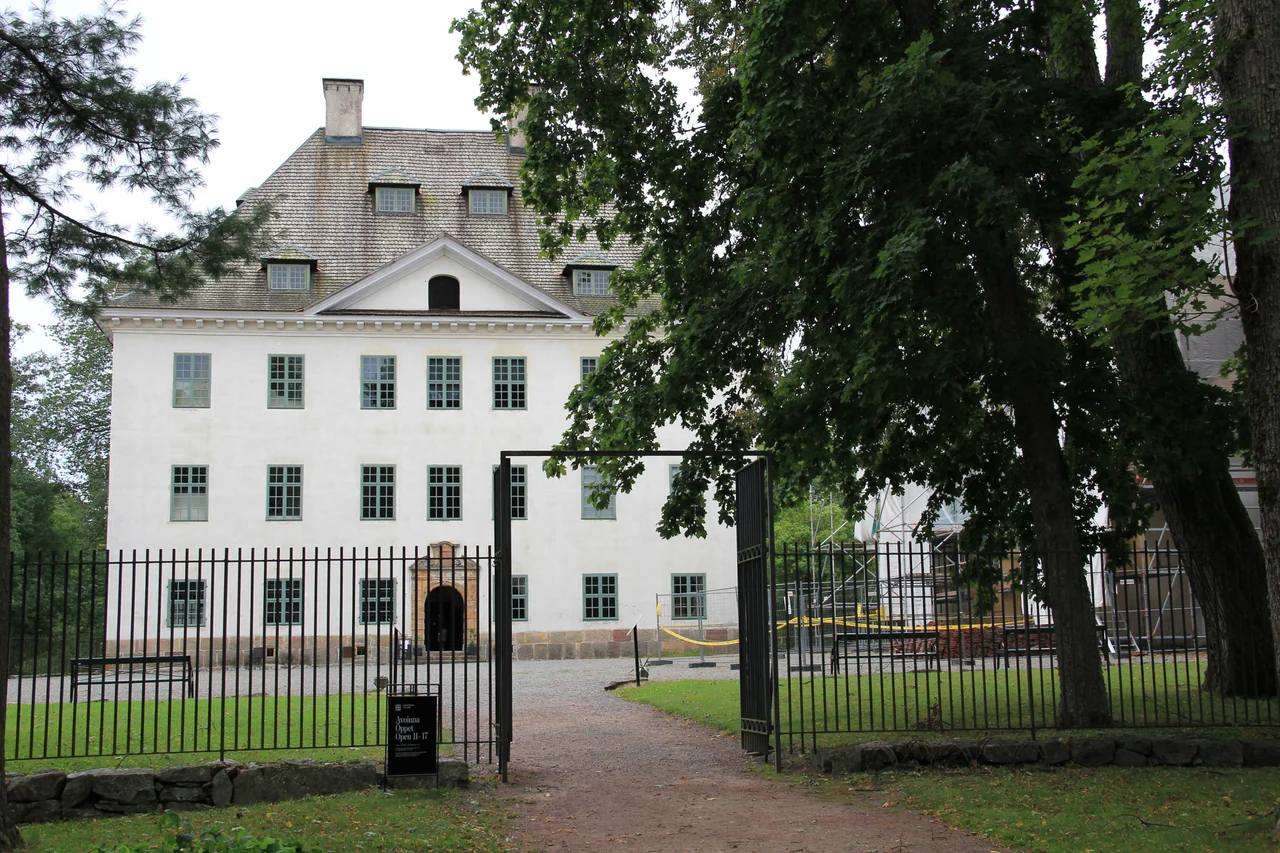

Louhisaari Manor
On the second floor there is a small blue bedroom, furnished the way it would have looked in the 1860s. Tradition holds that this is where Carl Gustaf Emil Mannerheim was born on 4 June 1867. Nothing about the room announces it. What gives Louhisaari its particular ache is not the birth but what came after: by the time the boy was thirteen his father had walked out and ruined the family finances, his mother was dead, and the house had been sold out from under them to an aunt. Finland's marshal and sixth president grew up as a guest in his own birthplace, and it took a public subscription three generations later to bring the building back.
The Admiral Who Built at Home
Herman Klasson Fleming (1619-1673) was an admiral and Governor-General of Finland, a man with estates in Sweden who could have built anywhere in the kingdom. He built here, at the place he was born. Askainen church went up under him in 1653; the manor was finished in 1655. What he produced is startling for coastal Finland in the 1650s - a three-storey brick block with symmetrical facades, a curved Dutch roof, and a stone portal carved by the Stockholm sculptor Johan Wendestam, drawing on Italian Palladian ideas that had barely reached this latitude. The floors were sorted by function in the continental manner: service and storage at ground level, living quarters above, ceremony at the top. No architect is recorded. Some historians think Fleming designed it himself, which would be entirely in character.
Three Centuries, Then a Sale
The Flemings had held Louhisaari since about the middle of the fifteenth century, when a woman named Elin married the squire Magnus Fleming, and they held it until 1791. In 1795 Carl Erik Mannerheim bought the estate, and for a hundred years it belonged to a family that produced an unusual number of interesting people. Carl Gustaf Mannerheim (1797-1854) governed the Viipuri province and became an entomologist of international standing, describing beetles from a manor on the Baltic. Vendla Sofia Mannerheim laid out the park in the English landscape style in the early 1800s, and it still frames the house. Then the line ran into trouble. Count Carl Robert Mannerheim (1835-1914), the marshal's father, was financially ruined and sold Louhisaari to his sister Wilhelmina in 1881; the marshal's mother, Hedvig Charlotta Helena von Julin, died that same year, not long after her husband left. Wilhelmina sold the house to the businessman Oskar Hannus in 1903.
The Boy from the Blue Room
The life that began in that bedroom went a very long way from it. Mannerheim served in the Russian Imperial Army from 1889 to 1917, fought in the Russo-Japanese War, and between 1906 and 1908 rode roughly 14,000 kilometres across Central Asia to Beijing on an expedition that was simultaneously an intelligence mission and an ethnographic one, returning with some 1,200 objects and 1,500 photographs. In January 1918 he took command of the White forces in the Finnish Civil War. That war lasted less than four months and killed around 38,000 people in a country of three million; roughly 12,500 of them were Red prisoners who died of hunger and disease in camps after the shooting had stopped, and the grief it left ran through Finnish families for two generations. He returned as commander-in-chief when the Soviet Union invaded in November 1939, served as president from 4 August 1944 to 4 March 1946, and died in Lausanne on 27 January 1951.
Bought Back by Subscription
After Hannus the manor passed to his daughter, Inkeri Hovinen. It came back into public hands by an odd route: a committee raising money for a statue of the marshal found itself with a surplus, bought the main building and grounds, and on 1 July 1961 handed them to the Finnish Heritage Agency. Restoration ran from 1962 to 1967, and it was deliberately layered rather than uniform - the exterior taken back toward its seventeenth-century appearance, the first and third floors with it, the second floor left to read as the eighteenth and nineteenth centuries, which is when the Mannerheims actually lived there. The main building opened to visitors on 1 June 1967. Askainen itself is no longer a municipality; it merged into Masku on 1 January 2009, so the address has changed even if nothing else has.
Keeping the Doors Open
The museum has not had an easy recent decade. Budget cuts at the Finnish Heritage Agency put Mannerheim's birthplace on a list of sites slated for closure in 2024, and it was spared only that November after public objection. In 2025 Louhisaari launched a crowdfunding campaign with a peculiarly Finnish sense of humour about it: each donor is symbolically allotted one square metre of the estate for a year and receives the titles Friend of Louhisaari and Honorary Herman - the second a nod to the admiral who built the place. Countess Margaretha Mannerheim is the campaign's patron. It is a modest scheme for a house that is one of only a handful of its kind in the country, and there is something fitting in a building the family lost being kept upright, once again, by people chipping in.
From the Air
Louhisaari stands at 60.5709 N, 21.8309 E, in the former parish of Askainen, now part of Masku in Southwest Finland, about 30 km northwest of Turku near the inner edge of the archipelago. Best seen from 1,200 to 2,500 ft: look for a pale three-storey block with a steep curved roof sitting in open parkland at the head of an inlet, with the red-roofed Askainen church about a kilometre away as the confirming landmark. Turku Airport (EFTU) lies roughly 30 km southeast; Pori (EFPO) is about 100 km north. The surrounding water is broken into narrow sounds and low wooded islands, so ground features can be hard to resolve in the flat overcast common here from October to March.
Nearby Stories
- Karuna Church 3.6 km away
- Kustavi 4.9 km away
- Paimio 15 km away
- Pyhämaa 15 km away
- Vaskijärvi Strict Nature Reserve 15 km away
- Tibet Art Center 21 km away
- Battle of Sandöström 31 km away
- Battle of Bomarsund 67 km away
Sources
- Louhisaari manor - Wikipedia
- History - Louhisaari manor - Kansallismuseo (Finnish Heritage Agency / National Museum of Finland)
- Louhisaari manor - Wikipedia
- Hélène Mannerheim - genealogical/biographical sources (Wikipedia, Find a Grave)
- Finnish Civil War prison camps - Wikipedia
- Museums to get reprieve after government finds funds to stave off closures - Yle News
- Louhisaaren kartanomuseo hakee vahvistusta joukkorahoituksella - Yle