
Battle of Sandöström
The attack came at three in the morning on 2 August 1808, in the half-dark that passes for night in a Finnish August. It came at a channel barely worth naming, in the maze of skerries north of the island of Kimito, because by that summer the whole Finnish War had been squeezed into places like this. Sweden's deep-water fleet ruled the open Baltic, and that supremacy had an unglamorous consequence: Russian reinforcements moving west toward Åbo could not use the sea at all. They had to thread the inshore fairways, single file, through water where one well-placed battery could stop an army.
One Channel to Cork
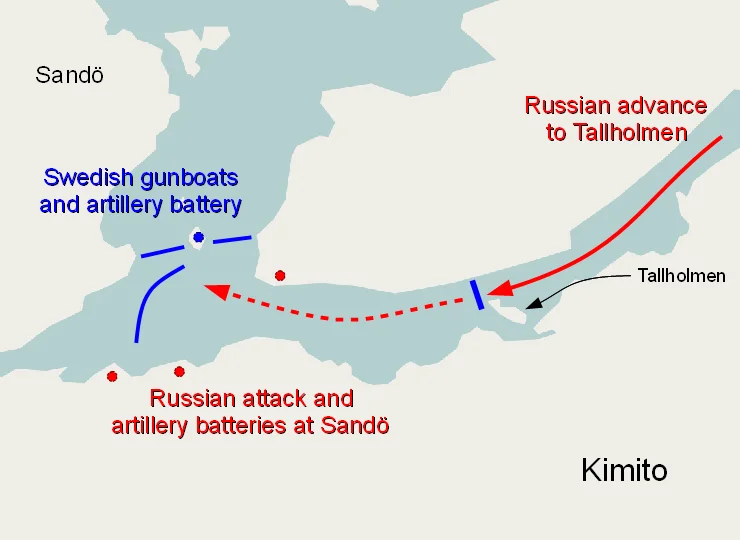
The Swedes had already tried and failed to destroy the Russian coastal squadrons near Åbo — Turku in Finnish — at Rimito Kramp and Bockholmssund. Blocking the reinforcements was the fallback plan, and the archipelago made it look feasible. Rear Admiral Klas Hjelmstjerna sent a detachment of gun sloops under Captain Sölfverarm to seal the passage north of Kimito at the little island of Tallholmen. It was not a generous allocation. Hjelmstjerna had to guard his own rear against Russian forces coming out of Åbo, so Sölfverarm got eight sloops to begin with and four more later, while other detachments were parcelled out to other channels. Sölfverarm understood perfectly well how thin this was. He took up the blockade anyway and set an artillery battery on the island in the middle of the passage, under Lieutenant Colonel Önnert Jönsson.
A Day of Attacks
What came at him was substantial: a dozen Russian gun sloops, thirty-eight gun yawls, six companies of infantry, and shore artillery brought up to work the flanks — a six-gun battery, a four-gun battery, a pair of field pieces. Jönsson's guns in the middle of the channel proved brutally effective even while absorbing concentrated fire, and the first Russian rush broke against them. Several Swedish sloops were shot out of the line and had to pull back, and the line closed up and held. Through the morning and into the day the Russians came again, and again, and each time the Swedes held. It was the kind of fighting the skerry fleets specialised in and nobody enjoyed: open, oared craft crowded with men, at ranges where the crews could hear each other, with almost nothing to hide behind.
When the Line Broke
Late in the fighting a heavier Russian push finally split the Swedish formation and forced the sloops into withdrawal. The withdrawal did what withdrawals do. Jönsson's battery, the thing the whole line had existed to protect, was left on its island with Russians closing around it. There is a bleak arithmetic to that moment: the position had done its job all day, and the moment the boats could no longer stay, the gunners' day ended too.
The Man in the Manor House
The most audacious part of the operation had nothing to do with boats. Colonel Axel af Palén came ashore with 150 men and worked his way unseen to a manor house nearby, where the Russian commander-in-chief in Finland, Friedrich Wilhelm von Buxhoevden, was quartered. Capturing him would have been the coup of the campaign. The Swedes were moving into position to surround the building when Russian pickets spotted them and raised the alarm, and Buxhoevden got out. Russian reinforcements arrived quickly enough to push the landing party back to its boats. A few hundred metres and a few minutes decided it.
The Price of an Ambiguous Day
The butcher's bill was heavier for the side that won. Russian losses came to 121 killed and roughly 200 wounded with thirty-five vessels damaged; the Swedes lost 36 killed and 93 wounded with a dozen ships knocked about. One hundred and fifty-seven men died in a strait most of them had never heard of a week earlier, for an outcome that historians still describe as tactically inconclusive. Strategically it was not inconclusive at all. The Russians got their channel, linked up their coastal naval units, and kept moving west. Within a year the war was over and Finland had passed from Sweden to Russia, to be governed for the next century as a Grand Duchy. Sail through Sandöström today and there is nothing to see — dark water, pines leaning off the granite, a marked fairway for pleasure boats. The archipelago keeps its secrets by simply looking like an archipelago.
From the Air
The action was fought in the channels north of Kimito island at approximately 60.21°N, 22.51°E, in the Archipelago Sea between Turku and the Kimitoön mainland. Turku Airport (EFTU) lies roughly 40 km northwest; Helsinki-Vantaa (EFHK) is about 160 km east and Hanko Airfield (EFHN) some 80 km southeast. Fly it low and slow — 1,500–3,000 ft — because the point of the place is the geometry: a labyrinth of forested islands separated by channels only a few hundred metres wide, where the navigable water is a thin thread and everything else is rock. From above, it is immediately obvious why twelve gun sloops could plausibly stop an army here. Summer haze is common over the archipelago; the clearest light comes in late spring and autumn, and winter ice can turn the whole pattern into a single white plain.
Nearby Stories
- Nådendal Abbey 7.3 km away
- Hitis 10 km away
- Archipelago National Park 15 km away
- Old Castle of Lieto 17 km away
- Ekenäs Archipelago National Park 19 km away
- Fiskars, Finland 21 km away
- Moomin World 31 km away
- Hiidenlinna 35 km away