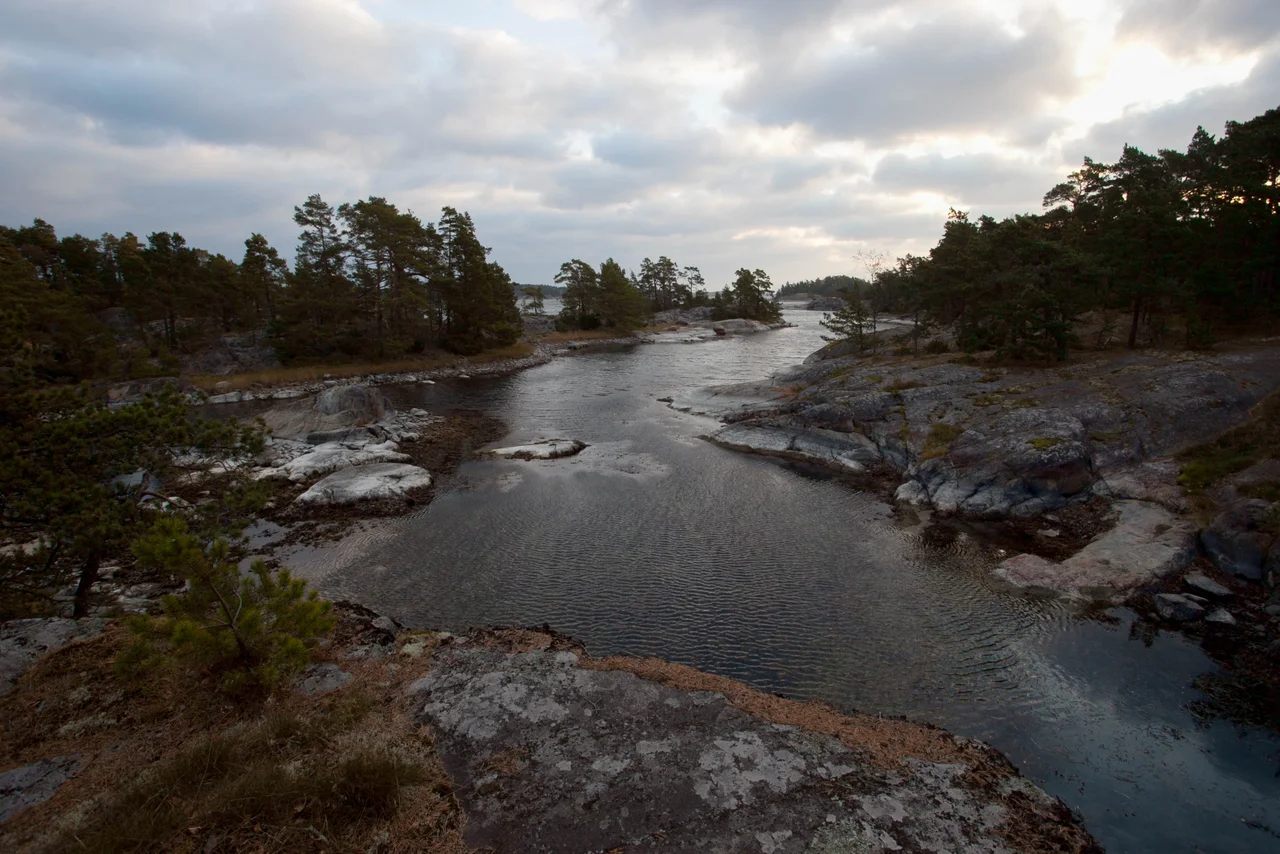

Ekenäs Archipelago National Park
Around the year 1250 a Danish sailing itinerary — a working pilot's manual for crews feeling their way along the Gulf of Finland — recorded a landmark on this coast in Latin as Iuxarae. The name comes down to us as Jussarö. Two of its neighbours, Rödjan and Elgö, appear in the same Danish material from the 1240s. Later clerks wrote Jusar in 1547 and Jussar in 1581, and the rock has been sitting there the whole time, exactly the easily recognised landmark the medieval pilot books describe, with the sound behind it offering the sheltered anchorage it has always offered. Everything else about this place has changed at least twice.
Eighty-Five Per Cent Water
Ekenäs Archipelago National Park was established in 1989 in the outer archipelago off Raseborg, in western Uusimaa, and it covers about fifty square kilometres. Roughly eighty-five per cent of that is sea. What breaks the surface is mostly bare rock — low granite islets scoured smooth by ice and polished since by weather, ringed by the open Baltic. Only two islands amount to much: Älgö, which carries the inner-archipelago vegetation and pulls in most of the visitors, and Jussarö out toward the horizon. The park did not appear from nothing. It grew outward from the Jussarö nature reserve, protected since 1956, and it holds Ramsar status as an internationally significant wetland. In 1996 the Council of Europe awarded it the European Diploma of Protected Areas, a recognition that has been renewed and now runs to 2031.
The Men Who Dug the Island
When Finland passed from Sweden to Russia, the new administration wanted iron of its own rather than Swedish iron on Swedish terms. Ore was located on Jussarö in 1834 and claimed for the crown, and then came the problem: nobody wanted to work there. The island was awkward to reach and wages had to be high, so the mine was supplied instead with forty-five men from the fortress of Viapori who had been convicted of vagrancy — of being poor without a fixed place. Guarding them took thirty marines and their officers. The shifts ran twelve hours. Each man got a plot for potatoes and the right to fish, a small wage, and, if he worked hard, tobacco and spirits until the spirits were stopped. From 1846 the labour force was made up of convicted criminals under Russian guard, and the Crimean War closed the mine altogether from 1854 to 1856.
Why Some Asked for Siberia
The cruelty of Jussarö was administrative rather than theatrical. Men held for vagrancy served indefinite sentences, and in an ordinary prison the way out was to be taken on by a private employer. On an island in the outer archipelago there were no private employers, so the sentence simply continued — for years, with no mechanism to end it. Some of the prisoners petitioned to be transferred to Siberia instead, on a rumour circulating among them that in Siberia a man might be given land to farm. That is what the record leaves us: people who calculated that exile across a continent was the better offer. A prayer house stood on the island from the 1830s until 1860 for the workforce and the archipelago families, and the chaplain from Ekenäs came out once a month to hold a service in Finnish and again in Swedish.
Iron as a Bargaining Chip
The mine wound down at the end of the 1850s and stopped in 1861, once better ore became easy to buy and Finnish blast furnaces stopped wanting the Jussarö rock. It stayed shut for the better part of a century. Then in 1954 Vuoksenniska Oy reopened it, and around two hundred miners went back underground on an island with no road to anywhere. It never really paid this time either, and the suspicion has always been that paying was not entirely the point — that a working Finnish iron mine was useful leverage in negotiations over the price of Swedish steel. Whatever the reasoning, it ended in 1967. The housing blocks and shop buildings from that decade are still standing, weathering quietly among the pines, and the Finnish Border Guard kept a coast guard station on Jussarö until November 2011, which is a large part of why the island stayed out of reach for so long.
The Closed Season
For four months of the year, much of this park is simply off limits. From the first of April until the end of July, landing and movement are forbidden on many of the islands so that nesting seabirds and the thin skerry vegetation are left alone; a few islands are closed all year round. That restriction is the park's real work, and it means the visiting season is short and concentrated. You need a boat, or a water taxi, and in recent summers a scheduled ferry has run from Ekenäs harbour out to Jussarö, where there are now small accommodation units and a café-restaurant. Rödjan, a former fishing croft on the southern shore of Älgö, serves as a nature hut and a favourite staging harbour for boats working their way along the coast. Three marked trails exist: two kilometres on Älgö, one and a half on Modermagan, and 4.7 kilometres on Jussarö. The park logged 59,400 visits in 2021 and 51,100 in 2025.
From the Air
Ekenäs Archipelago National Park is centred near 59.8228°N, 23.4542°E, in the outer archipelago south of Raseborg on Finland's south coast. From 2,000–3,500 ft the park reads as a scatter of dark granite islets and bare skerries breaking a wide field of open water, thinning southward until the Baltic takes over entirely — Älgö is the substantial wooded island on the inner side, Jussarö the outermost, identifiable by its lighthouse to the south on the Sundharu skerry and by the abandoned mining village at its centre. Hanko Airfield (EFHN), Finland's southernmost airfield, lies about 20 km west; Helsinki-Vantaa (EFHK) is roughly 100 km northeast and Turku Airport (EFTU) about 100 km northwest. Conditions here are maritime and can change fast: sea fog is common in spring and early summer when warm air moves over cold water, autumn brings strong southwesterlies and short steep seas, and the archipelago ices over in hard winters. Note that landing on many islands is prohibited from 1 April to 31 July for nesting birds.
Nearby Stories
- Kimitoön 8.6 km away
- Fiskars, Finland 9.6 km away
- Hitis 19 km away
- German submarine U-745 24 km away
- Peter the Great's Naval Fortress 31 km away
- National Museum of Finland 57 km away
- Estonian Open Air Museum 62 km away
- Sinking of the MS Estonia 70 km away