
Fiskars, Finland
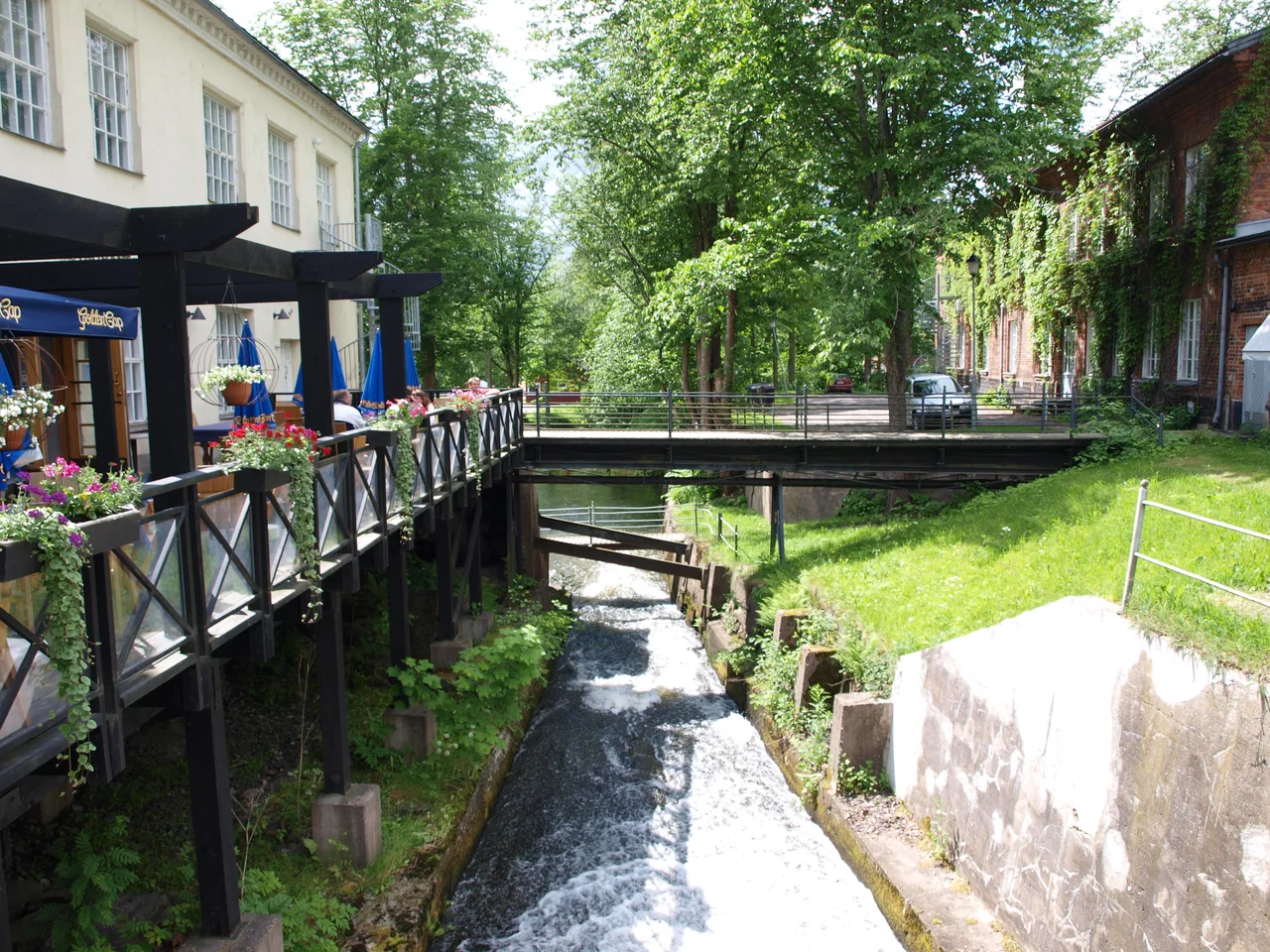
Check your kitchen drawer. If the scissors in there have bright orange plastic handles, the name on the blade leads back to a bend in a small river in southern Finland, where in 1649 a merchant named Petter Thorwöste was granted the right to build a blast furnace and a forge. The village that grew up around that permission is still there, tucked into forest about eighty kilometres west of Helsinki, and fewer than a thousand people live in it. Iron left long ago. What replaced it is stranger and, in its way, more interesting.
The Privilege of 1649
Queen Kristina's grant gave Thorwöste the right to manufacture cast and forged iron products — everything, the privilege specified, except cannons. He built a wrought-iron hammer, a blast furnace and a smithy on the land of an old farm beside the Fiskars river, and the geography did the rest: rushing water to drive the hammers, forest in every direction to be burned into charcoal, and a route down to the harbour at Pohjankuru for shipping out. Ore came in the other direction, first by sea from Utö in Sweden, then from the 1670s onward from the Malmberg mine at Kisko, a short haul inland. The output was unglamorous and useful — bar iron, nails, cast-iron pots, knives, hoes, reinforced wheels. For a while the works handled copper as well. The seventeenth-century workforce swung between roughly fourteen and ninety-five people depending on the year: smiths, a blast-furnace master, and farmers from the surrounding parishes performing the compulsory statute labour the estate could demand of them. Many of the skilled men had come from Sweden, carrying Walloon and German forging traditions with them.
Von Julin's Century
The works changed hands repeatedly and by 1802 the blast furnace had gone cold. Then in 1822 John Jacob von Julin bought both the ironworks and the village around it, and Fiskars became something closer to a laboratory. A foundry came first. Through the 1830s he added Finland's first fine forge and its first mechanical engineering workshop — the latter turning out a Finnish-built ship's steam engine almost immediately. The product range widened until it read like a hardware catalogue for a whole country: scissors, puukko knives, ploughs, forks, power transmission gear. A narrow-gauge railway ran the goods down to Pohjankuru from 1891 until 1952. The village's handsomest building predates all of it by four years — a mansion designed in 1818 by the Italian-born architect Charles Bassi, whose neoclassical restraint sits oddly and beautifully among the red-ochre workshops.
What the Wage Bought
Company villages were bargains, and it is worth being clear about both halves. Fiskars owned the houses its workers slept in — the tenements along Bruksgatan, the row on Åkerraden, whose name means Field Row because each household got a strip of ground to grow food on. The company also built a school in 1826, kept a doctor on staff from 1860, and opened a hospital in 1892, provisions well ahead of most Finnish industry. And still the burial records tell the other story: men died young and the village held a great many widows. Grinding metal produced a fine dust that settled in lungs, and when extraction machinery was invented, Fiskars fitted it — a genuine improvement that also happened to protect an expensive, hard-to-replace skill. The generosity and the arithmetic were never separable. The men who swung the hammers understood that better than anyone.
The Orange Handle
In 1967 the company put out a pair of scissors designed by Olof Bäckström, the first with moulded plastic handles rather than plain steel bows. Prototypes were made in black, red, green and orange, and after an internal vote at Fiskars, orange won — a colour now so tied to the brand that the company registered it as a trademark in Finland in 2003 and in the United States in 2007. More than a billion pairs have sold since. It is the most widely held piece of Finnish design in the world, and the village it is named for has no factory making it. The company's history starts at Fiskars Bruk; its production does not stay there.
The Village That Changed Its Spots
By the 1990s the industry had moved on and the ironworks buildings were emptying. Rather than let them rot, a company vice-president went looking for artists, inviting creative professionals to take over the vacant workshops as studios. In 1996 they organised themselves into Onoma, the cooperative of artists, designers and artisans in Fiskars, now one of the oldest working artists' cooperatives in Finland with around 145 members representing eleven nationalities, each of whom either lives or works in the village. About six hundred people live in the old ironworks area. The furniture makers at Nikari, the wallpaper studio Feathr, the ceramicist Karin Widnäs and the sculptor Kim Simonsson all work here, and since 2019 the Fiskars Village Art & Design Biennale has drawn international crowds to a place with one shop and one river. One more oddity for the record: the very first World Orienteering Championships were held here, on 1 and 2 October 1966, which means the sport's global history begins in these same woods.
From the Air
Fiskars sits at 60.13°N, 23.55°E in western Uusimaa, roughly 80 km west of Helsinki and 80 km southeast of Turku. Best viewed from 2,000–3,500 ft AGL, where the village reads as a linear cluster of red and ochre buildings strung along the Fiskarsinjoki river between forest and small lakes — the classic ruukki layout, works at the water, housing rows above. The wider landmark is Pohja Bay (Pojoviken) a few kilometres east, a long narrow inlet reaching north from the Gulf of Finland; Fiskars lies in the valley just west of its head. Nearby airports: Helsinki-Vantaa (EFHK) 85 km east, Turku (EFTU) 80 km northwest, Hanko (EFHN) 55 km southwest, Nummela (EFNU) 45 km northeast, Kiikala (EFIK) 35 km northwest. Summer brings long daylight and generally good VFR conditions; autumn and winter bring low cloud, and this coast produces sea fog that can fill the river valleys with little warning. Snow cover from December through March flattens the contrast and makes the buildings stand out sharply.
Nearby Stories
- Kimitoön 8.2 km away
- Ekenäs Archipelago National Park 14 km away
- Hitis 19 km away
- Old Castle of Lieto 26 km away
- Hiidenlinna 27 km away
- National Museum of Finland 57 km away
- Hakoinen Castle 59 km away
- Peter the Great's Naval Fortress 60 km away