.jpg)
Moomin World
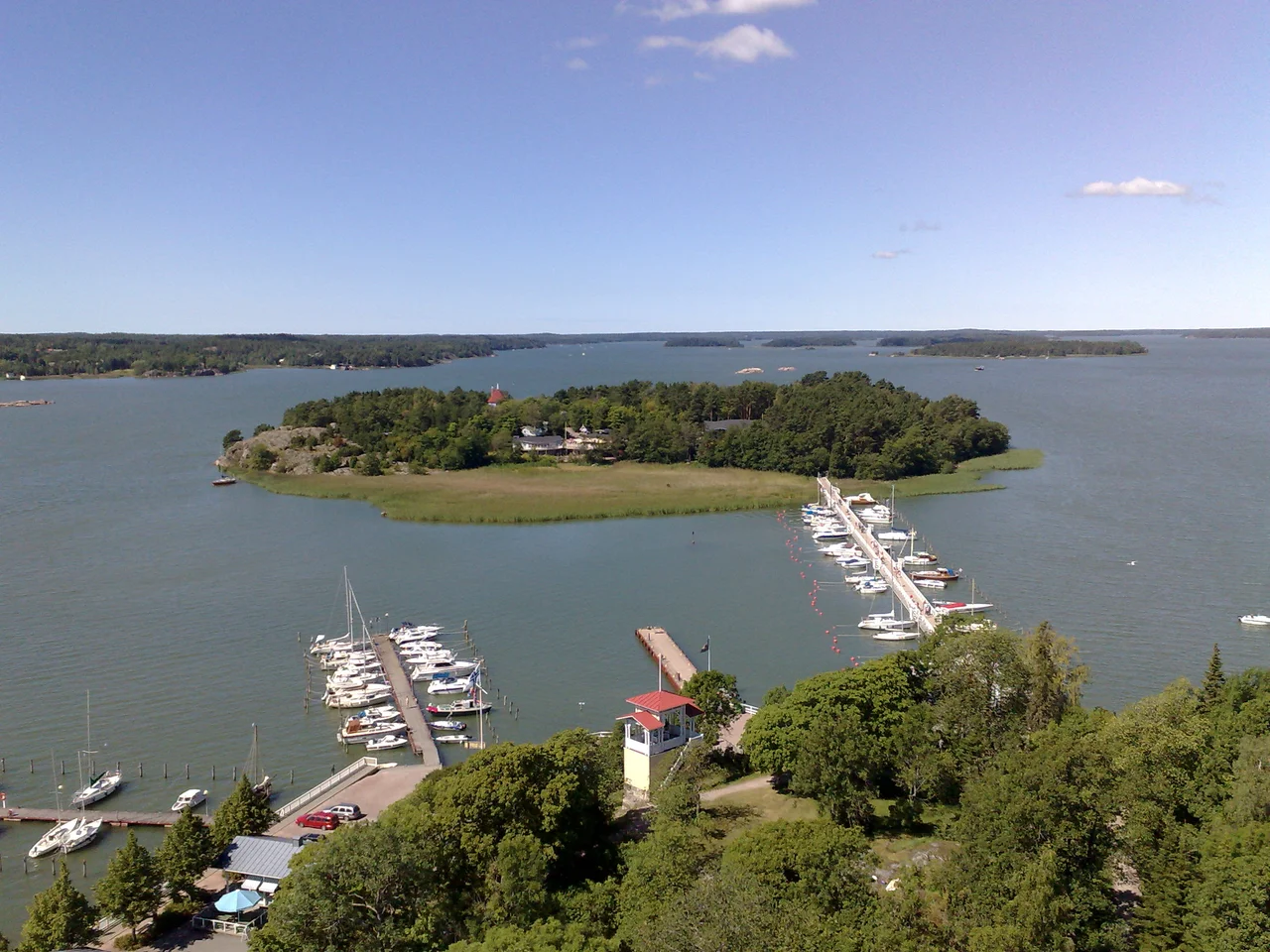
There are no roller coasters on Kailo island. No log flume, no drop tower, no queue barriers snaking back on themselves toward a ride. When Moomin World opened here on 26 June 1993, it did so on a decision that would sink almost any other theme park: it would have nothing to ride. What it has instead is a blueberry-blue house you are allowed to climb, a witch in a cottage, a theatre under a roof, and a pontoon bridge from the Naantali shore that you cross on foot - which turns out to be exactly the right way to arrive.
A House You Are Allowed to Enter
The Moomin House is the centre of everything, five storeys of it, painted the deep blue-black of a bilberry. It was built in 1993 to match drawings Tove Jansson had made years before, and unlike nearly every other landmark building in a theme park, visitors may go all the way up. Moominmamma's kitchen is there. So is the dining room, and a swimming room, and a sign on the stairs that tells children to stop running, because the smell of Moominmamma's jam is rising from the cellar and they should go carefully. Hemulen's house stands next door in yellow. Past it are the fire station, the police station, Snufkin's camp, and Moominpappa's boat - the Oshun Oxtra, the Ocean Orchestra - moored where the common reed thins out into the brackish water of the Baltic.
The Woman Who Drew It First
Tove Jansson was born in Helsinki on 9 August 1914 and died there on 27 June 2001, and she wrote the Moomins in Swedish, Finland's other national language. The first of the books, Småtrollen och den stora översvämningen - The Moomins and the Great Flood - appeared in 1945. Nine years later the comic strip launched in the London Evening News and spread to some 120 newspapers across roughly forty countries, which is how a family of round white creatures from a Finnish archipelago became legible to children who had never heard of Naantali. Jansson spent her own summers on Klovharu, a bare rock in the Pellinki archipelago, with her partner Tuulikki Pietilä. That matters here. The low granite, the reeds, the flat grey light off the water at Kailo are not invented scenery. They are the coast she lived on.
Paths Instead of Rides
Dennis Livson designed the park, and what he laid out was essentially a set of walks. Toffle's Path leads through the Witch's Labyrinth. There is a cave belonging to the Hattifatteners, and a house belonging to the Groke, who in the books freezes the ground wherever she sits and is lonelier than she is frightening. Characters move among the visitors rather than posing at fixed points. Performances run at Emma, the covered outdoor theatre. The approach won an unusual amount of professional respect for a park with no machinery in it: The Independent on Sunday called it the world's fourth-best children's theme park in October 2005, the Finnish Travel Fair named it the domestic destination of 2005, and in 2007 the Games & Parks Industry magazine gave it a Golden Pony Award, its jury calling the place "welcoming, well themed and full of educational content."
A Very Short Summer
The park is open daily from mid-June to mid-August - roughly two months, which is about as long as a southern Finnish summer honestly lasts. As of 2013 it drew around 240,000 visitors a year, and had passed three million since opening. Then the gates come off. In winter, Kailo is simply an island again: no ticket, no staff, nothing running, and anyone may walk the paths past the shuttered houses with the sea ice creaking somewhere out beyond the reeds. The island had a life before any of this. A fisherman named Aron Lehtonen lived on Kailo until 1928, and a plaque there still records it. Across the water rises the stone church that was once the abbey of Naantali, five centuries older than the Moomin House and no less strange to a child. In March 2019 a second Moomin park opened at Metsä in Hannō, northwest of Tokyo - Moominvalley Park, the first outside Finland, after delays that pushed it from 2015 to 2017 and finally to 2019.
From the Air
Kailo island sits at 60.4731 N, 22.0047 E, immediately west of Naantali old town and about 14 km west of Turku. Best viewed between 1,500 and 3,000 ft, where the island reads clearly as a wooded lobe joined to the mainland by its pontoon bridge, with the Naantali church tower and the guest harbour just to the east and the Kultaranta presidential estate on Luonnonmaa across the sound. Turku Airport (EFTU) lies roughly 20 km east-northeast; Helsinki-Vantaa (EFHK) is about 160 km east. The archipelago generates low stratus and sea fog in spring and early summer when warm air moves over cold Baltic water, so visibility here can drop far faster than inland conditions suggest.
Nearby Stories
- Karuna Church 3.6 km away
- Kustavi 4.9 km away
- Paimio 15 km away
- Pyhämaa 15 km away
- Vaskijärvi Strict Nature Reserve 15 km away
- Tibet Art Center 21 km away
- Battle of Sandöström 31 km away
- Battle of Bomarsund 67 km away