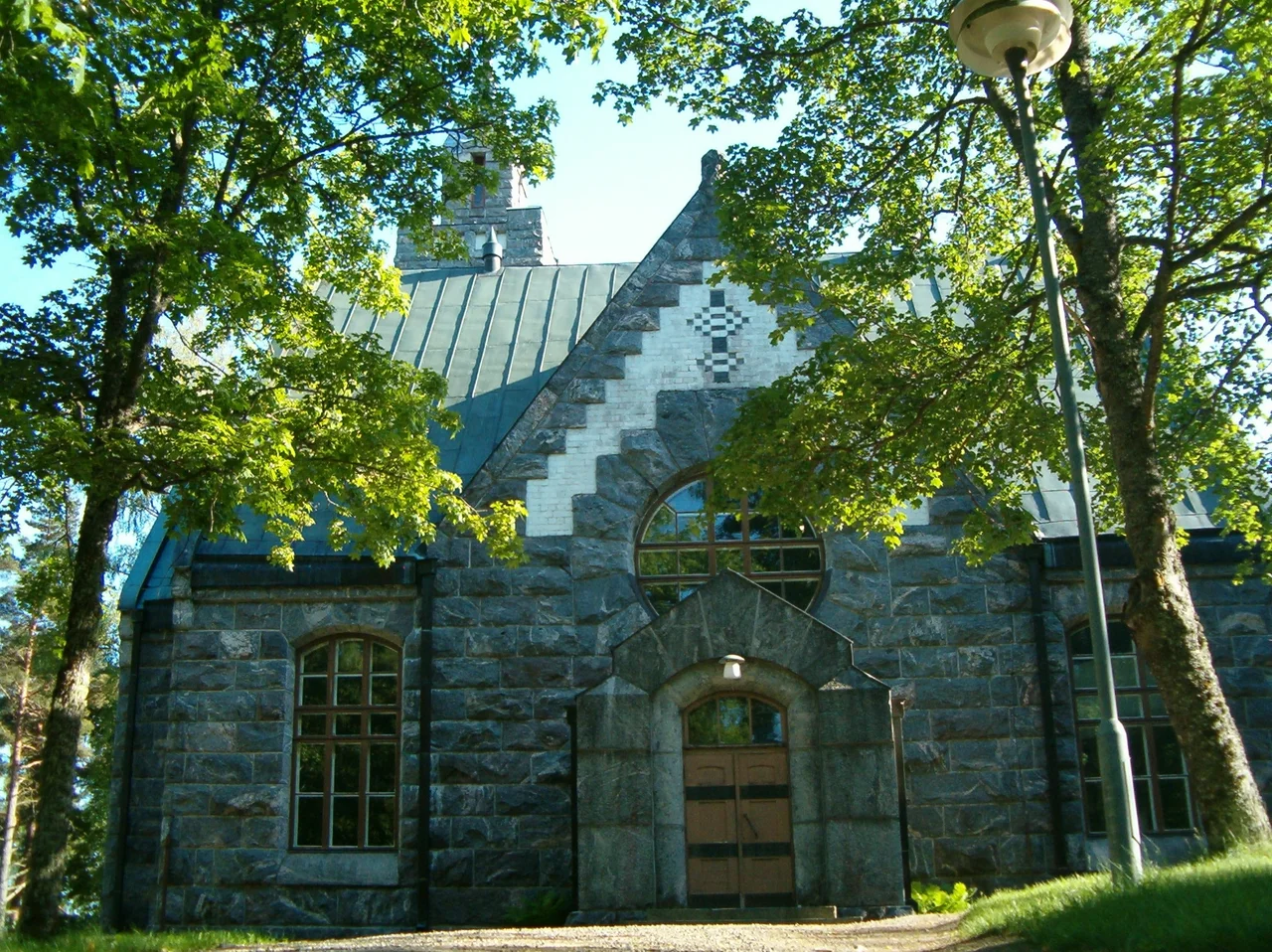

Karuna Church
Karuna's first church is no longer in Karuna. It stands on a wooded island in Helsinki, roughly 130 kilometres east, where it is the oldest building in the Seurasaari Open-Air Museum and where couples still book it for summer weddings. Moving it took a dismantling crew and the year 1912. What stands in Karuna instead is a low, heavy block of local grey granite that has been called one of the most successful and most beautiful National Romantic churches in Finland - and that, because of where it is, almost no traveller ever sees.
The Baron Who Built Himself Broke
Construction of the wooden church began in the summer of 1685, on land belonging to Karuna manor, and it was the manor's lord who paid for it: Baron Arvid Horn af Åminne. Under the church law that came into force the following year, the master of Karuna manor was granted the right of patronage - meaning he chose the parish priest himself. In July 1688 the cathedral chapter recognised Karuna as its own chapel congregation rather than a private manor chapel. Horn had bought influence, but at a price he had misjudged. The building project drove him so deeply into debt that he eventually had to sell the manor. The church outlasted him and kept changing. In 1773 and 1774 the original hipped roof was replaced by a steep gabled one, a wooden barrel vault was raised over the nave, and the windows were enlarged into arches. A vestibule went up at the west end in the 1780s. The freestanding bell tower, designed by the master builder Anders Wahlberg, was finished in 1767.
Granite for a Nation Not Yet Born
By the turn of the twentieth century, the parish wanted stone, and it wanted something that looked Finnish. Josef Stenbäck drew the plans, and between 1908 and 1910 the new church rose out of Karuna's own grey granite. It was consecrated on 9 October 1910, seven years before Finland's independence, in the years when National Romanticism was doing architectural work that was also political work. The building refuses symmetry. Its tower sits off to one side, at the southeast, with a semicircular porch apse pushed out to the south and the chancel to the east. Inside, the walls are plastered plain white; the drama is overhead, in a concrete star vault at the centre of the nave whose ribs and arches carry a running garland of carved ornament. Stenbäck designed the fixed interior himself, in the Jugend idiom of the day. There are 480 seats.
A River in the Glass
The altar is lit from behind by stained glass rather than paint - a detail often garbled in English accounts of the church. Ilmari Launis designed the windows. At the centre is the Crucified, with the river of the water of life running from the foot of the cross; on either side, angels carry the bread and the chalice. On a grey southwest Finnish afternoon the effect is muted and slow, the colour bleeding rather than blazing across the white plaster. On a clear morning in early summer, when the sun comes up over the Archipelago Sea and through the east chancel, the river in the window is briefly the brightest thing in the building.
What Came With the Old Church
Not everything left for Helsinki. The bells hanging in Stenbäck's tower were cast in 1689 for the wooden church, which means they were rung for the first congregation Arvid Horn assembled and are still rung for the parish today. The old five-stop organ made the move up the hill too, though an electric instrument is what actually gets played. Karuna itself has since stopped being a place in its own right - it was an independent municipality from 1869 until 1969, officially bilingual in Swedish and Finnish until 1933, and is now part of Sauvo. The church is not usually open outside services, and the road to it does not lead anywhere else. That is exactly why it survives as it does: unrestored by tourism, and quietly popular as a place to get married. The building it replaced, meanwhile, holds summer services and concerts of its own on an island in the capital, with the grave of the museum's founder, Axel Olai Heikel, in the churchyard beside it.
From the Air
60.2689°N, 22.5447°E, on the Karuna peninsula in southwestern Sauvo, near the innermost reaches of the Archipelago Sea. Best seen from 1,500-2,500 ft AGL; the church is a small, dark, high-roofed mass with an off-centre tower, sitting among fields a short distance inland from Karunanlahti bay. Useful visual anchors are the bridged strait of Rungonsalmi to the south toward Kemiönsaari and the long inlet of Paimionlahti to the northeast. Nearest airport is Turku (EFTU), about 40 km north-northwest; Kiikala (EFIK), a gliding field in Salo, lies roughly 45 km east, and Helsinki-Vantaa (EFHK) about 130 km east. Coastal haze and low stratus are common in spring; winter light is short but the low sun picks out the granite well.
Nearby Stories
- Nådendal Abbey 7.3 km away
- Hitis 10 km away
- Archipelago National Park 15 km away
- Old Castle of Lieto 17 km away
- Ekenäs Archipelago National Park 19 km away
- Fiskars, Finland 21 km away
- Moomin World 31 km away
- Hiidenlinna 35 km away