
Nan MacKinnon
Listen to the Tobar an Dualchais archive and you will hear, in scratchy reel-to-reel, a woman's voice singing in Gaelic. The recordings span decades. There are more than a thousand of them. Most belong to Nan MacKinnon of Vatersay, known in her own language as Nan Eachainn Fhionnlaigh, born in 1902 and gone in 1982. She was a fisherman's daughter who became one of the great tradition-bearers of twentieth-century Scotland.
Kentangaval to Vatersay
Nan was born in Kentangaval on the Isle of Barra on 12 December 1902. Her father, Hector MacKinnon, was a fisherman. Her mother, Mary MacPhee, kept the household running. The Vatersay where she would eventually settle had no causeway then. It was reachable only by small boat, weather permitting. Kentangaval was a small Gaelic-speaking community on Barra's eastern coast, the kind of place where songs and stories were the wallpaper of daily life. Children learned them by listening. They did not learn them as heritage. They learned them as living language.
A Politically Tumultuous Time
Nan's childhood unfolded against a backdrop of land politics that had shaped her family directly. The Highland Clearances of the previous century had emptied much of the Gaelic west. In 1906 and 1907, just before her fourth and fifth birthdays, the Vatersay Raiders, cottars from Barra and the surrounding isles, had seized grazing land on Vatersay in defiance of an absentee landlady who had let them go landless. Among the raiders was Neil MacPhee, who wrote songs about Mingulay. Her family had won security of tenure twenty years before she was born, yet the sense of injustice over how unevenly the land had been distributed never quite left. The songs Nan would carry remembered all of it.
The Tradition-Bearer
James Ross of the School of Scottish Studies described her significance plainly. Nan MacKinnon was not a performer in the modern sense. She was a vessel for an entire culture's memory. She knew lullabies, work songs, laments, love songs, satires, and the kind of biting personal compositions that small communities use to keep each other honest. One catalogued recording is Gura mis tha gu tinn, made in November 1964, a sad and bitter song by a woman who has lost the man she loved to another woman. There are praise songs and milking songs. There are songs that no one else in the world remembered by the time she sang them into a microphone.
What She Saved
By the late twentieth century, the daily Gaelic of the Barra Isles was contracting under the pressure of English-language schooling, broadcasting, and emigration. The old songs were not being sung in kitchens any longer. They were becoming museum pieces. Nan MacKinnon's recordings, more than a thousand tracks now hosted by Tobar an Dualchais, the Kist o Riches, were one of the great acts of cultural preservation in modern Scottish history. She died on 24 June 1982. Vatersay is still inhabited. The causeway to Barra opened nine years after her death, in 1991. The songs she carried are now sung by people she never met, in classrooms and concert halls and recording studios, in a language she would have recognised as the one spoken at her family's hearth on Barra a hundred and twenty years ago.
From the Air
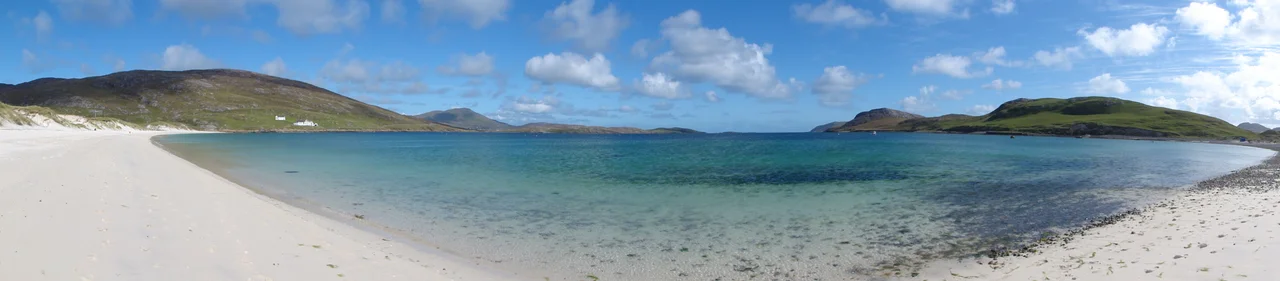
Located at 56.93 N, 7.53 W, on the small island of Vatersay south of Barra. Vatersay itself is shaped like a peanut with two rocky halves connected by a sand isthmus. The main village on the south coast is where Nan MacKinnon lived. Recommended altitude 1,500-3,000 ft for island detail. Approach from the north over the Vatersay Causeway for a sweep across both Vatersay and the western tip of Barra. Nearest airports: Barra (EGPR) approximately 6 nm north on Traigh Mhor beach, Benbecula (EGPL) approximately 53 nm north.
Nearby Stories
- German submarine U-722 7.3 km away
- Cladh Hallan 10 km away
- HMS Sturdy (1919) 13 km away
- SS Polonia 28 km away
- Canna 36 km away
- SS Athelstane (1941) 78 km away
- St Kilda, Scotland 82 km away
- German submarine U-516 102 km away