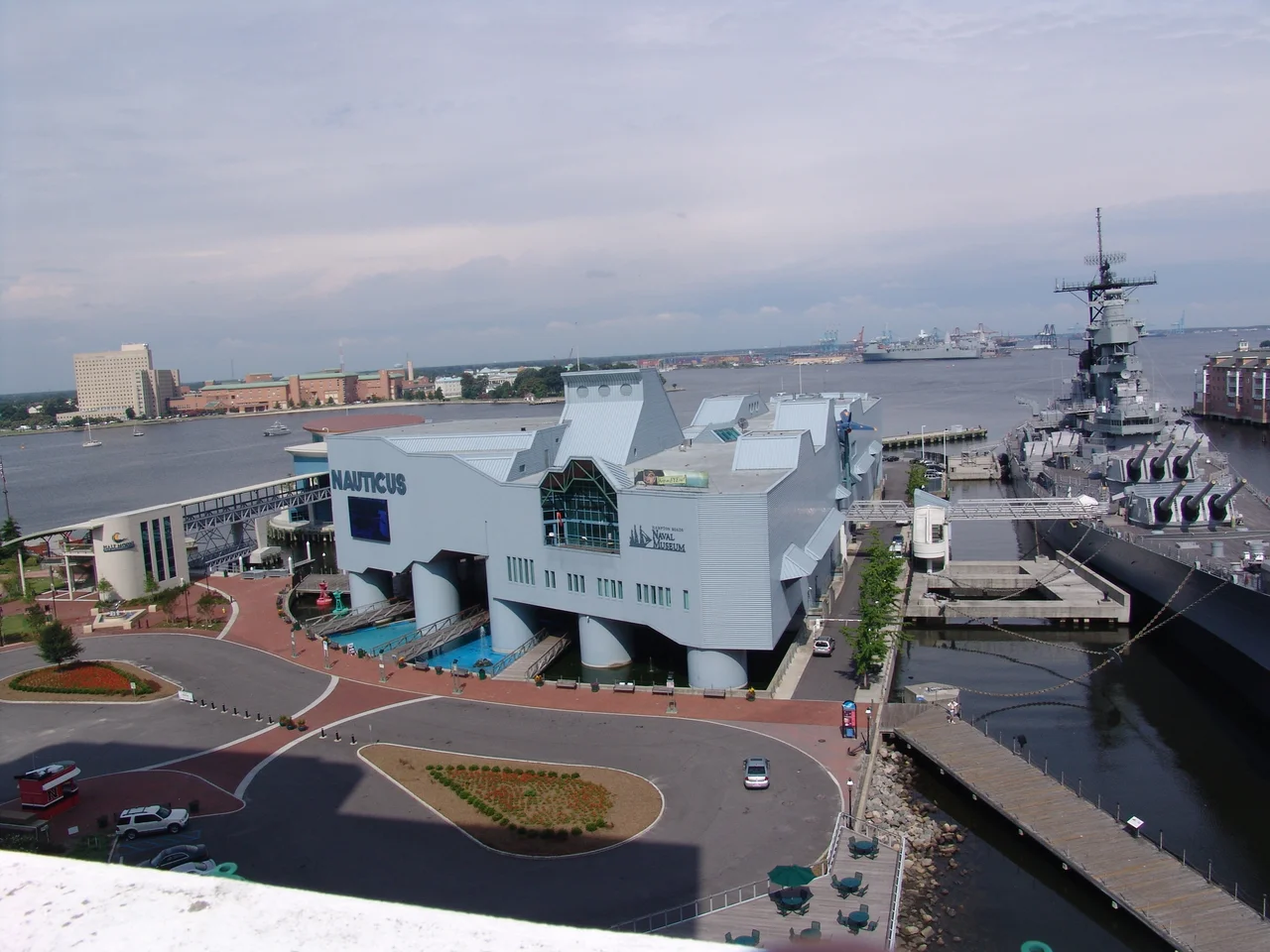

Nauticus
She came home on December 7, 2000 - fifty-seven years to the day after she first slid into the water, and fifty-nine years to the day after the attack that started the war she was built to fight. USS Wisconsin, 887 feet of Iowa-class battleship, eased against a pier on the Elizabeth River and was made fast in front of a glass-and-steel science museum called Nauticus. The dates were not accidents. Nauticus is a place where the Navy's calendar is the calendar, where the past arrives by water, and where Norfolk's relationship with the sea is laid out for visitors on three floors of exhibits and one teak deck the length of two football fields.
A Pier Called Banana
The land Nauticus stands on used to handle fruit. Banana Pier, the locals called it, one more working face of a working port that for decades fed Norfolk's downtown waterfront with cargo and grime. By the 1980s the bananas were gone and the pier was empty, and city leaders looking for something to fill the hole settled on an idea that was somewhere between a museum, a science center, and a tourism pitch. They incorporated the National Maritime Center Authority in February 1988, hired a retired Rear Admiral named Jackson Knowles Parker to run it, broke ground in February 1992, and opened the doors in June 1994. The name Nauticus is a coinage; the building's footprint, however, sits on top of more than three centuries of harbor history.
Half Moone
On the south side of the complex stands the Half Moone Cruise and Celebration Center, opened April 7, 2007. The name reaches back to 1673, when colonists built a half-moon-shaped fort on this same site to defend Norfolk's young maritime trade. The modern building is 80,000 square feet of cruise-ship terminal, with an enclosed gangway, a retractable bridge, and event spaces that fold the harbor view into wedding receptions. The first ship to call was Royal Caribbean's Empress of the Seas on April 28, 2007. In April 2024, when the Francis Scott Key Bridge collapsed in Baltimore and the cruise industry needed an alternate port, Carnival Legend was rerouted here. Half Moone caught the overflow and kept the schedules running.
The Battleship
Wisconsin is one of only four Iowa-class battleships ever built. The Philadelphia Navy Yard laid her keel in 1941 and launched her in 1943; she earned five battle stars against Japanese forces, served off Korea, and in 1991 led the Navy's surface attack on Iraq during Desert Storm, firing one of the campaign's opening Tomahawk missiles. After her decommissioning at Philadelphia in 1991 and a brief retirement at the inactive fleet in Portsmouth, Virginia, the city of Norfolk asked for her. On April 16, 2010 - the sixty-sixth anniversary of her commissioning - Vice Admiral David Architzel formally transferred her to Mayor Paul Fraim. By the end of November 2009, more than 2.4 million visitors had already walked her teak decks. They came, the museum's count says, from all fifty states and dozens of countries.
What Nauticus Does
Inside the main building, three floors carry the museum's working ideas. The second floor houses the Hampton Roads Naval Museum, run by the Navy, and the entrance to Wisconsin. The third floor opened a new permanent exhibit called Norfolk in Time in May 2023, threading together the city's history with the natural and engineered systems that shaped it. A children's exhibit called Aquaticus opened a month later, complete with a slide built into the play structure, and the Nautical Neighborhood Aquarium runs the wall. A high-definition theater called the Broke Theater shows ocean and nautical films. Out back, Sail Nauticus - a 2013 nonprofit running a fleet of Harbor 20 sailboats - teaches Norfolk middle schoolers seamanship and marine STEM. Victory Rover boats leave from the dock for tours of Naval Station Norfolk, the largest naval base in the world, just a few miles upriver.
A Museum You Can Walk Onto
The peculiar thing about Nauticus is that the most popular exhibit weighs 45,000 tons and is moored to the building. You buy a ticket, walk up a gangway, and step onto a ship that fired sixteen-inch shells at three different wars. The teak underfoot is original. The turrets still pivot to wherever the deck crew left them. Below decks, the crew spaces are kept as they were when she went into reserve. Children climb on the same anchor chains that sailors handled in 1944. The museum did not have to recreate a battleship; the Navy gave them a real one, and they put it where Norfolk could see it from across the river.
From the Air
Nauticus and USS Wisconsin sit on the downtown Norfolk waterfront at 36.847N, 76.294W on the Elizabeth River. From the air the battleship's long gray hull is instantly identifiable, parallel to the curving shoreline just south of the high-rise cluster of downtown. Nearest major airport is Norfolk International (KORF) about 6 nm northeast. Naval Station Norfolk (KNGU) is 4 nm to the north. Recommended viewing altitude 1,500-3,000 feet AGL for clear identification.
Nearby Stories
- Thomas Jefferson National Accelerator Facility 1.6 km away
- Cape Charles Lighthouse 4.6 km away
- Dismal Swamp Canal 7.6 km away
- Nat Turner's Rebellion 16 km away
- Chowan University 17 km away
- Flowerdew Hundred Plantation 25 km away
- False Cape State Park 27 km away
- Kitty Hawk: Where Humans First Flew 65 km away