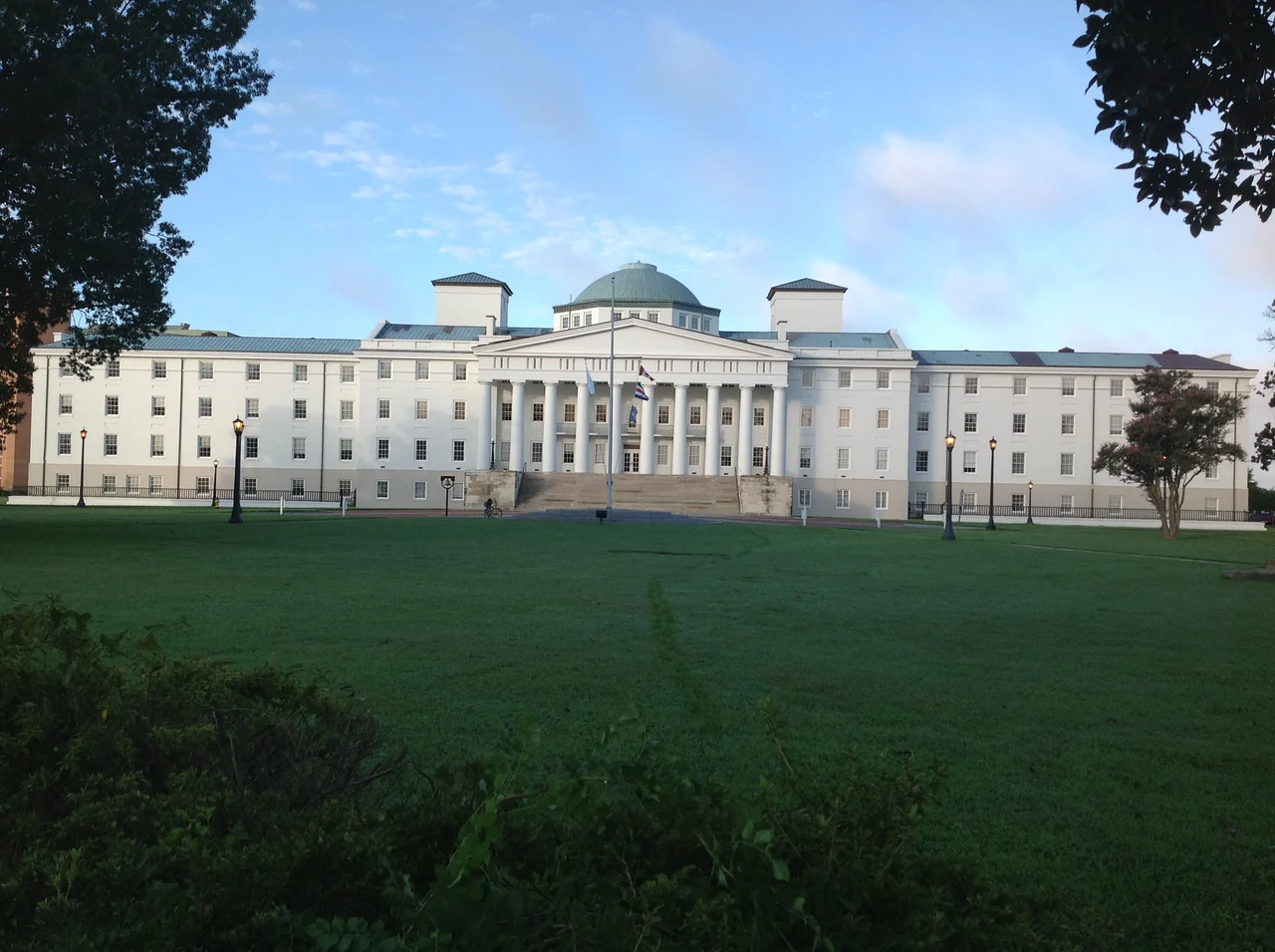

Naval Medical Center Portsmouth
Workers building the new naval hospital in 1827 carried more than five hundred thousand bricks across the lawn. They came from Fort Nelson, the Revolutionary War earthwork that had defended this bend of the Elizabeth River from the British and had since fallen into disrepair. The architect, John Haviland, set those bricks into the foundation and interior walls of his three-story granite building. The men working the cholera wards in 1832, and the influenza wards in 1918, and the burn wards after Pearl Harbor, walked on floors held up by the rubble of an older war. Naval Medical Center Portsmouth is the oldest continuously running hospital in the Navy. It has been on the same point of land, doing the same work, for almost two centuries.
The Building
Haviland was one of the most accomplished architects of early-republic America - he designed prisons, churches, and asylums up and down the East Coast - and he gave the Navy a building of unusual gravity. A hollow rectangle, 172 feet wide by 192 feet deep, set on a twelve-foot granite basement. The front portico runs ninety-two feet across and carries ten Doric columns. The man who designed it also marked the grave of Major John Saunders, the old commander of Forts Nelson and Norfolk, who had died in 1810; the marker stands on the lawn. A cannon nearby commemorates Fort Nelson itself. In 1907 the interior was rebuilt and a shallow dome added, and from 1910 to 1940 Navy surgeons operated under that dome by skylight, the daylight pouring in over them as they worked.
Who Did the Work
The early hospital ran on enslaved labor. The 1815 payroll and the 1832 hospital muster name African Americans working as nurses, attendants, cooks, washers, boatmen, and gravediggers, and on January 2, 1832 Commodore Lewis Warrington confirmed the practice in a letter to the Secretary of the Navy. Madeline Flanders, listed in 1832, was the first woman recorded as a nurse on the muster. Years earlier, in 1810, an enslaved woman named Lydia Cypis had become the first female hospital nurse at the Norfolk Station, serving through the War of 1812. Her pay - five dollars a month - went not to her but to the man who owned her. These names matter. The hospital that still treats sailors today was built and kept running by people who had no choice in whether they were there, and they deserve to be remembered by name in a place that, for a long time, did not give them one.
The Yellow Fever Summer
In June 1855, the steamer USS Franklin docked at Norfolk after sailing from the West Indies. Mosquitoes carrying yellow fever escaped the ship. By August, twenty to seventy citizens a day were falling ill. Portsmouth begged the Navy for help. The hospital threw open its doors to civilians and treated 587 townspeople. When the epidemic finally burned itself out, the Common Council of Portsmouth presented gold medals to six of the naval surgeons who had stayed at their posts. A generation earlier, during the cholera outbreak of summer 1832, the same staff had refused to leave. It is the hospital's oldest tradition - the one that does not change.
The Influenza Ward
On September 13, 1918, the great influenza pandemic arrived at the Naval Training Station at Hampton Roads. Recruits filled the hospital. Three thousand five came down with the disease at the training station alone; one hundred seventy-five of them died. Many were treated at Portsmouth, and the registers from that fall record the speed of the virus through the wards. The nurses caught it from their patients. Nineteen Navy nurses died on active duty during the war, more than half from influenza. Two of them - Hortense Elizabeth Wind and Ann Marie Dahlby, both stationed at Portsmouth, both born in 1891 and 1892 - died at the hospital where they had been caring for the dying. They were twenty-six and twenty-seven.
The Skyscraper and What Came After
World War II expanded the hospital fast. A $1.5 million emergency program in 1941 pushed bed capacity to 3,441; on a single August day in 1944, the staff cared for 2,997 patients at once. After the war the campus kept growing. Building 215, finished to centralize the scattered medical departments, rose seventeen stories - the tallest all-welded steel-framed building between New York and Miami. In 1973 the twelfth floor of that tower received twelve American prisoners of war returning from Vietnam, who were reunited with families on the same floor where they recovered. The current main facility, the Charette Health Care Center, opened in April 1999 - a million square feet, 296 beds, 17 operating rooms, 300 exam rooms. It is named for Master Chief Corpsman William R. Charette, who carried wounded Marines under fire in Korea while wounded himself, and earned the Medal of Honor for it.
From the Air
Naval Medical Center Portsmouth occupies Hospital Point on the west bank of the Elizabeth River at 36.844N, 76.305W, opposite downtown Norfolk. The seventeen-story former main hospital building and the surrounding complex are visible from the water. Norfolk International (KORF) is 8 nm east-northeast; Naval Station Norfolk (KNGU) is 5 nm to the north. Recommended viewing altitude 1,500-3,500 feet AGL.
Nearby Stories
- Thomas Jefferson National Accelerator Facility 1.6 km away
- Cape Charles Lighthouse 4.6 km away
- Dismal Swamp Canal 7.6 km away
- Nat Turner's Rebellion 16 km away
- Chowan University 17 km away
- Flowerdew Hundred Plantation 25 km away
- False Cape State Park 27 km away
- Kitty Hawk: Where Humans First Flew 65 km away