
Ness of Brodgar
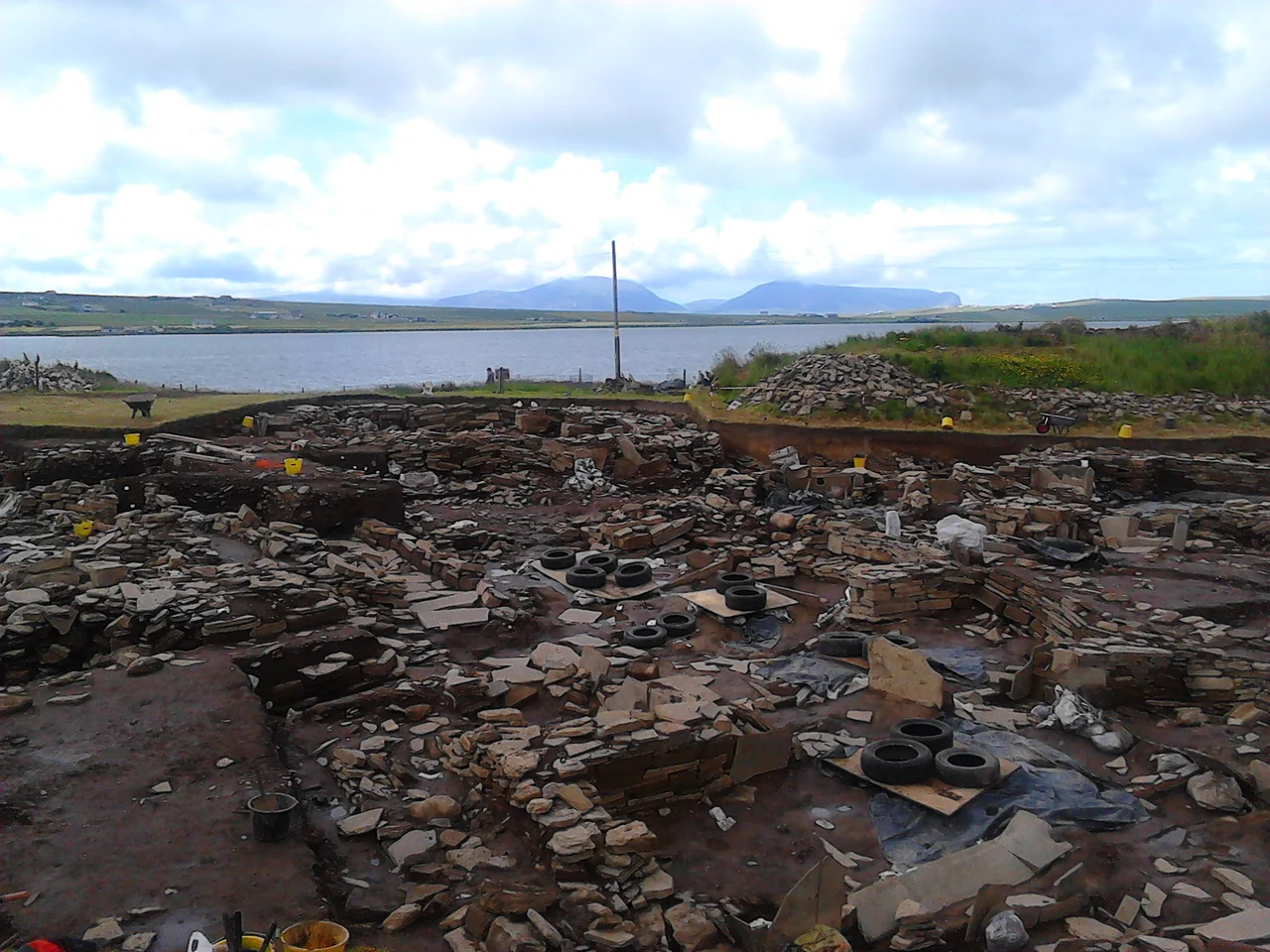
In August 2024, archaeologists buried the most important Neolithic site in Britain. They had to. Five thousand years of being sealed under earth had preserved the Ness of Brodgar perfectly. Twenty years of being exposed to Orkney weather had started to crumble the soft flagstone walls into useless dust. So once the final dig season ended, the team covered the trenches in geotextile, returfed the site, and walked away. What lies beneath is a ceremonial complex bigger and more sophisticated than anyone in 1999 imagined existed in Stone Age Britain. The only way to see it now is in photographs, reports, and the imaginations of the people who stood inside it.
The Discovery That Wasn't Supposed to Happen
When UNESCO inscribed the Heart of Neolithic Orkney in December 1999, the Ness was a quiet stretch of pastureland between the Ring of Brodgar and the Stones of Stenness. A geophysical survey in 2002 turned up unexpected anomalies. In 2003, a farmer's plough struck a large notched slab, and excavators investigating the find spot uncovered a Neolithic building roughly fifteen by twenty metres. From that single trench, the dig expanded outward across the next two decades. By the time excavations ended in 2024, archaeologists had identified a complex covering 2.5 hectares with structures dating from around 3500 to 2200 BC. The site rewrote what specialists thought they knew about Late Neolithic Britain.
Structure Ten and the Cattle Feast
The largest building on the site is Structure Ten, discovered in 2008 and immediately nicknamed the 'Neolithic cathedral.' It measures twenty-five metres long by twenty wide, with walls four metres thick and a cross-shaped inner sanctum surrounded by a paved outer passage. A standing stone with a hole shaped like an hourglass was built into the wall. When the site was decommissioned around 2200 BC, the people who had used it held what appears to have been a massive farewell feast. The slaughter involved approximately four hundred cattle, identified by the tibia bones piled around the structure. In a world without refrigeration, this was a single ritual event involving a meaningful fraction of the regional cattle population. It is impossible to read it as anything other than a deliberate, ceremonial closing of an era.
The Painted Walls
The Ness produced the earliest evidence in Britain of Neolithic people decorating buildings with paint. The pigments were derived from local materials: ochre for red, soot for black. The source of the white colouring has not yet been identified. Stone slabs throughout the complex carry incised geometric designs, lozenges and zigzags and lattices typical of other Neolithic ritual sites. In 2013 a stone was discovered in Structure Ten that the excavators described as 'potentially the finest example of Neolithic art found in the UK for several decades,' inscribed on both sides. The same season produced a carved stone ball found in situ, a rare and significant context for an object usually recovered from disturbed deposits. A small clay figurine called the Brodgar Boy, with a head and two eyes, came out of the rubble in 2011.
The Great Wall and the Buried Baby
A massive stone wall, dubbed the Great Wall of Brodgar, may have traversed the peninsula at over a hundred metres long and six metres wide. Archaeologists interpret it as a symbolic boundary between the ritual landscape of the Brodgar ring and the everyday world beyond. The complex was a place of profound importance to the people who used it, marked by elaborate architecture and unusual finds. In 2015, the bones of an infant who died around the time of birth were found in a recess of Structure One. The discovery is a reminder that whatever ceremonial function the Ness served, it was also a place where ordinary human lives began and ended. The people who built and used these walls grieved, celebrated, decorated, and feasted here for centuries.
Buried Again
The decision to backfill the Ness in 2024 was driven by physics, not politics. The Orkney flagstone the Neolithic builders used is durable when sealed in damp soil and fragile when exposed to wet-dry cycles in open air. The quarried stonework had begun to laminate and crumble after fifteen summers under tarpaulins. Continued exposure would have destroyed the site within a generation. By burying it, the team preserved everything for future archaeologists with better technologies. A new four-week excavation with Time Team is planned for July 2026, prompted by ground-penetrating radar imagery that has revealed even more structures beneath the surface. What lies under the turf at Brodgar is bigger than anyone has yet uncovered.
From the Air
The Ness of Brodgar sits at 58.997°N, 3.216°W on the narrow isthmus between the Loch of Stenness and the Loch of Harray. Kirkwall Airport (EGPA) is 12 km east, with paved facilities and limited instrument approaches. From 2,000 to 3,000 ft AGL the two lochs form a clear figure-eight, with the Ring of Brodgar visible to the northwest and the Stones of Stenness to the southeast. The Ness itself is now returfed and looks like ordinary pasture from the air, but its location is unmistakable: a peninsula a few hundred metres wide connecting two large freshwater bodies. Westerly winds routinely exceed 30 kt. Best viewed in late-afternoon light when low sun raises subtle ground patterns.
Nearby Stories
- Castle of Mey 9.7 km away
- Copinsay 12 km away
- HMS Sword Dance (1918) 27 km away
- Strathnaver Museum 28 km away
- HMS King Edward VII 35 km away
- Fair Isle 74 km away
- Jarlshof 135 km away
- The Laki Eruption: The Volcano That Changed World History 926 km away