.jpg)
New Bern, North Carolina
On August 24, 1898, a New Bern pharmacist named Caleb Bradham renamed the drink he had been mixing behind his soda fountain. He had been calling it Brad's Drink. He started calling it Pepsi-Cola, after dyspepsia — the digestive ailment the drink was marketed to relieve — and the kola nut. That little reformulation of branding would, in time, build a global empire and put a North Carolina coastal town on the back of millions of soda cans. But Pepsi is only the second-oldest founding story in New Bern. The first goes back almost two centuries earlier, to a Swiss aristocrat, a group of German Palatine refugees, and a confluence of two rivers in the marshy lowland of coastal North Carolina.
Founded by a Swiss Baron
Christoph de Graffenried, 1st Baron of Bernberg, was a Bernese nobleman with grand ambitions and limited cash. In 1710, he led a colony of about 650 Palatine Germans - refugees from the wars of the Rhineland - and a smaller party of Swiss to the confluence of the Neuse and Trent Rivers in coastal North Carolina. He bought land that the Tuscarora considered theirs. He laid out the town in a tidy grid. He named it New Bern, after the Swiss capital of Bern, whose coat of arms includes a black bear. New Bern still uses bears on its seal, in its street art, and in the name of its downtown development corporation, Swiss Bear. The colony nearly failed within its first year - disease, starvation, and the Tuscarora War of 1711-1715 killed many of the original settlers, and Graffenried himself was captured by the Tuscarora before being released. The town survived. The Tuscarora, ultimately, did not survive on their land.
Colonial Capital, Palatial Governor's House
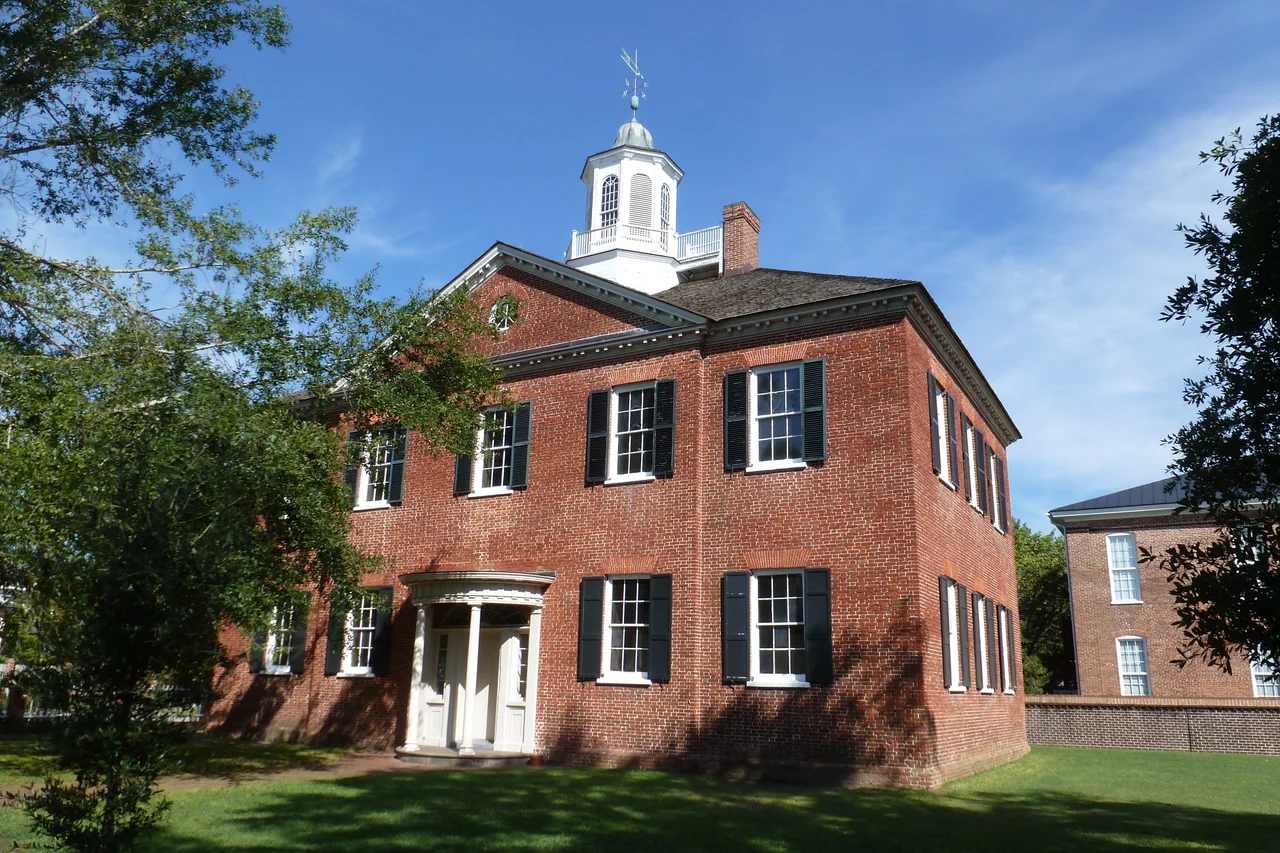
By the 1760s, New Bern was the political and commercial center of colonial North Carolina. In 1765 the colony designated it the capital, and from 1767 to 1770 Royal Governor William Tryon built a palatial home and seat of government on the south side of town. Tryon Palace, designed by English architect John Hawks in the Georgian style, was - at the time - one of the finest public buildings in colonial America. It burned in 1798, leaving little but the kitchen and stables. A reconstruction, opened in 1959 after decades of research, now stands on the original foundations, surrounded by formal gardens. After the American Revolution, New Bern remained the state capital briefly, until Raleigh took the role in 1792. The town stayed a port and a center of trade through the early 19th century, exporting naval stores, lumber, and tobacco out the Neuse to Pamlico Sound.
War, Occupation, and a Long Recovery
In March 1862, Union forces under General Ambrose Burnside captured New Bern, and the town remained under federal occupation for the rest of the Civil War. The occupation transformed the town: thousands of enslaved African Americans crossed Union lines to freedom, and New Bern became one of the largest contraband camps in the South. The James City freedmen's settlement, just across the Trent River, took shape during these years. William Henry Singleton, born enslaved near New Bern in 1843, escaped to join the Union Army and later wrote a memoir of his journey from slavery to freedom. After the war, New Bern recovered slowly. Confederate raiders tried to retake it in February 1864 and failed - and that failure was followed by one of the war's worst atrocities, the Kinston hangings, in which George Pickett ordered the execution of 22 captured Union prisoners as deserters.
Pepsi, Hurricanes, and the Long 20th Century
Pepsi-Cola came in 1898, born in Bradham's drugstore at Pollock and Middle Streets. The drink moved out of New Bern eventually - PepsiCo today is headquartered in Purchase, New York - but a small museum on the original drugstore site, the Birthplace of Pepsi-Cola, draws steady visitors. Through the 20th century the town navigated hurricanes (the 1769 storm that destroyed the docks, the 1955 Hurricane Ione, and most recently Hurricane Florence in 2018, which flooded much of the historic district), the decline of the lumber industry that built the Blades House and other Queen Anne mansions, and the slow growth of tourism and retirement housing along the rivers. As of the 2020 census, 31,291 people live in the city, and around 2,000 Burmese refugees have been resettled here since the early 2000s, adding new layers to a town that started as a refugee settlement itself.
What's Still Here
Today the New Bern Historic District holds one of the largest concentrations of pre-1865 architecture in coastal North Carolina - Federal townhouses, Greek Revival mansions, Italianate row buildings, Queen Anne wood-frame palaces, and the reconstructed Georgian splendor of Tryon Palace. The waterfront has been rebuilt as a marina and tourist district. Nicholas Sparks, who lives nearby, has set several novels in and around the city, including The Notebook. Pollock Street still runs east-west through the historic core; Middle Street still runs north-south. The Baxter Clock still ticks. The Neuse River still empties into Pamlico Sound. The town keeps adding chapters without throwing out the old book.
From the Air
New Bern at 35.108 N, 77.044 W, on the south bank of the Neuse River at its confluence with the Trent. Coastal Carolina Regional Airport (KEWN) sits 3 nm south of the central business district. Alternates: KMRH (Beaufort) 30 nm SE, KISO (Kinston) 30 nm W, KNKT (Cherry Point MCAS) 25 nm SE. Best viewed from 2,000 to 4,000 feet AGL. The historic district shows clearly as a dense grid between the two rivers; Tryon Palace's formal gardens form a distinctive green wedge on the southwest. The Neuse widens dramatically east of town into a broad saltwater estuary.
Nearby Stories
- Swansboro 13 km away
- Harkers Island, North Carolina 15 km away
- Beulaville, North Carolina 18 km away
- 1961 Goldsboro B-52 Crash 23 km away
- Battle of Washington 26 km away
- Pender County, North Carolina 37 km away
- Crystal Coast 43 km away
- Lake Mattamuskeet 45 km away