
Ningaloo Marine Park (Commonwealth Waters)
Every autumn, the largest fish on Earth keeps an appointment off this coast. Whale sharks - spotted, slow, and as long as a bus - drift in from deep water to feed in the warm seas beyond Ningaloo Reef, three hundred to five hundred of them in a good season. They are not hunting the krill alone but tracking a pulse of plankton that follows the reef's mass coral spawn. The Ningaloo Marine Park in Commonwealth waters exists to protect that gathering, and the slice of ocean where it happens is one of only a handful of places on the planet where these gentle giants reliably appear.
The Park Beyond the Reef
There are two Ningaloo marine parks, side by side, and the distinction matters. The shallow, brilliantly clear state waters hugging the reef belong to Western Australia. Beyond them, in the deeper blue, lies the Commonwealth park - 2,435 square kilometres of Australian-government water managed as one of thirteen reserves in the North-west Marine Parks Network. This is the outer apron of the Ningaloo system, where the continental shelf falls away. It protects what the postcard reef cannot: the slope habitats, the seafloor pinnacles and terraces, and the open-water highway that the great migratory animals travel.
A Convergence of Giants
The whale sharks get the headlines, and rightly so - Ningaloo ranks among the twenty-five most significant whale shark aggregation sites in the world. But they share these waters with a remarkable cast. Manta rays wheel through the lagoons and outer reef in unusual abundance. Marine turtles forage here, never far from the nesting beaches just inshore. And twice a year, humpback whales pass through on one of the longest migrations of any mammal, moving between their Antarctic feeding grounds and the warm calving waters of the Kimberley to the north. The park sits squarely on that ancient route.
What the Zoning Protects
From the surface, the park looks like featureless ocean. Underwater, it is anything but. The reserve takes in shallow shelf environments and the deeper habitats of the Central Western Shelf Transition - a bioregion few people will ever see but which underpins the whole food web that draws the sharks and whales. The park carries an IUCN category IV designation, with two internal protection zones that set the rules for fishing and other activity. The logic is simple: protect the food, the seafloor, and the corridor, and the spectacle takes care of itself.
A Warming Sea
Protection on paper does not make the threats vanish. Climate change is the park's gravest concern, and it arrives in several forms at once. Warmer, more acidic water stresses the corals whose spawning starts the whole seasonal chain. Stronger storms and rising wave energy batter shallow habitats. A marine heatwave can bleach reef and scatter the plankton that the whale sharks travel thousands of kilometres to find. The Commonwealth waters were first proclaimed for protection in 1987 and reshaped under federal environment law in 2013 - but the animals they shelter now face pressures no boundary line can hold back.
From the Air
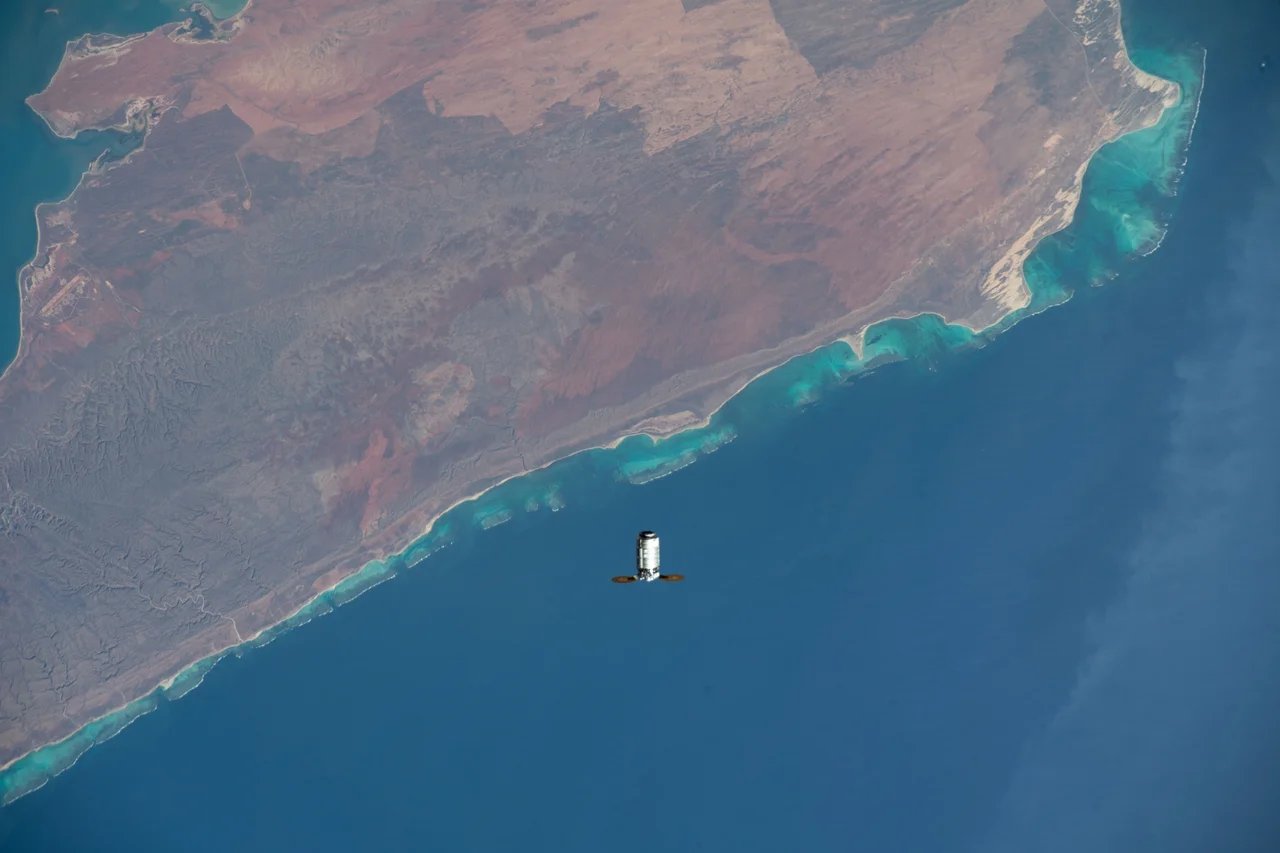
The Ningaloo Marine Park (Commonwealth waters) lies off Western Australia's North West Cape, centred near 22.62 degrees S, 113.55 degrees E, west of the Ningaloo Reef line. From altitude in clear conditions the pale turquoise reef and lagoon give way sharply to the deep blue of the protected shelf waters. The nearest airport is Learmonth (YPLM/LEA), about 36 km south of Exmouth on the cape; Carnarvon (YCAR) lies further south down the coast. Best visibility is in the dry season from roughly April to October; whale shark season runs March through June.
Nearby Stories
- Qantas Flight 72 21 km away
- Ningaloo Station 48 km away
- Exmouth (Western Australia) 76 km away
- North West Coastal Highway 85 km away
- Naval Communication Station Harold E. Holt 99 km away
- French Western Australia 329 km away
- The Silent Wave: Java's 1994 Tsunami Earthquake 1317 km away
- The Ghost Casino at the Edge of the World 1548 km away