
The Island That Became a Cage
In early 2014, seven asylum seekers at Christmas Island's North West Point detention centre stitched their lips shut. They were among 375 detainees on hunger strike, protesting in solidarity with Reza Barati, an Iranian asylum seeker who had been killed at the Manus Island facility. The lip-stitching was an act of desperation from people who had run out of ways to be heard -- detained on a speck of Australian territory in the Indian Ocean, 1,600 kilometers from the mainland, in a facility that had been designed to be difficult to reach and easy to forget. North West Point has been closed, reopened, repurposed as a coronavirus quarantine station, and emptied again. Its story is inseparable from two decades of Australian immigration policy.
Built on Phosphate, Built for Distance
The facility sits on 40 hectares of land that was once a phosphate mining lease, at the northwestern end of Christmas Island, adjacent to the Christmas Island National Park. Temporary detention facilities had existed on the island since late 2001, hastily established at Phosphate Hill to process asylum seekers arriving by boat. Those makeshift quarters were quickly deemed inadequate, and in March 2002 the Australian government announced construction of a purpose-built immigration reception and processing centre with capacity for 1,200 people. The plan was scaled back to 800 places when boat arrivals declined, then construction was restarted in 2003. The builder, Baulderstone, worked from January 2005 to August 2007, with final completion in 2008. The result was a compound of eight accommodation units, an education and recreation building, tennis courts, a medical centre, and administrative facilities. By 2010, capacity had been expanded to over 2,000 places. In April of that year, 2,208 people were being held.
The Weight of Overcrowding
The centre was designed for a regular operating capacity of 1,094 people, with contingency space for 2,724. In June 2013, those numbers stopped being theoretical. After four boats carrying 350 asylum seekers were intercepted in six days, the Immigration Department reported 2,960 people held in the facility -- more than double its intended capacity. The human cost of overcrowding emerged in waves of unrest. In 2011, more than 250 detainees hurled rocks at staff and set fire to accommodation blocks; they were subdued with tear gas and bean bag rounds, one of the first times such munitions were used in Australia. Mothers detained with their children at Construction Camp were reportedly told by immigration officials in 2014 that they would never settle in Australia -- that Nauru or Manus Island was their only future. The Department of Immigration confirmed that following the confrontation, seven individuals threatened self-harm and four carried it out. A class action was filed that year on behalf of a six-year-old girl who had developed a dental infection, a stammer, and separation anxiety during more than a year of detention.
Closed, Opened, Closed Again
The political life of North West Point has been defined by cycles of closure and reopening that mirror shifts in Australian immigration politics. The facility closed in October 2018 after its population dwindled to 314. Four months later, in February 2019, the Morrison government announced its reopening after parliament passed the Medevac bill, which allowed medical professionals greater say in transferring sick asylum seekers from offshore processing. Prime Minister Scott Morrison cited increased boat arrivals as the justification. The island's Shire President, Gordon Thomson, called the announcement "stunning" and said it "made no practical sense," noting that Christmas Island had never provided medical treatment to detainees. In April 2019, the government sent 140 Serco employees to the island despite there being no refugees to manage. The facility became a symbol of deterrence politics -- its mere existence intended to send a message, regardless of whether anyone was actually detained inside.
Quarantine and the Tamil Family
The centre's most unexpected chapter began in January 2020, when Prime Minister Morrison announced it would serve as a coronavirus quarantine facility for Australians evacuated from Wuhan. On February 3, approximately 240 citizens, including 84 children and five infants, were flown from the Chinese city on a Qantas evacuation flight and then transferred to Christmas Island for two weeks of isolation. Another 35 Australians arrived from a New Zealand-organized flight out of Wuhan. A detention centre built to contain asylum seekers was repurposed to protect citizens from a pandemic. But the facility's most personal story involved a Tamil asylum seeker family taken by chartered jet from detention in Melbourne in August 2019, bound for deportation to Sri Lanka. A last-minute court injunction forced the plane to land in Darwin, and the family was subsequently flown to Christmas Island -- held on one of the most remote facilities in the Australian system while their legal battle continued.
Forty Hectares of Contested Ground
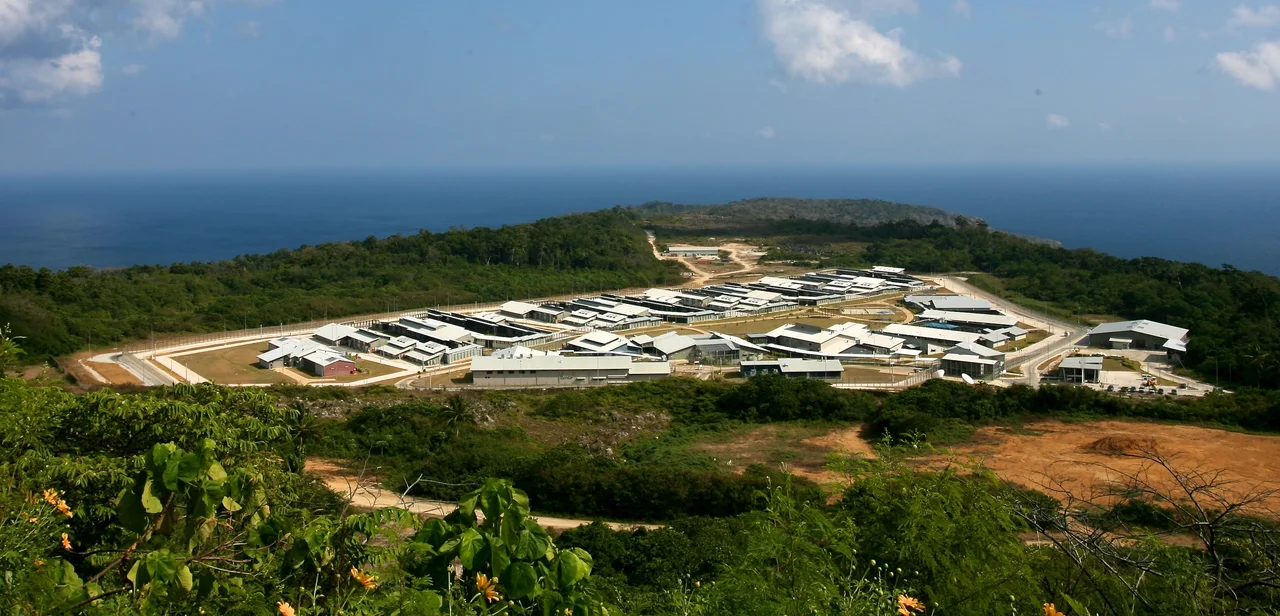
From the air, North West Point is visible as a cleared compound adjacent to the dark green canopy of Christmas Island National Park -- a geometric interruption in the jungle at the island's northwestern tip. The contrast is stark: pristine tropical forest on one side, institutional buildings and fencing on the other. The last detainees left in August 2023, when 36 people remained. The facility now sits empty again, managed by Serco under contract, maintained by CI Resources, the same company that operates the island's phosphate mine. The 40-hectare site carries the layered history of phosphate extraction, immigration enforcement, protest, and pandemic response. Whether it will be repurposed, demolished, or reopened yet again depends on political decisions made 4,000 kilometers away in Canberra.
From the Air
Located at 10.47°S, 105.58°E on the northwestern end of Christmas Island, adjacent to Christmas Island National Park. The compound is visible as a cleared area contrasting with the surrounding dense tropical forest. Christmas Island Airport (YPXM) is approximately 8 km to the east. The island sits 380 km south of Java in the Indian Ocean. Best viewed from 2,000-4,000 ft AGL on approach from the northwest. The cleared compound and institutional layout are distinctive against the jungle canopy.
Nearby Stories
- SIEV X 6.9 km away
- LAPAN: Indonesia's Space Agency 354 km away
- Where the Gods Were Smiling 381 km away
- Where Tigers Return and Addicts Heal 480 km away
- 1933 Sumatra Earthquake 588 km away
- Tryal Rocks 1448 km away
- Operation Mosaic 1509 km away
- Sainte-Rose, Réunion 5378 km away