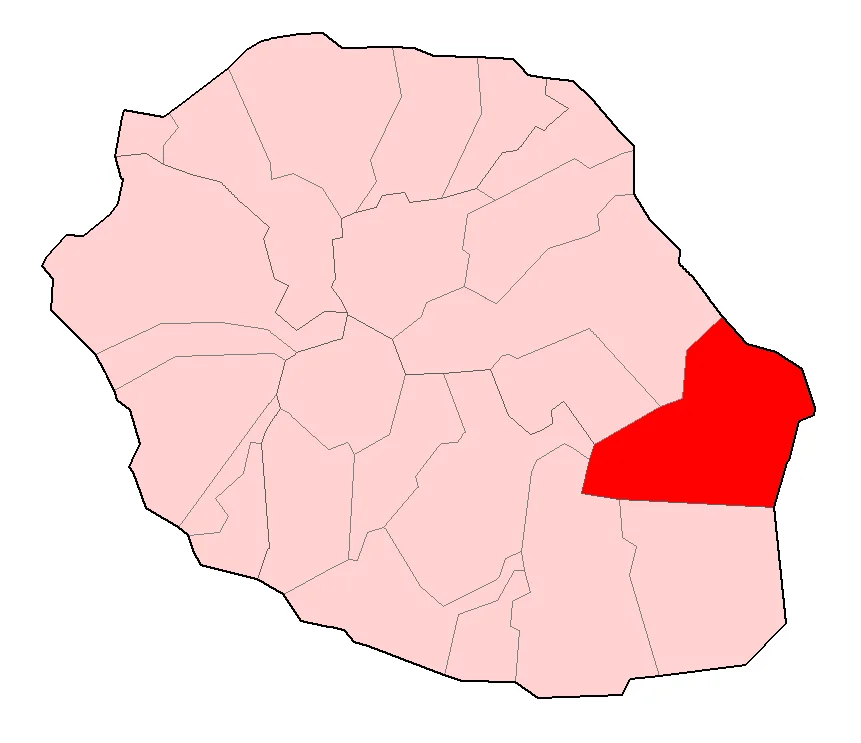

Sainte-Rose, Réunion
In April 1977, the people of Piton Sainte-Rose evacuated their village and watched a river of molten rock come down the mountain toward their homes. The lava crossed the coast road, buried gardens and houses, and rolled up to the village church. Then something happened that the village would never stop talking about. The flow reached the front steps, pushed through the doorway - and stopped. The walls held. The roof stayed up. The locals renamed the building Notre-Dame des Laves, Our Lady of the Lavas, and to this day the hardened black flood lies frozen around it.
The Church and the Flow
The eruption came from Piton de la Fournaise, the active volcano that built and still builds the eastern third of Réunion. As the lava advanced on the village, residents fled, and most of what stood in the flow's path was destroyed. The church's survival became a local miracle, but the honest version is more complicated than the legend. By more careful accounts, the lava did breach the entrance and damage the interior; what endured was the shell of the building while the land around it was scoured clean. That a structure should remain standing at all, in the middle of a flow that erased crops and houses, was remarkable enough. The molten rock was later cleared from the doorway, and the church returned to service. Stained-glass windows inside now depict the eruption that nearly consumed it.
The Wettest Edge of France
Sainte-Rose faces directly into the trade winds, on the windward side of one of the rainiest islands on Earth, and the numbers are staggering. This is one of the wettest inhabited places anywhere, mentioned in the same breath as Cherrapunji in India and Quibdó in Colombia. Moist Indian Ocean air piles up against the volcano and dumps its load here, feeding a tropical rainforest climate where rain falls in every month and the vegetation grows with jungle ferocity. Higher up the slopes the air cools toward something gentler, but down on the coast, life is lived under frequent, generous, drenching rain.
Where France Ends
Follow the coast to the Pointe des Cascades and you reach a genuine edge of the world. This headland is the easternmost point of Réunion - and because Réunion is a full department of France, it is also the easternmost point of France itself and of the entire European Union. Stand here and the next land east is thousands of kilometers of open ocean. It is a fitting place for a frontier: black volcanic rock, white surf, and nothing beyond but water and horizon.
Lava, Wind, and Power
Life at Sainte-Rose has always meant living with the volcano and the elements, and the village has learned to turn some of that energy to use. In 2004 it became home to the first wind farm on the island, harvesting the same relentless trade winds that bring the rain. It is a small modern footnote to a place defined by deep forces - the eruptions that keep reshaping the coastline, the storms that soak it, and a single church that stood its ground against the fire.
From the Air
Sainte-Rose sits on Réunion's east (windward) coast at approximately 21.13°S, 55.79°E, near sea level, with Piton de la Fournaise (the active volcano, summit ~2,632 m) rising to the southwest. Expect cloud, heavy rain showers, and reduced visibility here far more often than on the leeward side - this is among the wettest coasts on the planet. The nearest airport is Roland Garros / Saint-Denis (ICAO FMEE) on the north coast; Pierrefonds / Saint-Pierre (ICAO FMEP) lies on the southwest coast. The dark, recent lava fields below the volcano and the Pointe des Cascades headland (easternmost point of the EU) are the key visual landmarks.
Nearby Stories
- Saint-Denis: The Capital Named for a Lost Ship 29 km away
- Tromelin Island: The Forgotten Enslaved People of the Isle of Sand 563 km away
- Battle of Tamatave 685 km away
- Canal des Pangalanes 773 km away
- Ambalavao 909 km away
- Siege of Galle (1640) 3978 km away
- Galle Fort 3999 km away
- French Western Australia 5743 km away