.jpg)
Ambalavao
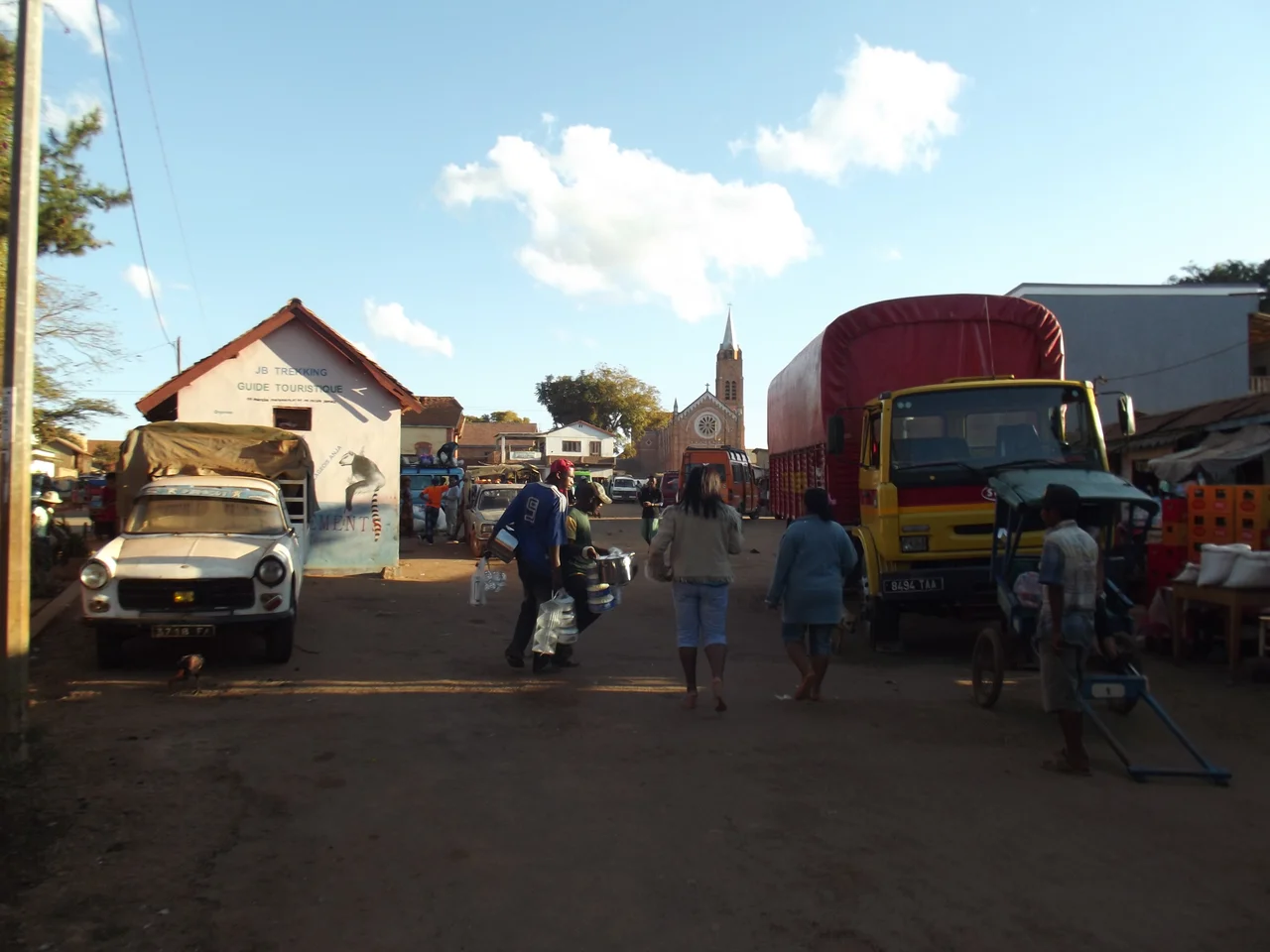
Every Wednesday, the dust rises over Ambalavao. Down the trails and along Route Nationale 7 they come, herdsmen driving thousands of zebu, the humped cattle that are wealth, status, and ancestry made flesh in Madagascar. This is the largest cattle market in the country, a churning crowd of horns and haggling at the southern edge of the Central Highlands. By midday the deals are struck, the herds move on toward the slaughterhouses and farms of the north, and the town settles back into its quieter trades, the ones that have made its name for far longer than any market.
Paper Pressed with Petals
Ambalavao is the home of Antemoro paper, a craft carried inland centuries ago by the Antaimoro people of the southeast coast, who learned the technique from Arab traders. The bark of the avoha shrub is boiled, pounded into a grey pulp, and spread thin across cloth frames stretched in the sun. Before it dries, artisans press fresh flowers and leaves into the surface, so that each finished sheet sets with a garden suspended inside it. Visitors can watch the whole slow process in the town's workshops, from the steaming pots to the drying racks, and lay their own blossoms into the wet pulp. What began as a way to copy sacred manuscripts has become Ambalavao's signature, a handmade paper sold in markets across the island and carried home in the luggage of travelers who watched it being made.
Silk and the Shroud
The town's looms tell another story. Ambalavao is a center for weaving wild silk, spun from cocoons gathered in the surrounding forests rather than farmed, then boiled, teased into thread, and dyed before it reaches the loom. Among the cloth produced here is the lamba mena, the burial shroud that wraps the dead in Malagasy tradition. In the Betsileo highlands and beyond, the bond between the living and their ancestors is woven into daily life, expressed most powerfully in the famadihana, the ceremony in which families exhume their dead, rewrap them in fresh silk, and dance with them before returning them to the tomb. The silk that shrouds a body is no morbid afterthought but a thing of dignity and love. To watch the weavers at their work is to see a culture's relationship with its own past being made thread by thread.
Vines on the Hills
Few people expect wine in Madagascar, yet the slopes around Ambalavao are stitched with vineyards. The highland climate here is humid subtropical, warm and wet enough for the vine, and the region is part of the small but proud wine country that centers on nearby Fianarantsoa, considered the wine capital of the island. The vintages are modest by European standards and rarely leave Madagascar, which is exactly what makes them worth seeking out. A glass of Malagasy red, drunk on a terrace as the cattle market disperses, is a flavor you will find almost nowhere else. The same hills that ripen the grapes also feed the silkworms and shelter the avoha groves, so that paper, cloth, and wine all rise from one patch of highland earth.
Gateway to the Granite
For travelers, Ambalavao is also a threshold. The town is the staging point for Andringitra National Park, whose granite massif and the second-highest peak in Madagascar lie 47 kilometers to the south, reached only by a jolting four-wheel-drive track. Just 13 kilometers down the road sits the Anja Community Reserve, where ring-tailed lemurs gather among fallen boulders. The roads are rough and the rainy season can turn them to mire, but the rewards are immediate. Cyclists who pass through speak of villages where children run alongside shouting greetings, and of a welcome warm enough to make the potholes worth enduring.
From the Air
Ambalavao lies at approximately 21.84 degrees south, 46.94 degrees east, in Madagascar's southern Central Highlands along Route Nationale 7. From the air it reads as a compact highland town set among hills and terraced fields, with the granite ramparts of the Andringitra massif visible to the south. A viewing altitude of 6,000 to 9,000 feet AGL gives a good sense of the town in its valley setting. The nearest major airport is Fianarantsoa Airport (ICAO: FMSF), about 56 km north; a small airfield also serves the town directly. Highland terrain and afternoon cloud build-up favor morning flights for the clearest air and best light.
Nearby Stories
- Andringitra National Park 7.2 km away
- Fianarantsoa 26 km away
- Canal des Pangalanes 82 km away
- Teniky 114 km away
- Isalo National Park 130 km away
- Makay Massif 132 km away
- Moramanga 246 km away
- Mantasoa 321 km away