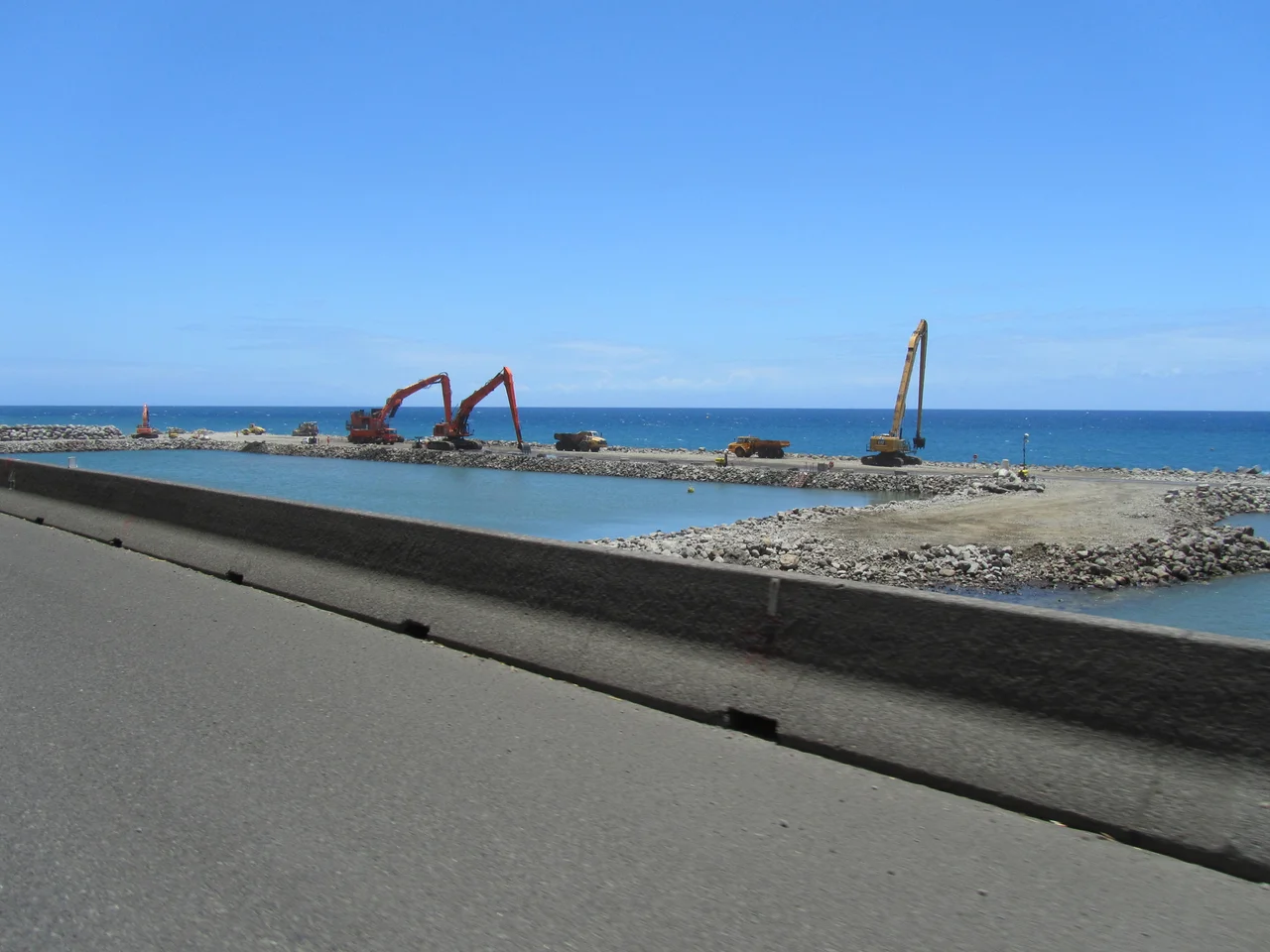

Nouvelle Route du Littoral
Most highways follow the land. This one flees it. Along Réunion's northern coast, where a wall of crumbling cliff plunges straight into the sea, the old coastal road has long been a place where boulders fall onto traffic and storm waves wash across the lanes. So engineers made a radical choice: rather than hug that deadly cliff, they carried the new road out over the open ocean on a viaduct held up by concrete piles driven into the seabed. The result, the Nouvelle Route du Littoral, runs for kilometers across the Indian Ocean - and with a price tag that has climbed past two billion euros, it has earned an unwelcome nickname: the most expensive road in the world.
The Killer Cliff
To understand why anyone would build a road on the sea, you have to see what it replaces. The old route du Littoral threads the narrow gap between the Indian Ocean and a sheer cliff hundreds of meters high that rises toward the village of La Montagne. The rock is unstable, and over the years rockfalls have killed drivers and forced repeated closures; heavy swells routinely flood the seaward lanes. For one of Réunion's busiest links - the artery connecting the capital, Saint-Denis, to the port town of La Possession - that combination was untenable. Planners weighed everything: a tunnel bored beneath the mountain, a causeway of piled rock doubling the old road, a full viaduct over the water. In the end they chose to go offshore.
A Road on Stilts
The centerpiece is a viaduct stretching some 5.4 kilometers out to sea - the longest offshore viaduct ever built in France - carried on massive piers and lifted thirteen to twenty-two meters above the waves to clear the swell. Building it meant assembling colossal deck segments and lowering them into place from a purpose-built barge, working in open ocean exposed to cyclones. The full crossing was planned to run about 12.5 kilometers between Saint-Denis and La Possession, part viaduct and part rock causeway. At roughly 130 million euros per kilometer in its early estimates, it stood among the costliest stretches of road ever laid anywhere on Earth - a staggering sum for an island of under a million people.
Mountains of Rock, Walls of Lawsuits
The causeway sections demanded something Réunion could not easily supply: roughly three million tonnes of large boulders, enough to require opening new quarries at Saint-Leu and Bois-Blanc. Environmental groups went to court over the damage that quarrying and the causeway would inflict on land and sea, and in 2019 a court suspended the quarry authorizations. Work stalled. Costs climbed. In 2021, hundreds of the giant concrete wave-breaking blocks called tetrapods were found to have been installed incorrectly, adding further delay. Faced with the mess, officials made a costly reversal in 2022: the troubled causeway section would instead be rebuilt as a second viaduct, adding hundreds of millions of euros more to the bill.
A Bridge to Nowhere - For Now
For years the finished viaduct ran out from Saint-Denis and simply stopped, an elegant ribbon of roadway ending in mid-coast where the abandoned causeway should have continued. Critics called it a bridge to nowhere. In August 2022 a portion finally opened to traffic - in one direction only, between Saint-Denis and Grande Chaloupe - while drivers heading the other way still ran the gauntlet beneath the old cliff. The remaining viaduct is now expected to carry the road through to completion around 2030, nearly two decades after work began. When it is whole, Réunion will have one of the most spectacular drives anywhere: a highway suspended over the sea, the cliffs that once threatened it standing safely to one side.
From the Air
The Nouvelle Route du Littoral runs along Réunion's north coast between Saint-Denis and La Possession, centered near 20.89°S, 55.39°E. From the air the completed viaduct is unmistakable - a slender concrete causeway tracing a line across the open ocean just offshore of the towering coastal cliffs below La Montagne. Roland Garros Airport (ICAO: FMEE) lies immediately east at Sainte-Marie, just a few kilometers from the road's Saint-Denis end, making this structure highly visible on approach and departure. Pierrefonds Airport (ICAO: FMEP) is on the far south coast near Saint-Pierre. Best viewed in the clear, dry austral winter (May-October); the dramatic interplay of the white viaduct, blue sea, and dark cliffs is sharpest in low morning light.
Nearby Stories
- Cirque de Cilaos 11 km away
- Tromelin Island: The Forgotten Enslaved People of the Isle of Sand 521 km away
- Battle of Tamatave 634 km away
- Toamasina 680 km away
- Canal des Pangalanes 747 km away
- Siege of Galle (1640) 3975 km away
- Galle Fort 3996 km away
- French Western Australia 5789 km away