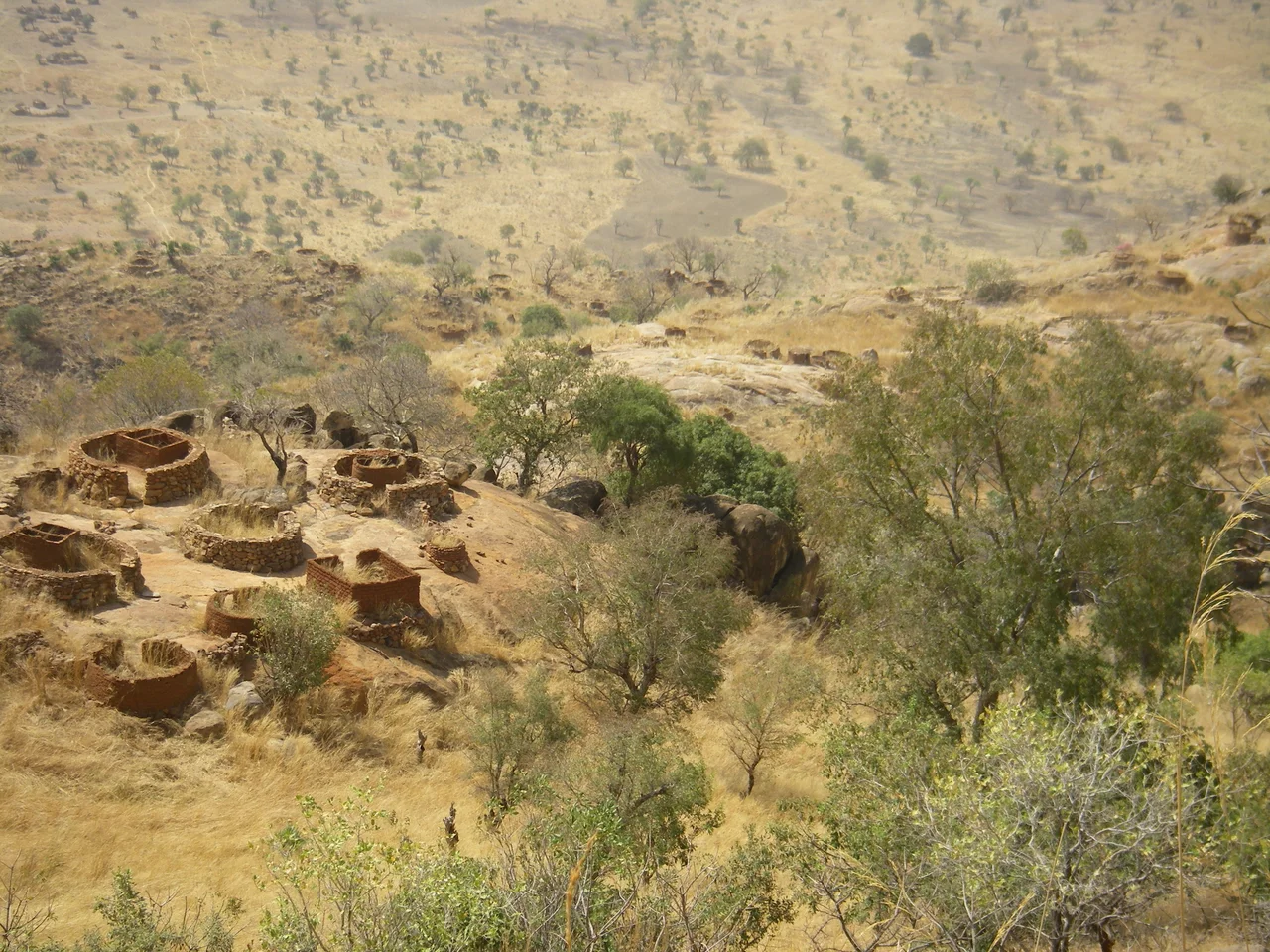

Nuba Mountains
They are not the Nubians. That confusion has cost the Nuba people centuries of being misidentified, miscounted, and underestimated. The Nubians live along the Nile in northern Sudan and Egypt. The Nuba live here, in the hills of South Kordofan, a hundred and fifty kilometers south of the Nile's middle reaches, and they are a family of roughly fifty distinct ethnic groups speaking dozens of languages across a cluster of rocky inselbergs rising from the Sudanese plain. Their name comes from the mountains themselves, which in turn carry something older. In antiquity this was Kushite land. In the Middle Ages, part of the Christian Nubian kingdom of Alodia. In the eighteenth century, the small kingdom of Taqali ruled the high country. And then, slowly, the attention of more powerful neighbors began to settle on them, and it has not lifted since.
A Green Island in a Dry Land
The Nuba Mountains cover some 48,000 square kilometers in South Kordofan. The hills rise 450 meters or more above the surrounding plain, and their igneous inselbergs stand sharp against the metamorphic lowlands like stone waves. The rainy season from mid-May to mid-October brings 300 to 800 millimeters of rainfall, enough for seasonal agriculture and rain-fed grazing. The dry months, February to May, bring water shortage, and villagers walk hours to reach wells. Compared to the semi-arid plain around them, the mountains are lush, green, and cool. This has kept the Nuba peoples here for millennia. It has also, at critical moments, kept the Sudanese government out, because the terrain is hard to control militarily, and Nuba fighters know every cave and ridge.
Who the Nuba Are
The Nuba are not one people but many. Their languages belong to several different language families, some Kordofanian, some Nilo-Saharan, some that linguists still argue about. Their religions vary: some follow Islam, some Christianity, many preserve ancestral Nuba practices that predate either. Their cultural traditions, including the extraordinary body-painting and wrestling traditions documented by the photographer George Rodger in the 1940s and by Leni Riefenstahl in the 1970s (whose gaze carried its own problems), have made them famous in ways they did not always choose. What unites the Nuba is a shared sense of mountain identity, and a shared history of being pushed into these hills by Arab migrations and staying to defend them. They number roughly 1.5 million in the mountains, with smaller Baggara Arab pastoralist communities sharing the plain below.
Genocide by Attrition
During the Second Sudanese Civil War (1983-2005), the Sudanese government under Omar al-Bashir targeted the Nuba systematically. The scholar Samuel Totten described the campaign as genocide by attrition, using starvation as a tool of extermination. Villages were bombed. Relief convoys were blocked. Mines were placed at the entry points to the mountains, preventing humanitarian access. In 2002, under international pressure, Khartoum agreed to an interim ceasefire to let food and medical supplies reach the mountains. American and international observers deployed alongside SPLA fighters. Randolph Hampton, an American observer, was stationed at Kauda with the SPLA command. Indiscriminate bombing continued during the supposed ceasefire, with evidence documented photographically by observers on the ground. Abdelaziz al-Hilu, a Nuba military leader, became the SPLA's regional commander, and the Nuba fighting forces held their ground.
The New War and the Old
South Sudan became independent on July 9, 2011. The Nuba Mountains, geographically north of the new border, had voted overwhelmingly for the SPLM but found themselves cut off from it by the border. Within weeks, new fighting broke out between the Sudanese government and the newly-formed SPLM-North, led by al-Hilu. South Kordofan's governor, Ahmed Haroun, had already been indicted by the International Criminal Court for war crimes in Darfur. Cluster bombs were used against Nuba villages, documented by Human Rights Watch. In 2015, actor George Clooney and reporter Nicholas Kristof traveled to the Nuba Mountains to bring international attention. The New York Times ran Kristof's column titled The Worst Atrocity You've Never Heard Of. The atrocities continued. Most of the international community did not respond. The people of the Nuba Mountains kept growing their millet and sorghum, kept wrestling in their traditional way, kept teaching their children the languages that each mountain speaks.
Still Holding
As of 2025, during Sudan's ongoing civil war, most of South Kordofan including the largest town of Kologi is controlled by al-Hilu's SPLM-North forces. They describe themselves as secular, free-market, and democratic, and they have been fighting for autonomy and rights for more than four decades without ever having been fully defeated. The Nuba Mountains have been a place of Kushite kings, Christian Alodia, Muslim Taqali, British administration, Sudanese independence, and three separate wars, all against the same mountains and the same stubborn mountain people. The story of Sudan's twentieth and twenty-first centuries cannot be told without the Nuba, and yet the Nuba themselves remain largely absent from that story as it is told outside Sudan. They are here. They have been here. The mountains hold them, and they hold the mountains.
From the Air
The Nuba Mountains are centered at approximately 12°N, 30.75°E in South Kordofan, Sudan. Peak elevations reach around 1,400-1,500 meters (inselberg igneous formations rise up to 1,000 meters above the plain). The range stretches roughly 200 km east-west and encompasses about 48,000 km² of mountains, foothills, and valleys. Recommended viewing altitude: 12,000-16,000 feet for a view of the massif rising from the plain. Nearest airports are Kadugli (HSKG), the regional center, and El-Obeid (HSOB) to the north, though operational status is variable during ongoing conflict. Expect cooler air with orographic clouds during July-September rainy season; smoke from seasonal burning and dust storms during the dry season (February-May).
Nearby Stories
- Ed Dubeibat 53 km away
- Sudanese Conflict in South Kordofan and Blue Nile 59 km away
- South Kordofan 108 km away
- Battle of Shaykan 114 km away
- 2012 Talodi Antonov An-26 crash 134 km away
- Fashoda Incident 229 km away
- Kodok 256 km away
- Jebel Moya 258 km away