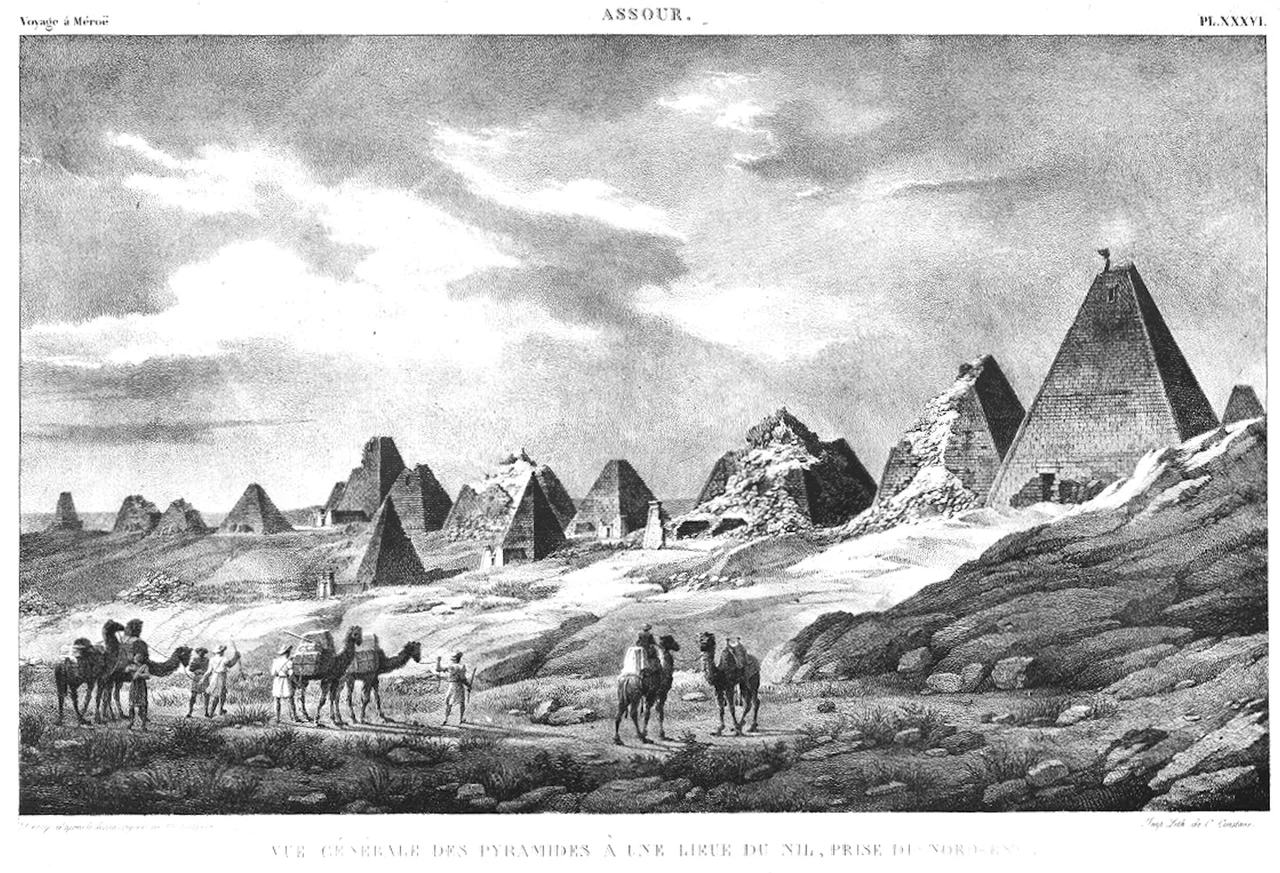

Nubian pyramids
Sudan has more ancient pyramids than Egypt. That single sentence is a useful corrective to a centuries-old imbalance in how the pyramids of Africa have been written about. The Nubian pyramids cluster at four sites along the Nile in northern Sudan -- El-Kurru, Nuri, Jebel Barkal, and Meroe -- and they were built by the Kushite kings and queens who ruled the Kingdom of Kush from roughly 750 BCE until 350 CE. They are steeper than the Egyptian pyramids. They are narrower. They are more densely packed. And one of them, raised around 350 CE at Meroe, was the last pyramid ever built anywhere in the Nile Valley -- or indeed anywhere in the ancient world.
The First African Pyramids in a Thousand Years
The tradition began at El-Kurru in 751 BCE, during the reign of King Piye (Piankhy), founder of the 25th Dynasty of Egypt. After centuries in which no pyramids had been built in either Egypt or Nubia, the Kushite kings deliberately revived the form as part of their self-conception as restorers of classical Egyptian religious and cultural order. El-Kurru became the royal cemetery for Kashta, Piye, Tantamani, Shabaka, and several queens. The pyramids were inspired specifically by the smaller private Egyptian pyramids of the New Kingdom -- not the colossal royal pyramids of the Old Kingdom at Giza, but their humbler cousins from a thousand years later. That design choice was deliberate. The Kushites were linking themselves to a particular tradition of funerary monument that was recognizable, reverent, and adaptable to a Nubian aesthetic sensibility.
Nuri and the Great Kings
Twenty-six kilometers upstream from El-Kurru, at Nuri, the next generation of Kushite kings built their tombs. Nuri held the burials of 21 kings and 52 queens and princes between 670 and 310 BCE, including Taharqa, whose reign from 690 to 664 BCE represented the Kushite dynasty's apex. The royal granite sarcophagi at Nuri were extraordinary. Aspelta's weighed 15.5 tons, and its lid alone weighed four tons -- quarried, transported, and placed by engineers whose techniques included the shadoof counterbalanced lever hoist, whose central pivot poles were left buried in the pyramid's heart and covered by cap stones. The tombs were later plundered in antiquity. Wall reliefs preserved in the offering chapels tell us what was lost: the royal occupants were mummified, dressed in jewelry, laid to rest in wooden mummy cases. Trade goods from the Hellenistic world -- metal vessels, colored glass, pottery -- confirm how far Meroitic commerce reached.
Meroe and the Last Royal Cemetery
When the Kushite capital moved from Napata to Meroe around 270 BCE, the royal cemetery moved with it. Meroe's North Cemetery holds pyramids built from around 300 BCE to 350 CE -- roughly 700 years of continuous royal burial. The South Cemetery is older, dating to the Napatan period, around 720 to 300 BCE. The Nubian pyramid form had evolved by this point: tall, narrow structures with stepped courses of horizontal stone blocks, rising at an angle of about 70 degrees from fairly small foundation footprints. Egyptian pyramids of comparable height had footprints at least five times larger and were inclined at 40 to 50 degrees. The Meroitic pyramids also feature something Egyptian pyramids did not: offering temple chapels abutting the pyramid's base, built in distinctively Kushite style with unique architectural and artistic features.
Ferlini's Hammer
In 1834, an Italian physician and treasure hunter named Giuseppe Ferlini arrived at Meroe. Having heard rumors of gold concealed inside the pyramids, he began systematically tearing them apart from the top down. At Wad ban Naqa, he demolished the pyramid of the kandake Amanishakheto, starting with her tomb chapel and working downward until he found a cache of dozens of gold and silver jewelry pieces in the pyramid's upper structure. Ferlini is considered responsible for the destruction of more than 40 Nubian pyramids. He returned to Europe in 1836 and tried to sell his finds. At the time, nobody in European antiquities markets believed that jewelry of such quality could have been made in Sub-Saharan Africa, and the hoard went unsold for years. Eventually it was purchased by German collectors -- part went to King Ludwig I of Bavaria and is now in the State Museum of Egyptian Art in Munich, the rest to the Egyptian Museum of Berlin on the recommendation of Lepsius and von Bunsen. The pyramids Ferlini demolished remain demolished.
George Reisner and the Rediscovery
The serious archaeological understanding of the Nubian pyramids begins with George Andrew Reisner, the American archaeologist who excavated at El-Kurru, Nuri, and other sites in the early twentieth century. It was Reisner who solved a longstanding puzzle: while Egyptian pyramids contain the burial chambers of their rulers within the pyramid itself, Nubian pyramids are built on top of burial chambers that lie beneath them. The entryways were filled in and concealed after the funeral, making the pyramid function as an elaborate tombstone. Reisner's work at Nuri was eventually halted when a staircase collapsed and killed five of his workers. He believed the project too dangerous and abandoned it, though he had already pieced together the outlines of an ancient kingdom that had been largely unknown outside biblical references to the land of Cush. More recent projects have used remote-controlled robots and scuba divers -- Nuri's burial chambers have been flooded by the rising water table, and archaeologists now explore them underwater. The pyramids are a UNESCO World Heritage Site. They still stand, some of them. What is visible at Meroe today, with three pyramids partially reconstructed and most others in various states of damage, carries both the elegance of a thousand-year royal tradition and the scars of the nineteenth-century hammer that never fully finished its work.
From the Air
The Nubian pyramid sites cluster in Sudan's Northern and River Nile states. Meroe (Begarawiyah) is at approximately 16.94 degrees north, 33.75 degrees east between Khartoum and Atbara -- a UNESCO World Heritage Site. El-Kurru, Nuri, and Jebel Barkal cluster near the Fourth Cataract around 18.5 degrees north, 31.8 degrees east near the modern town of Karima. Best viewed at 5,000 to 15,000 feet to appreciate the steep-sided, narrow shape and the cemetery-like density of the pyramid fields. Nearest airports: Khartoum (HSSS), Atbara, Merowe (HSMN), and Dongola (HSDN). Note: Sudan's ongoing civil war since April 2023 affects airspace. Extreme desert heat and occasional dust storms year-round.
Nearby Stories
- Ghaba 14 km away
- Esh Shaheinab 89 km away
- Wadi Seidna Air Base 139 km away
- Northern Sudan 157 km away
- Monastery in Ghazali 220 km away
- Red Sea State 261 km away
- Kassala 282 km away
- El-Gadarif 354 km away