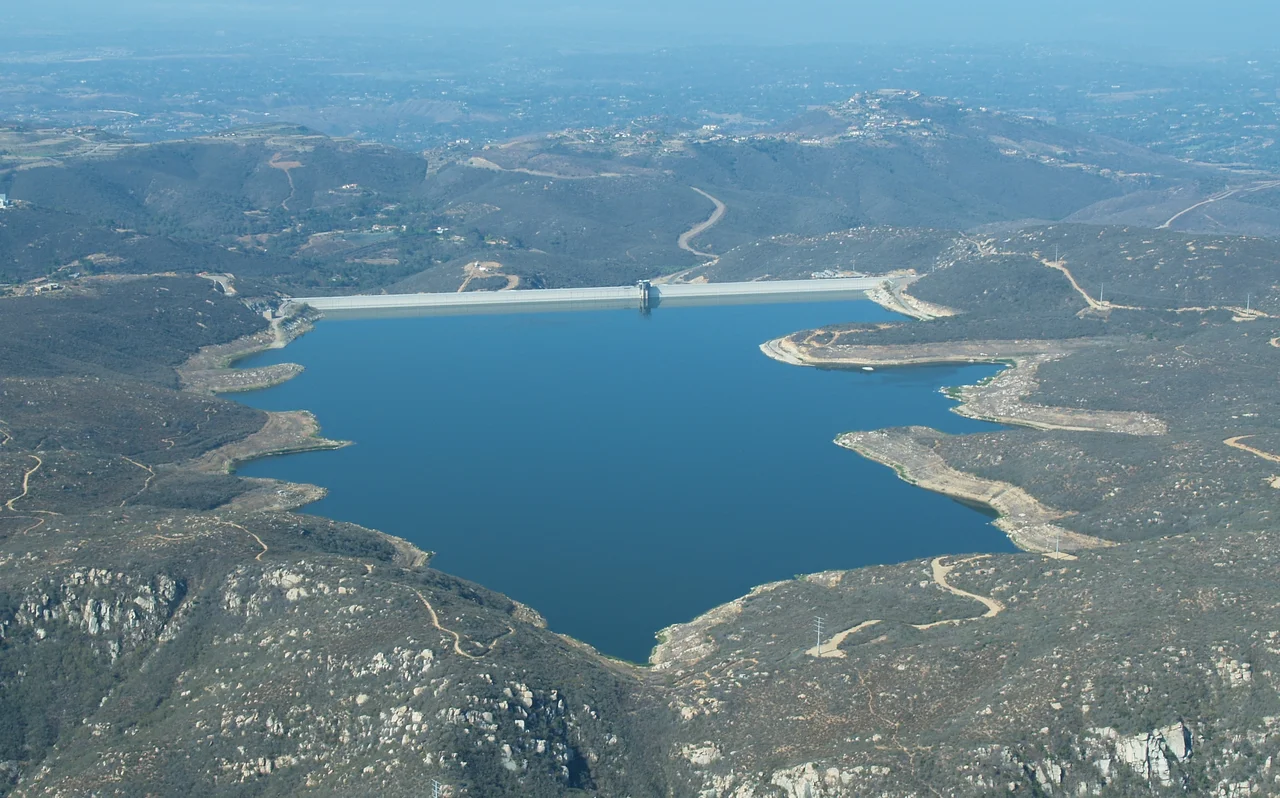

Olivenhain Dam
Most dams are built where a river is. Olivenhain Dam was built where a valley was. Completed in 2003 as part of San Diego's Emergency Storage Project, the dam sits near Escondido in a landscape without a natural river to hold — instead, water is pumped in from the Second San Diego Aqueduct and stored against the possibility that the region's primary water sources might fail. The reservoir can hold enough water to supply the region for several weeks during an emergency. The dam itself is the first of its kind in California, constructed using roller-compacted concrete, a technique that fills a dam's body with dry concrete mix compacted layer by layer with vibrating rollers rather than poured in conventional wet lifts.
Engineering a Reserve
San Diego County sits at the end of two long water supply lines — the Colorado River Aqueduct and the State Water Project — that deliver water from distant sources to a region that generates relatively little of its own. This dependence creates vulnerability. An earthquake, a pipeline failure, or an extended drought could interrupt supply. The Emergency Storage Project, approved and funded in the 1990s, was designed to build a reserve: a stored supply sufficient to bridge gaps in delivery.
Olivenhain Dam and its reservoir are connected to Lake Hodges and the Second San Diego Aqueduct, forming a linked system that can move water in multiple directions depending on need. The dam does not manage flood flows — no significant river runs through this valley — but it manages something arguably more important: the security of a region of nearly four million people dependent on infrastructure it did not build.
Roller-Compacted Concrete
The dam is a gravity dam — a type whose weight alone holds back the reservoir, without arches or external buttresses. What made Olivenhain unusual in California when it was completed is the material and method: roller-compacted concrete (RCC), a dry mixture placed by standard earthmoving equipment and compacted by vibratory rollers working in thin horizontal lifts.
RCC construction is faster and cheaper than conventional concrete dam construction because it eliminates the complex formwork and cooling systems required for conventional poured concrete. Concrete was placed in 12-foot lifts and 'topped off' on October 31, 2002. The Ladd Associates firm excavated the foundation, removing 700,000 cubic yards of material on an $8.4 million contract. Kiewit Pacific handled the main dam construction. Morrison Knudsen Corp received a $23 million contract to install the pipeline system. The entire structure, including inlet/outlet works and mechanical systems, was complete in August 2003.
The Elfin Forest
A 750-acre park was constructed around the dam and reservoir site as part of the project. The Olivenhain Municipal Water District — one of two agencies that own the dam, alongside the San Diego County Water Authority — operates the Elfin Forest Recreational Reserve around the reservoir.
The Elfin Forest is a chaparral landscape of low-growing coastal shrubs, oak woodland fragments, and creek corridors supporting a variety of native plant communities and wildlife. Hiking trails wind through terrain that most visitors to Carlsbad or Encinitas never encounter: the inland Southern California that exists behind the coastal strip, rough and dry and alive with the scrub vegetation that defines the Peninsular Ranges foothills. The dam made the park possible. The park made the dam's presence a gift rather than merely an infrastructure project.
A Quiet Achievement
Olivenhain Dam is not a famous landmark. It does not have the dramatic scale of Hoover Dam or the scenic setting of Shasta. Most residents of San Diego County could not say where it is. But infrastructure does not require recognition to matter. The dam was designed by JV Parsons Engineering Science Inc and Harza Engineering Co., and when it was completed it gave a water-scarce region a buffer against the failures that statistical probability says will eventually come — a pipeline break, a prolonged drought, an earthquake along one of the faults that cross the southern California landscape.
Completed in 2003, first in its category in California, and quietly filling with pumped water ever since, Olivenhain Dam represents an unglamorous category of achievement: the well-engineered reserve, the safety margin, the infrastructure that does its most important work by not being needed.
From the Air
Olivenhain Dam sits at 33.07°N, 117.14°W near Escondido in eastern San Diego County. The reservoir behind the dam is visible from altitude as a narrow lake in a chaparral valley. The Elfin Forest Recreational Reserve surrounds the site. McClellan-Palomar Airport (CLD) is approximately 13 miles to the northwest. Lake Hodges, to which Olivenhain is connected, is visible several miles to the east-northeast. Best viewed at 4,000-6,000 feet AGL.
Nearby Stories
- Where Hollywood Came Home to Make Theater 0.5 km away
- Viejas Band of Kumeyaay Indians 3.4 km away
- Santa Ysabel Asistencia 3.8 km away
- Cahuilla Band of Indians 14 km away
- Tenaja Fire 15 km away
- Laguna Art Museum 16 km away
- Balboa Island Ferry 54 km away
- USS Agerholm 165 km away