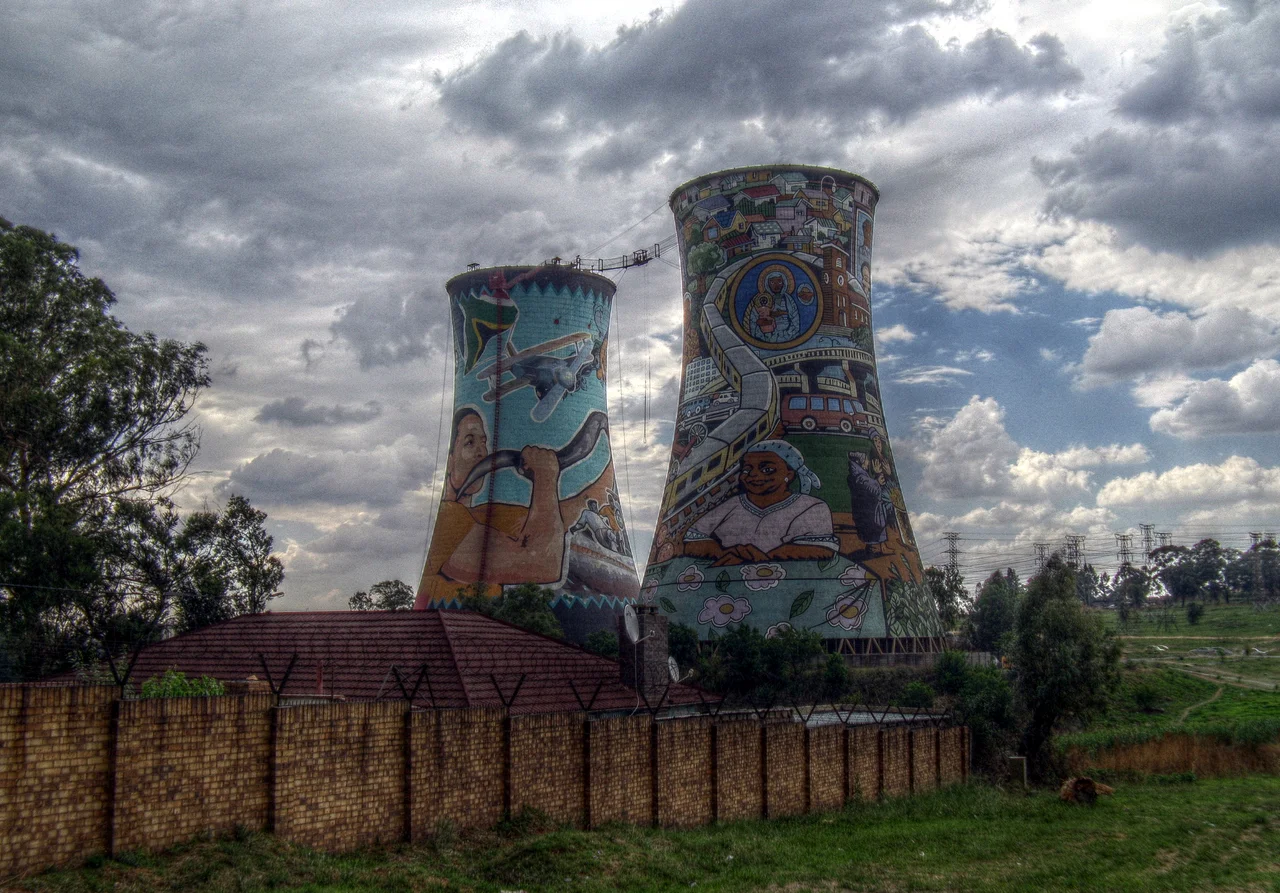

Orlando Power Station
For more than half a century, these two towers exhaled steam over Soweto and never gave the township a single watt in return. The Orlando Power Station burned coal to light Johannesburg's white suburbs while the Black neighbourhoods at its feet went without electricity for decades. The plant fell silent in 1998. What happened next is one of the great reversals in South African public space: the cooling towers that symbolised exclusion were repainted, climbed, and reclaimed, until they became the most recognisable landmark in the largest township in the country.
Built to Feed a Hungry City
Planning began in 1935, when Johannesburg's appetite for power outpaced the old generating station downtown. Engineers chose this spot in Orlando for two unglamorous reasons: it sat near a water source for coolant and near the rail lines that could haul in mountains of coal. Commissioned at the end of the Second World War, the plant ran for 56 years before decommissioning in 1998. The two concrete cooling towers came later, raised in 1951 once the original spray-pond system could no longer keep up. They were the practical heart of an industrial machine, and for years they were simply that, two grey funnels venting steam over a township that the same grid kept in darkness. The danger of the aging structure was made plain on 25 June 2014, when part of the abandoned plant collapsed during demolition work, killing one person and trapping five others in the rubble. By then the towers had already begun their second life, and the contrast between the derelict plant and the painted landmark beside it had become the whole point.
A Canvas the Size of a Building
Look up and the towers tell you where you are. One face carries a vast advertising billboard; the other holds what is recognised as the largest mural in South Africa. The painted side has been refreshed over the years, most strikingly by the Johannesburg illustrator Karabo Poppy, whose bold graphic style now wraps the curved concrete. The imagery is unmistakably local: scenes of township houses, vendors selling fresh produce, the Soweto String Quartet, the face of Nelson Mandela. There is something pointed about it. A structure built to serve everyone but the people around it now broadcasts their faces, their music, and their daily life across the Soweto skyline, visible for kilometres in every direction.
The Leap Between the Towers
Since 2009, the towers have done something no power plant was designed to do: they have become a launchpad. A platform suspended in the gap between the two structures sends bungee jumpers plunging 33 storeys toward the ground, while a power swing offers a 40-metre freefall before the cables catch. The reinvention drew cameras from around the world. The towers appeared on a season of The Amazing Race, served as a graffiti-soaked headquarters in the science-fiction film Chappie, and frustrated comedian Karl Pilkington on An Idiot Abroad, where he refused to jump while one of his own cameramen did. The adrenaline tourism brought money and footfall back to Orlando, turning a derelict relic into a reason to visit Soweto.
What the Towers Mean Now
Few landmarks carry their history so visibly on the outside. The Orlando Towers stand at the centre of a township that the apartheid state built as a labour dormitory and tried to keep powerless, and they have ended up as a stage for art, adventure, and civic pride. Visitors come for the jump and stay for the view, looking out over the matchbox houses and the wider sprawl of Soweto. The towers were never beautiful by design. They became beautiful by reclamation, which in this corner of Johannesburg is a more honest kind of beauty.
From the Air
Orlando Power Station sits at 26.254 degrees south, 27.925 degrees east, in the Orlando district of Soweto, southwest of central Johannesburg. The twin painted cooling towers, roughly 100 metres tall, are the dominant visual marker on the otherwise low Soweto skyline and are easily picked out from the air against the township's dense low-rise housing. Recommended viewing altitude is 1,500 to 3,000 feet AGL for a clear read of the murals. The nearest major airport is OR Tambo International (FAOR), about 35 km to the east; Lanseria International (FALA) lies roughly 35 km to the northwest, and Rand Airport (FAGM) sits about 20 km to the east in Germiston. Highveld afternoons bring strong summer thunderstorms (November to March); winter mornings can carry haze and smoke that soften the skyline.
Nearby Stories
- Kyalami Grand Prix Circuit 12 km away
- TauTona Mine 16 km away
- Boipatong Massacre 17 km away
- Battle of Bronkhorstspruit 33 km away
- Nan Hua Temple 57 km away
- Royal Bafokeng Nation 59 km away
- Secunda CTL 69 km away
- Vaal Reefs Mining Disaster 79 km away