
Pallot Steam, Motor & General Museum
Lyndon Charles Pallot - everyone called him Don - left school at fourteen, started remaking bicycles in the parish of Trinity on Jersey, and eventually became a trainee engineer with Jersey Railways, where he caught steam the way other people catch religion. He never let go. By the time he died in 1996 at the age of 85, he had spent decades quietly assembling the largest privately built collection of mechanical heritage in the Channel Islands - locomotives ferried in from Britain, Belgium, and Alderney; traction engines, motor cars, agricultural implements he had invented himself, and a Compton theatre organ that no normal collection would ever have made room for. The museum he founded in 1990 still runs the way he wanted it to. His surviving children are the trustees.
An Engineer During the Occupation
In the early 1930s, Pallot opened Central Motor Works at Sion in Trinity, an agricultural engineering shop. He invented and built tools that Jersey farmers needed - the Pallot elevator digger, the last-furrow reversible plough, the single-furrow reversible plough, the tractor-mounted Côtil winch designed for Jersey's steep côtil hillsides, the tractor-mounted two-point linkage transport box. These are not glamorous inventions. They are the practical kit of an island that grows potatoes on slopes most countries would consider too steep to bother with. Then in 1940 the Germans arrived. Jersey was occupied for nearly five years. Spare parts evaporated. Fuel was rationed almost out of existence. An engineer's gift for improvisation became a survival skill - patching, adapting, jury-rigging machines to keep doing what they had been built to do with whatever could still be found. The exhibits at the museum that date from that period carry the visible fingerprints of constraint.
Opening Day, 1990
The L C Pallot Trust was set up in 1985 to permanently preserve the collection - steam engines, farm machinery, vehicles, the lot. The Pallot Steam Museum opened in 1990. Items had been bought outright or acquired on long-term loan; railway locomotives had been imported from Britain, Belgium, and from the Alderney Railway across the water. Don and his family did most of the restoration work themselves, with volunteers - some exhibits restored only cosmetically to look correct, others returned to full working order. The site expanded quickly. A larger modern exhibition hall, leased from a property company also owned by the Pallot family, was added on the same plot. It now holds the main collection - musical instruments, motor cars, road vehicles, steam locomotives, a church pipe organ and that Compton theatre organ wedged in among the engines. The new hall opened officially on Liberation Day 2002, with Michael Wilcock - owner of the former Jersey Motor Museum - cutting the ribbon.
Two Railways and a Reconstructed Station
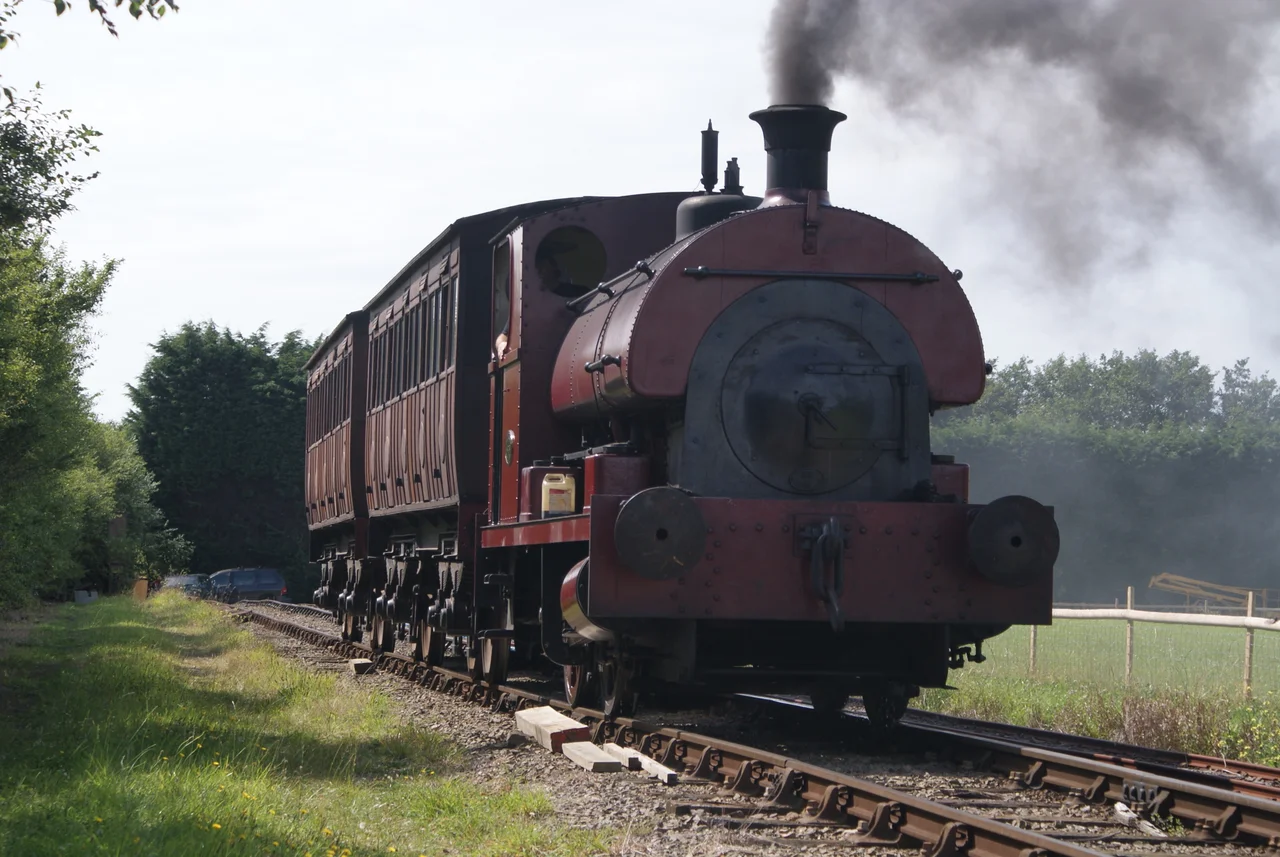
Around the perimeter of the museum site, a standard-gauge demonstration railway used to circle the buildings. The Victorian-style station was reconstructed using salvaged elements of Snow Hill railway station from Saint Helier - opened on Liberation Day 1996 by Senator Dick Shenton. A lean-to shed was later built over the running line to house the service train. Passengers travelled in two restored Victorian carriages originally built for the North London Railway in England; they had been found at Stratford in London in 1989, brought to Jersey, fitted with wheels recovered from the Woodham Brothers scrapyard at Barry Docks in Wales. The museum owns five standard-gauge locomotives. Two - 'La Meuse,' a Belgian-built 0-6-0T from 1931, and 'Foleshill,' a Peckett 0-4-0ST from Bristol in 1948 - are too big for the tight curves and live as static exhibits. Two others, 'Kestrel' (Peckett, 1952) and 'J T Daly' (W.G. Bagnall, Stafford, 1931), have operated the line. 'J T Daly' came to Pallot in 1993 after stints on the Foxfield Light Railway and the Alderney Railway. A separate narrow-gauge loop runs behind the main hall, worked by an 0-4-0 steam-outline Simplex locomotive. Both railways are currently out of service, awaiting overhauls.
Dolly May
Don Pallot lived at Sion with his wife Dolly. They had eleven children - six sons, five daughters. The Ransomes, Sims & Jefferies traction engine in the main hall, still operational, is named 'Dolly May' in her honour. It runs at Steam Fayres in May and Autumn, the museum's two major fundraising events, which have between them sent more than £40,000 to local charities. The museum operates on a thin margin. The only income is admission charges, souvenir sales, donations, and Steam Fayre profits. Two full-time staff handle most of the work; the trustees - Don's surviving children - handle administration voluntarily to keep running costs down. There is no public subsidy. What survives is what one farmer's son with a knack for engines decided was worth saving, kept going by the family who shared his particular fascination with steam, gears, and the working logic of older machines.
From the Air
The Pallot Steam Museum sits on Rue de Bechet in the Parish of Trinity on Jersey, at approximately 49.225°N, 2.107°W - inland from the north coast of the island. From the air the museum is visible as a cluster of long sheds with the demonstration railway looping around the perimeter, behind a green field and the parish church. Nearby airports: Jersey (EGJJ) 4 nm south-southwest, Guernsey (EGJB) 25 nm north-northwest, Alderney (EGJA) 40 nm north. Best viewing altitude 1,000-1,500 ft on a clear day.
Nearby Stories
- Operation Ambassador 14 km away
- 1993 Cherbourg Incident 22 km away
- German Submarine U-672 53 km away
- Mont Saint-Michel: The Abbey That Becomes an Island Twice a Day 55 km away
- D-Day: The Longest Day 83 km away
- Carisbrooke Castle 124 km away
- 1955 Le Mans Disaster 170 km away
- 1941 Santander Fire 629 km away