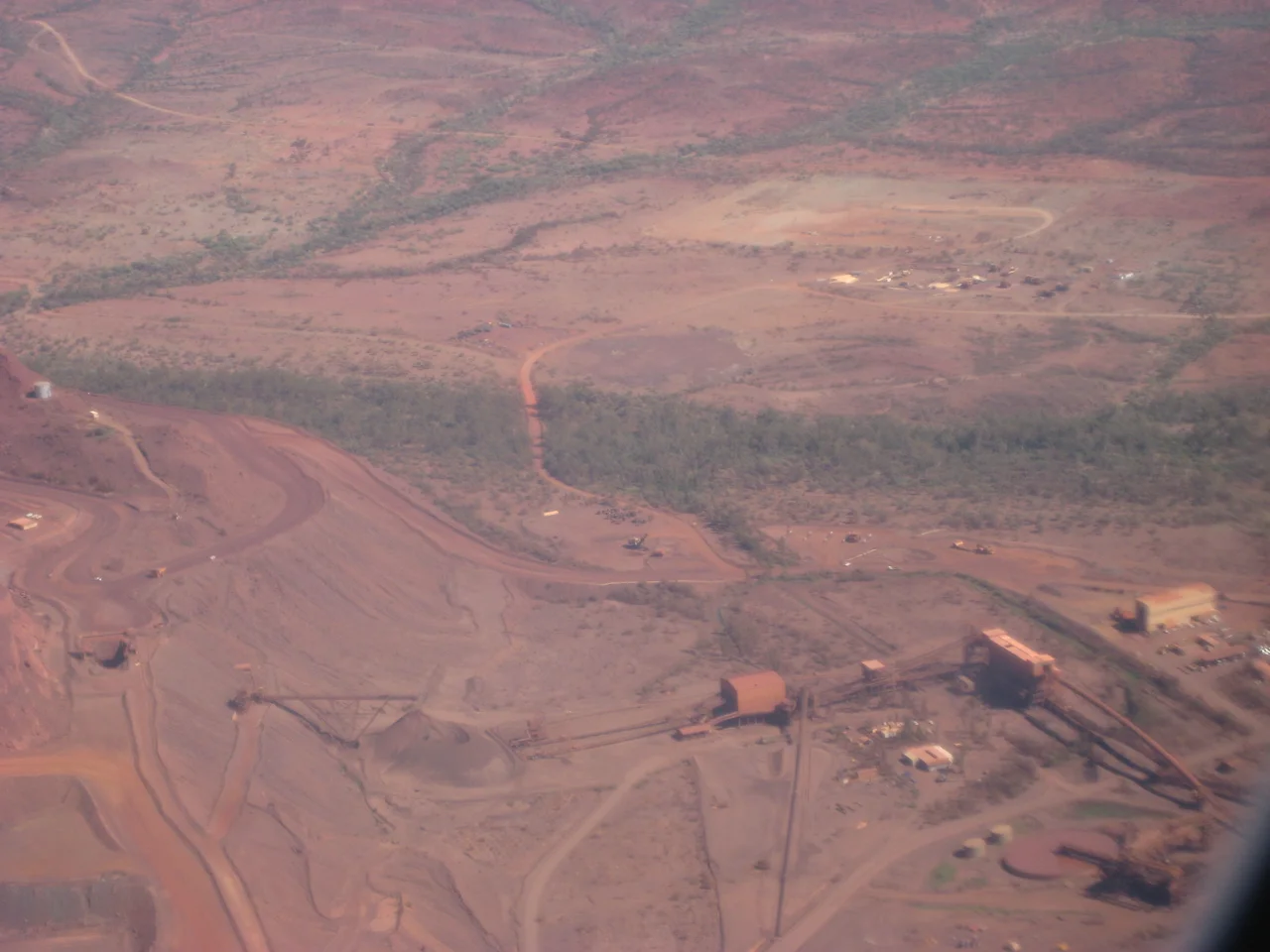

Paraburdoo Mine
The name is a gift from the people who lived here first. Paraburdoo comes from a local Aboriginal word for 'feathered meat' - a reference to the corellas and flock pigeons that wheel over this corner of the Pilbara in noisy white clouds. It is a soft, almost gentle name for a place defined by something hard: iron. Beneath the red dust and spinifex lies one of the richest concentrations of ore on the planet, and the open pit that carries the birds' name has spent half a century being carved, blasted, and hauled away one trainload at a time.
Eighty Percent of a Nation's Iron
The Hamersley Range is not just an iron province; it is the iron province. The ranges holding the Paraburdoo mine contain roughly 80 percent of all identified iron ore reserves in Australia, making this one of the great mineral storehouses of the world. The numbers from the mines around it are almost too large to picture. In a single year, 2009, Rio Tinto's combined Pilbara operations produced 202 million tonnes of ore - close to 13 percent of everything the entire planet dug out of the ground that year. Paraburdoo is one of a dozen such mines the company runs across the region, each one a piece of a machine that turns ancient banded rock into the steel of distant cities.
A Town Built to Dig
Paraburdoo exists because the ore does. When Hamersley Iron - a subsidiary of Rio Tinto - opened the mine in 1972, it gazetted a town the same year to house the people who would work it. Unlike the fly-in camps that dot much of the modern Pilbara, Paraburdoo's workforce actually lives in the place that shares the mine's name, raising families in a community planted in the desert for a single industrial purpose. Together with the nearby Eastern Range and Channar pits, Paraburdoo can turn out 20 million tonnes of ore a year. The mine had a predecessor and a parent in Mount Tom Price to the north, the very first Pilbara operation, and it became part of a network of pits all feeding the same hungry line to the coast.
The Long Iron Road
Mining the ore is only half the story. Getting it to a ship is the other. Crushed and screened on site into lump and fines - the lumps capped at 31.5 millimetres, the fines at 6.3 - the ore is loaded onto trains and sent down the Hamersley and Robe River railway toward the port of Dampier on the coast. Paraburdoo's output joins ore from Brockman, Mount Tom Price, Channar, Marandoo, and Yandicoogina, all of it blended and rescreened before it pours into the holds of bulk carriers bound for the steel mills of Asia. The railway is one of the busiest heavy-haul lines on Earth, a steel artery threading hundreds of kilometres of empty country, carrying the Pilbara's red wealth to the sea in a procession that almost never stops.
The Cost of the Boom
It is tempting to read the Pilbara purely as a triumph of engineering and scale, and on one level it is. But the same iron that built the boom has carried a heavier cost, paid mostly by the Aboriginal peoples whose country this is. Less than a hundred kilometres north of Paraburdoo lies Juukan Gorge, where in 2020 Rio Tinto legally blasted rock shelters holding 46,000 years of continuous human occupation. The destruction triggered global outrage and forced a reckoning across the entire industry. Paraburdoo itself is one quiet pit among many, but it sits inside that larger and harder truth: this landscape is at once one of the world's great mines and one of the oldest continuously inhabited places on Earth, and the two have not always been allowed to coexist.
From the Air
The Paraburdoo mine lies at about 23.23 degrees south, 117.61 degrees east, in the southern Hamersley Range of the Pilbara, beside the town of Paraburdoo. From the air it is a sprawl of terraced open pits, waste dumps, processing plant, and rail loadout, cut into red ranges striped with the dark bands of iron-bearing rock. Paraburdoo's own airport (YPBO) sits right at the town, one of the busiest regional strips in the state thanks to the mining workforce; Newman (YNWN) lies to the east. The Hamersley and Robe River railway runs north from here toward Dampier on the coast. Expect heat haze and red dust in summer; the dry winter air gives the clearest views of the pit terraces and the long ore trains snaking across the plain.
Nearby Stories
- Mount Tom Price Mine 36 km away
- Mount Augustus Station 85 km away
- Wittenoom, Western Australia 90 km away
- Hope Downs Mine 109 km away
- Mount Augustus (Burringurrah) 115 km away
- Mount Augustus National Park 118 km away
- Collier Range National Park 166 km away
- Karratha 256 km away