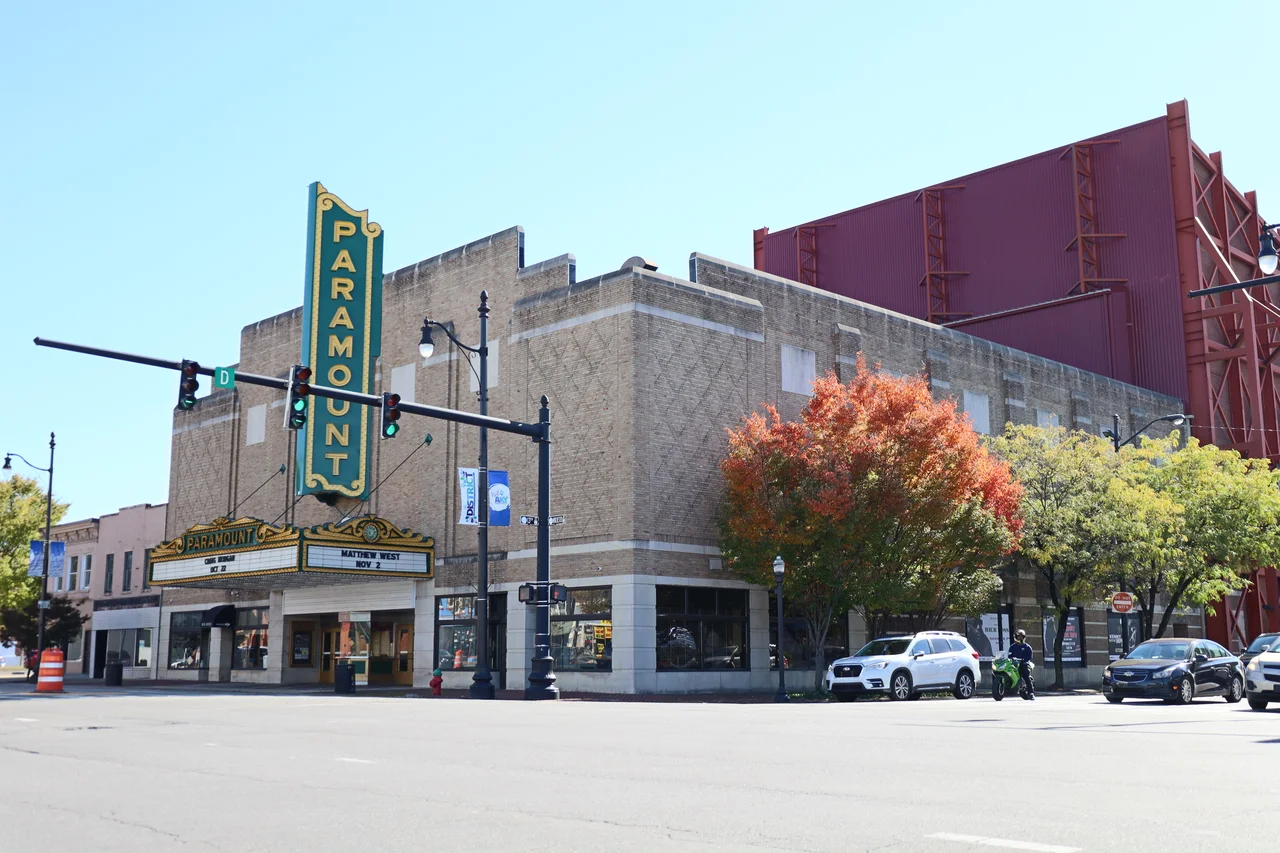

Paramount Arts Center
Paramount Pictures had ambitions for Ashland, Kentucky. The studio planned the Paramount Theater here in 1931 as a model showcase for its talking pictures, hiring the legendary Chicago firm Rapp and Rapp - architects of New York's Paramount Building and dozens of the country's grandest movie palaces - to design it. The Great Depression had other plans. Paramount pulled out before the building was finished. An Ashland-based company took over, completed a scaled-back version with Paramount craftsmen still doing the interior fittings, and leased the result back to the Paramount Publix Corporation for operation. The theater opened on September 5, 1931. Ninety-five years later it is still going, with a Broadway calendar, a hometown community theater troupe, and a ghost whose poster cannot be removed from the box office without consequences.
Built for Talking Pictures
The Paramount opened at the precise hinge point of cinema history, when silent films were being replaced by sound. The building was one of the first transitional theaters built specifically for talking pictures, with the acoustics and the projection equipment designed around the new technology rather than retrofitted in. The Rapp and Rapp design, even in its scaled-back final form, gave Ashland a movie palace that punched well above its city size - elaborate plaster ornament, deep balcony, careful sightlines from every seat. The Great Depression's interruption of Paramount's original plans saved the building in an odd way. A scaled-back Rapp and Rapp design still produced a theater with enough grandeur to feel like a destination, while the budget compromises kept the operation sustainable through the lean decades that followed.
Forty Years and a Foundation
The theater closed in 1971 after forty years of continuous operation, a long run by any measure but particularly impressive given how many American movie palaces had already fallen to demolition or conversion by the early 1970s. Ashland could have lost it. Instead, the Greater Ashland Foundation organized in 1972, drawing on the Blazer family's Ashland Oil fortune to purchase and reopen the building as the Paramount Arts Center. Paul G. Blazer Jr., son of the company founder, led the effort. Half the corpus of the terminating Stuart M. Blazer Family Foundation was gifted to enable the purchase. The new operation reopened the same year as a nonprofit performing arts center, programming symphonies, plays, ballets, and Broadway tours. The model has held ever since.
Achy Breaky Heart
In 1992, Billy Ray Cyrus filmed the music video for Achy Breaky Heart inside the Paramount. The song became one of the defining country hits of the early 1990s, the soundtrack to the line-dancing boom, and the launch pad for Cyrus's career. The Paramount handled the film shoot as it had handled countless concerts and performances - efficient hospitality, no special fuss. When Cyrus was told about the theater's ghost, a construction worker named Joe who had died there in the 1940s, he autographed posters for every female employee on staff, including one personally inscribed to Paramount Joe. That poster still hangs in what is now the Marquee Room. Decades later, the city of Ashland remembers the shoot less for the celebrity than for the genuine kindness with which it was conducted.
Paramount Joe
Joe was a construction worker employed by the Boyd Theater Company of Cincinnati who, by local account, died inside the auditorium in the early 1940s. The story has him hanging from the curtain rigging when his three coworkers returned from lunch. The death was real. The haunting that has accumulated around it is theater folklore, and like all the best theater folklore, it includes specific tests. When the staff once took down Cyrus's poster signed to Paramount Joe to make room for newer celebrity photos, the next morning's box office was strewn with shattered frames - every other autographed photo on the floor, glass everywhere. The poster went back up. In 2004, marketing director Tyson Compton paused mid-tour to ask Joe directly whether it was all right to tell his story, and reported a chair squeak in answer. The next day, a local psychic called Compton with a message: Joe says he is here.
Beauty Pageant, Steamer, Sprinklers
In November 2006, a beauty pageant contestant at the Paramount used a steamer to remove wrinkles from her dress. She hung the dress from what she took to be a hanging hook. It was a fire sprinkler head. Heat from the steam triggered the sprinkler system, which began pouring water from the second floor through the building. Damage came to roughly $30,000. The story made CNN. The Paramount, which had survived the Depression, the death of movie palaces, and forty years of continuous operation, was nearly water-damaged into closure by a contestant trying to look her best on stage. The theater absorbed the cost, repaired the damage, and added the incident to its lengthy list of survival stories.
From the Air
Located at 38.480 degrees north, 82.643 degrees west, in downtown Ashland, Kentucky. Recommended viewing altitude 3,500 to 5,500 feet AGL for views of the Commercial Historic District and surrounding downtown. Nearest airport is Ashland Regional (KDWU); Tri-State (KHTS) at Huntington is about 12 nautical miles northwest. The theater anchors the cultural side of downtown Ashland, with the Highlands Museum and other historic buildings in the same block.
Nearby Stories
- Yatesville Lake 8.4 km away
- Hardin Village Site 13 km away
- Morris Memorial Hospital for Crippled Children 14 km away
- Lake Tight 15 km away
- Hobet Coal Mine 26 km away
- The Kentucky Meat Shower: When Flesh Fell From a Clear Sky 38 km away
- Serpent Mound: The 1,400-Foot Snake Nobody Can Explain 40 km away
- Battle of Blue Licks 59 km away