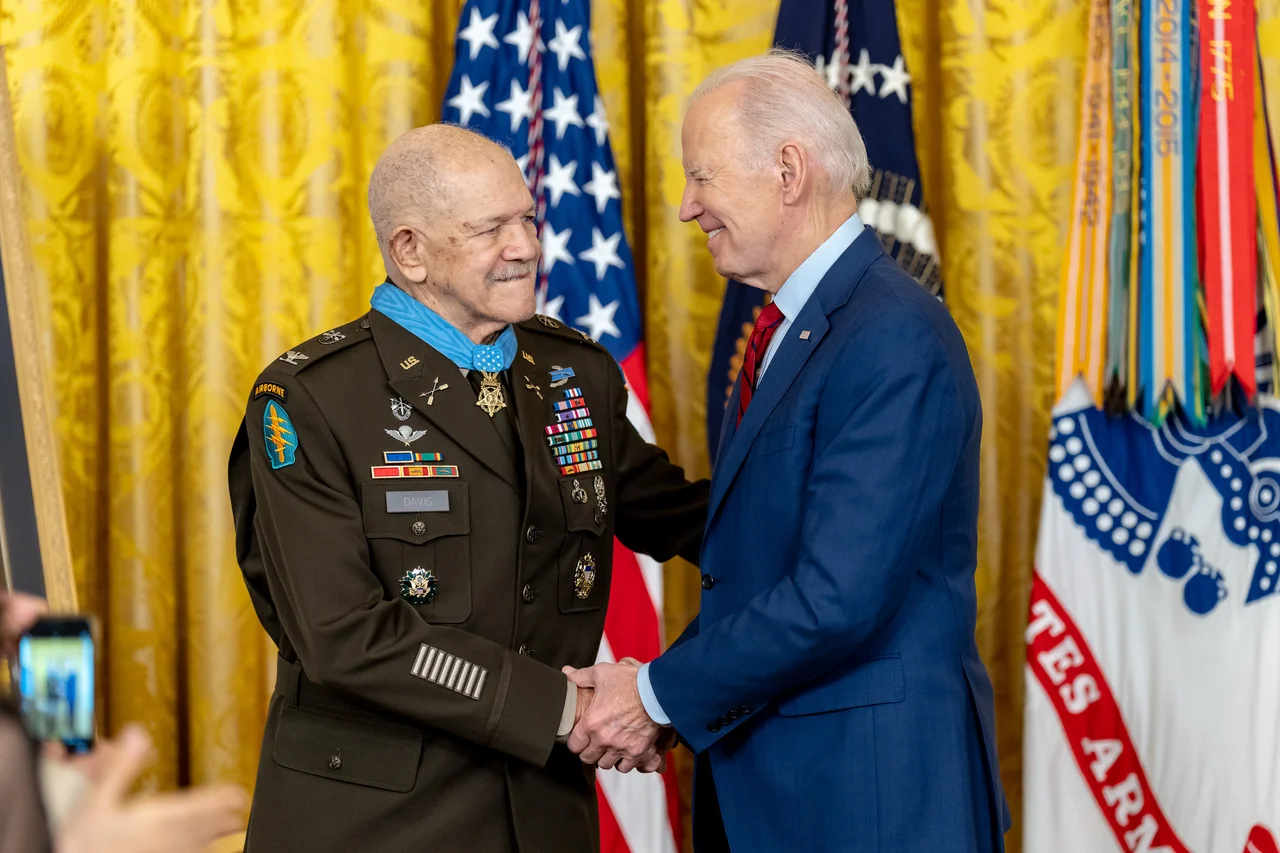
.jpg)
Paris Davis
The paperwork disappeared twice. The first nomination for the Medal of Honor went in after June 1965, when Captain Paris Davis had spent nearly twenty hours under fire near Bồng Sơn in Bình Định Province, going back again and again into enemy fire to bring out his wounded soldiers. The paperwork was lost. A second nomination followed years later. That disappeared too. For 58 years, Davis carried a Silver Star — the citation that acknowledged what he had done without fully honoring it. He did not speak bitterly about the delay. He simply waited, and lived his life, and in March 2023 stood in the White House to receive, at age 83, what had been owed to him since before some of the people in that room were born.
The Man Who Arrived at Camp Bồng Sơn
Paris Davis was born on May 13, 1939, and grew up to study political science at Southern University in Baton Rouge, Louisiana, on an ROTC scholarship. He was commissioned as a Reserve Component officer in 1959, earned his Airborne and Ranger qualifications in 1960, and qualified for Special Forces in 1962. Those three qualifications — parachutist, Ranger, Green Beret — represented a particular kind of soldier: someone who had chosen, repeatedly, to go toward danger rather than away from it. In April 1965, he arrived for his second tour in Vietnam and took command of Special Forces Team A-321 at Camp Bồng Sơn in Bình Định Province. The camp sat in a coastal province that would be contested for the next decade, a place where the People's Army of Vietnam and Viet Cong forces had deep roots among the population. Davis was a Black officer commanding a Special Forces A-Team, training South Vietnamese fighters in a war that America was only beginning to understand the shape of.
June 18, 1965
The engagement began during a raid on a Viet Cong position near Bồng Sơn, returning through the coastal lowlands when the ambush came. Davis's team was badly exposed. One by one, four American soldiers went down: his team sergeant shot in the foot and leg, a weapons specialist wounded by shrapnel and stuck in a cesspit, a reinforcement Green Beret shot in the chest who weighed around 240 pounds, and his medic — shot in the head, a man who had just learned he was a new father. Davis went back for each of them. He was shot in the arm during the first rescue. Shot in the leg while carrying his team sergeant uphill. He took grenade fragments. He called in artillery support. He refused medical evacuation for himself. The engagement lasted nearly twenty hours, and when it ended every one of his wounded soldiers had been brought out alive. Davis was the last American to leave the battlefield.
The Lost Paperwork and the Long Wait
After June 1965, the nomination for the Medal of Honor was prepared. It disappeared. A second nomination was submitted years later. It also disappeared. Davis received the Silver Star — significant, but not the nation's highest honor. He served a third Vietnam tour in 1969. He later commanded the 10th Special Forces Group. He retired from the Army in 1985 as a full colonel after 26 years of service. Then he ran the Metro Herald newspaper in Virginia for thirty years. He was inducted into the U.S. Army Ranger Hall of Fame in 2019. Through all of it, the Medal of Honor sat uncollected, its paperwork lost in whatever bureaucratic void swallowed it twice. In January 2021, Acting Secretary of Defense Christopher C. Miller ordered an expedited review. In June 2021, Miller published an op-ed saying the military bureaucracy was stalling again and urging President Biden to act. The nomination was finally approved by the Chairman of the Joint Chiefs in November 2022.
The White House, 2023
On March 3, 2023, President Joe Biden presented the Medal of Honor to Paris Davis in a ceremony at the White House — 58 years after the action it recognized, and after two previous nominations that both vanished into files that were never found. The third nomination had required the direct involvement of two Secretaries of Defense, the Chairman of the Joint Chiefs of Staff, and the President of the United States to complete. Davis, then 83, accepted it with the composure of someone who had long since made his peace with the wait, though the men he had carried out of that rice paddy and that cesspit and that hillside near Bồng Sơn did not need the ceremony to know what he had done. In June 2025, Davis published his autobiography, Every Weapon I Had: A Vietnam Vet's Long Road to the Medal of Honor, with St. Martin's Press. The title is a statement of fact about what he used to keep his soldiers alive on June 18, 1965. It is also something else — a description of what it takes to wait 58 years for a country to finish what it started.
From the Air
The action for which Paris Davis received the Medal of Honor took place near Camp Bồng Sơn in Bình Định Province, at approximately 14.42°N, 109.00°E. The camp and the lowland terrain of the Bồng Sơn plain are visible from the air at 3,000–5,000 feet — flat rice paddies and coastal lowland near Highway 1, bounded to the west by the Annamese foothills. Landing Zone English, the major U.S. forward operating base in this area, was located in the same district. The nearest airport is Phù Cát Airport (VVPC), approximately 30 km to the south. This same stretch of Bình Định Province saw multiple major Vietnam War operations — Operation Masher, the Battle of Tam Quan, and Operation Washington Green — across a decade of fighting.
Nearby Stories
- Phù Cát Air Base 34 km away
- Kon Ka Kinh National Park 34 km away
- Battle of Mang Yang Pass 49 km away
- Batangan Peninsula 55 km away
- Battle of Hill 488 74 km away
- Battle of the Paracel Islands 284 km away
- Hainan Island Incident 389 km away
- Kashmir Princess 437 km away