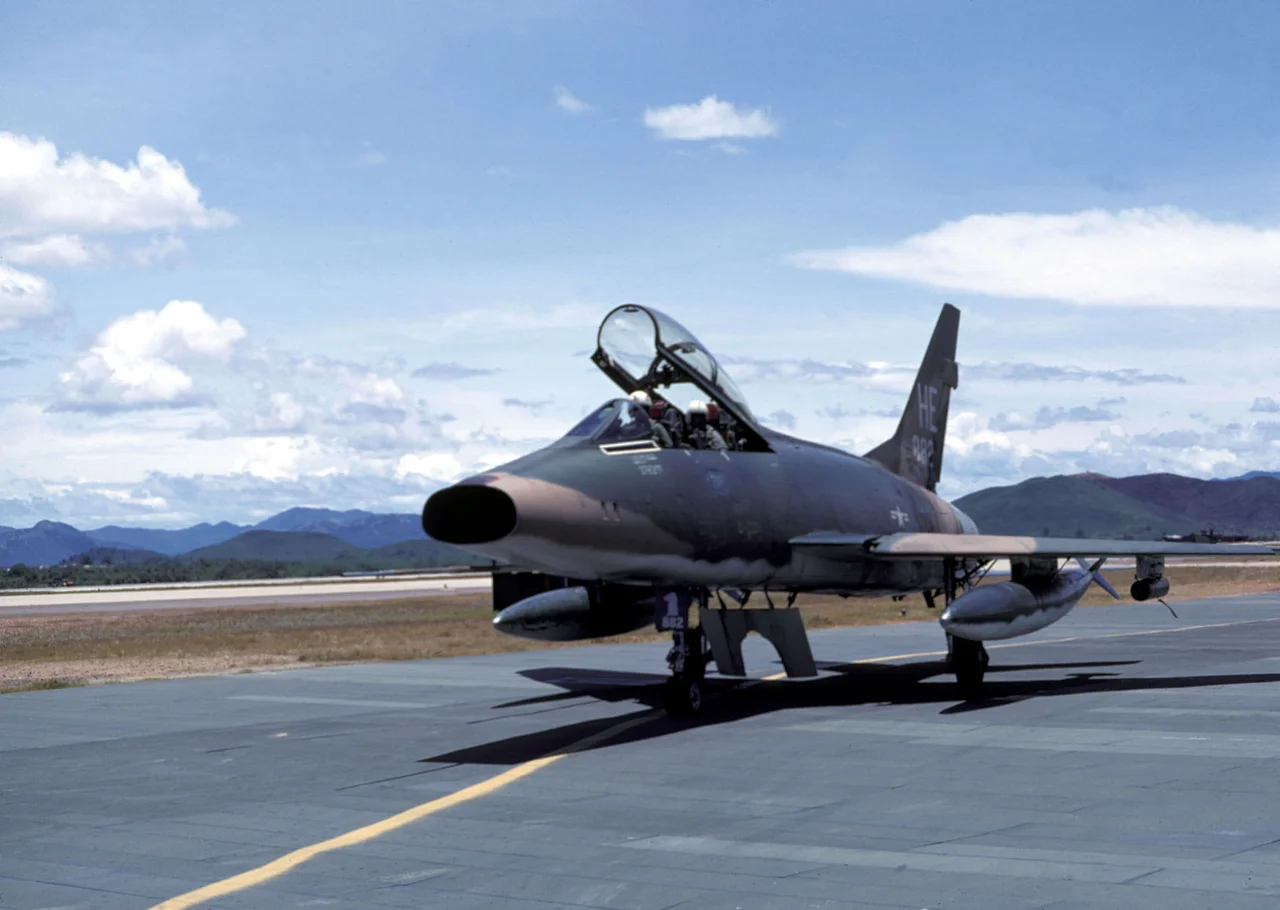

Phù Cát Air Base
The call sign was Misty, and the pilots who flew under it were doing something the Air Force had never tried before: fast forward air control at combat speed, using two-seat F-100F Super Sabres to locate targets ahead of strike aircraft rather than slower, more vulnerable propeller-driven spotters. The technique was born at Phù Cát Air Base, a base that didn't exist in 1965 and was built in a matter of months on a flat agricultural plain 24 kilometers north of Qui Nhơn. From that unlikely origin — rice paddies converted to runway, farmers' land to fighter wing — the base became one of the more tactically innovative installations of the Vietnam War.
Built in a Year
In late 1965, the U.S. Air Force was running out of room. The existing bases in South Vietnam were overcrowded as American airpower surged, and a proposed base at Qui Nhơn itself was abandoned when engineers found the site conditions unsuitable. In January 1966, planners settled on Phù Cát District, a rural area 24 kilometers north of the city. By February, Military Assistance Command Vietnam had authorized a full jet-capable base. Construction moved fast. By April 1967, the 37th Tactical Fighter Wing had begun operations, flying F-100 Super Sabres. A fuel pipeline was laid from a tank facility on the outskirts of Qui Nhơn. In less than eighteen months, an airstrip capable of supporting supersonic combat aircraft had been carved from the Vietnamese lowlands.
The Misty FACs
Forward air control — directing strike aircraft onto targets — was traditionally done from slow, propeller-driven aircraft that could loiter over the battlefield. The problem was those aircraft were easy to shoot down. At Phù Cát, a detachment from the 416th Tactical Fighter Squadron tried something different: flying two-seat F-100F Super Sabres at combat speed under the code name Commando Sabre, call sign Misty. The Misty FACs operated at high speed and relatively low altitude, locating targets and directing faster jets onto them before antiaircraft guns could track them effectively. The program, pioneered at Phù Cát, produced some of the most experienced and decorated tactical aviators of the war — and suffered correspondingly high casualty rates.
Nine Years of Operations
Through the late 1960s and into the 1970s, the base cycled through multiple wings and squadrons. The 37th Tactical Fighter Wing gave way to the 480th Tactical Fighter Squadron flying F-4D Phantoms, transferred from Da Nang in 1969. A detachment of the 38th Air Rescue Squadron — later redesignated the 3d Aerospace Rescue and Recovery Group — maintained search and rescue capability from the base until late 1971. The Republic of Vietnam Air Force operated the 412th Transport Squadron from the base after 1970, flying C-7A Caribou transports. Through all of this, the base remained a working military airfield, home to hundreds of American and South Vietnamese personnel, their families and support staff living in the sprawling installation north of the city.
The Last Night
By mid-March 1975, the military situation in South Vietnam was collapsing. The ARVN 40th Regiment defending Qui Nhơn and Phù Cát was redeployed elsewhere to shore up another collapsing front, leaving only regional militia forces at the base. On the morning of March 30, those forces abandoned their positions. By afternoon, Viet Cong fighters were attacking the perimeter — held off only by base security troops. The base commander called for help. A South Vietnamese wing commander, Colonel Le Van Thao, organized a night strike: forty A-37 Dragonflies flying against their own base perimeter to break up the attack. It worked, for one more night. The next morning, the 2nd Air Division evacuated, taking 32 aircraft and leaving 50 behind. By the afternoon of March 31, 1975, the base belonged to the North.
Phù Cát Today
Phù Cát Airport operates today as a civilian airfield serving Quy Nhơn and Bình Định Province, under the Vietnam Air Defence - Air Force. Passenger services connect the city to Hanoi and Ho Chi Minh City. The original American base operations building, visible in wartime photographs, is gone; the runways remain. Bình Định Province has grown substantially since 1975, and what were once military flight lines are now departure gates for domestic travelers. The flat plain where the Misty FACs took off remains flat; the rice paddies that surrounded the base are still there, worked by farmers whose parents' generation watched fighter jets take off into the monsoon sky.
From the Air
Phù Cát Airport (IATA: UIH, ICAO: VVPC) sits at 13.9550°N, 109.0422°E on a flat coastal plain in Bình Định Province, approximately 25 km north of Qui Nhơn. The single runway runs roughly northeast-southwest. Approaching from the south at 3,000–5,000 feet, the airport is clearly visible against the agricultural plain, with the green hills of the interior to the west and the coast about 15 km to the east. Da Nang (VVDN) is approximately 200 km to the north; Nha Trang/Cam Ranh (VVCR) lies roughly 200 km to the south.
Nearby Stories
- Paris Davis 26 km away
- Sông Cầu 29 km away
- Kon Ka Kinh National Park 31 km away
- Battle of Mang Yang Pass 41 km away
- 22nd Division (South Vietnam) 78 km away
- Battle of the Paracel Islands 327 km away
- Kashmir Princess 406 km away
- South China Sea 421 km away