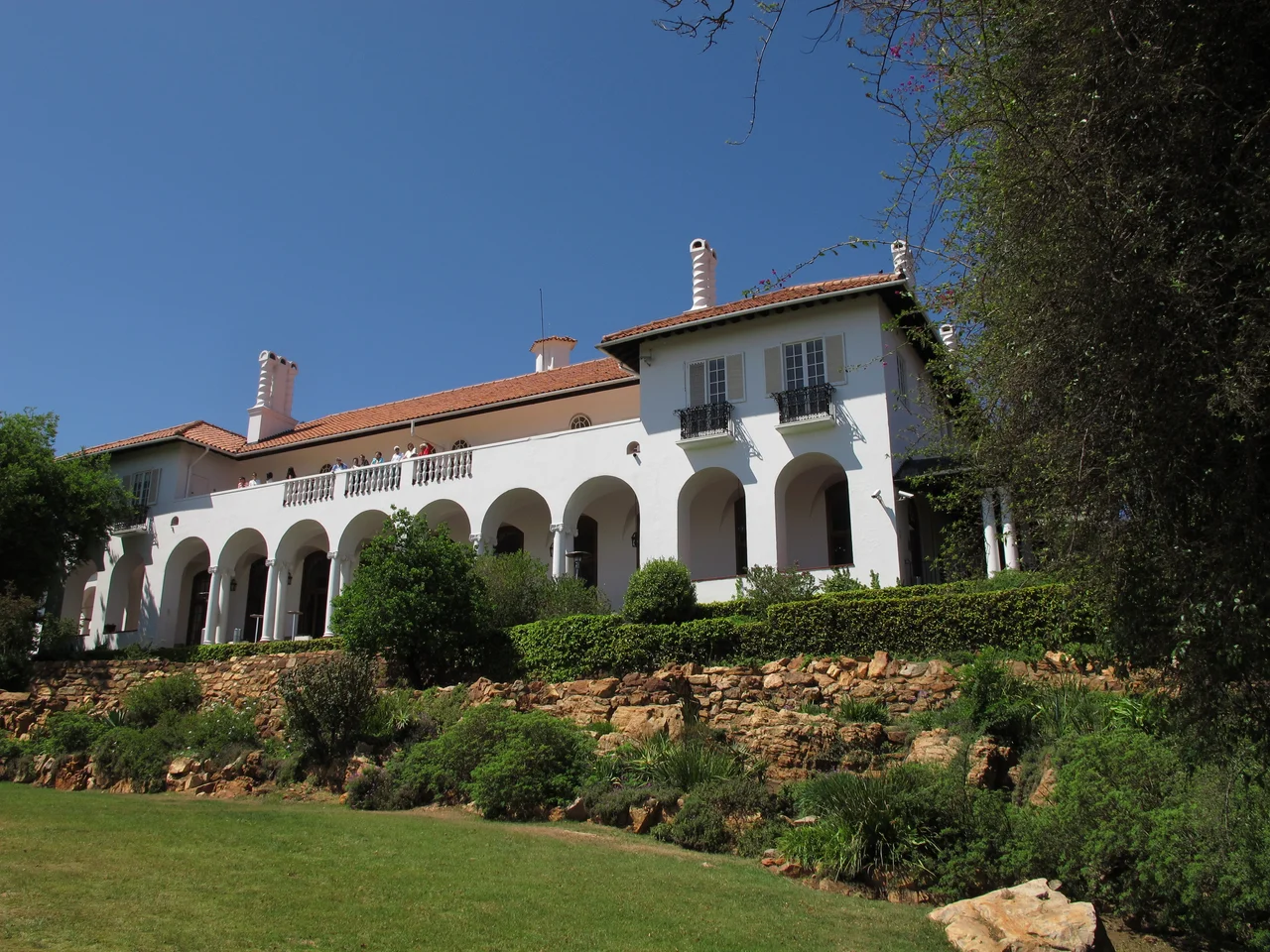

Parktown Mansions
Rudyard Kipling kept coming back to the house called Hohenheim. He was a guest there in the early 1900s, and over those long Highveld evenings he needled his host, a transplanted Englishman named Percy Fitzpatrick, to write down the hunting stories he told so well. Fitzpatrick eventually did. The result was Jock of the Bushveld, one of South Africa's best-loved books, about a brave little dog on the wagon roads to the goldfields. The mansion where that nudge happened was demolished in 1972. But it was the first of dozens of grand homes that the men who got rich on Johannesburg gold raised on the ridge of Parktown, and enough of them survive that you can still read the wealth of an entire era in stone and slate.
Houses the Gold Built
Johannesburg barely existed before 1886, when prospectors struck the Witwatersrand reef and the largest gold deposit on Earth began to draw fortune-hunters from across the world. The men who controlled the mines became known as the Randlords, and they were almost obscenely rich. They wanted to live above the dust and noise of the diggings, so they climbed the cool, breezy ridge north of town and built. Hermann Eckstein named the first great house Hohenheim, after his birthplace in Germany. Frank Emley designed it; it was finished in 1894. Sir Lionel and Lady Florence Phillips lived there next, until Lionel was banished from the Boer republic for his part in the failed Jameson Raid of 1895. Into the empty house moved Percy Fitzpatrick, and with him, his houseguest Kipling.
Baker's Stone Vision
The architect who gave Parktown its character was Sir Herbert Baker, who arrived in 1902 and would later design South Africa's Union Buildings in Pretoria. Baker loved local stone, much of it quarried from the very properties the houses stood on, and he built for the climate and the view rather than for English fashion. His mansions sit low on the ridge, their long verandas and arched colonnades aimed at the horizon. Villa Arcadia, finished in 1909 with Florence Phillips overseeing every detail, stretches behind eleven arches that look out past the modern motorway toward the suburbs and the city zoo. Baker worked with partners Masey, Sloper and Fleming, and other firms followed his lead, lining the ridge with the most ambitious domestic architecture the young country had seen.
What the Wreckers Spared
The twentieth century was hard on Parktown. The growing city wanted the ridge for a teaching hospital, a university campus, parks and a six-lane motorway, and one fine house after another came down. Hohenheim fell in 1972 to make way for the hospital now named for Charlotte Maxeke. A round blue plaque marks the bare spot where it stood. The Johannesburg Heritage Foundation now guards what remains, and what remains is remarkable. Some homes still belong to the families that built them more than a century ago. One, Dolobran, designed in 1905 with a fairytale turret and a weathercock, is lived in by the great-great-grandchildren of the man who commissioned it.
Lives Behind the Walls
These houses are not just architecture; they are biographies in brick. Brenthurst became the Johannesburg home of the Oppenheimer mining family in 1922 and still is, its famous gardens opened to the public only a few days a year. Other mansions slipped quietly into new lives: one became a steakhouse, another a children's convalescent home, a third the headquarters of the Order of St John, which during the Second World War ran a Westcliff estate as a recovery ward for amputee soldiers. The grandest of them all, a Killarney residence built by the film pioneer who later raised Johannesburg's first shopping mall, is now an apartment block. The Randlords are long gone. The dew still settles on their lawns each morning, exactly as it did.
From the Air
Parktown sits on a ridge immediately north of central Johannesburg at roughly 26.18°S, 28.02°E, around 1,750 m above sea level. From the air the wooded ridgeline stands out as a dark green band between the dense city center and the leafy northern suburbs, with the M1 motorway slicing past below. The nearest major airport is O.R. Tambo International (FAOR), about 25 km east; Rand Airport (FAGM) lies to the southeast and the smaller Grand Central Airport (FAGC) to the north near Midrand. Highveld light is sharp and clear through the dry winter months (May to August); afternoon thunderstorms build quickly in the summer rainy season. A recommended viewing altitude of 1,500 to 2,500 ft above ground gives the best sense of how the green ridge separates old Johannesburg from new.
Nearby Stories
- Pelindaba 4.6 km away
- TauTona Mine 6.3 km away
- Zonderwater POW camp 18 km away
- Kweneng' Ruins 25 km away
- Battle of Bronkhorstspruit 40 km away
- Royal Bafokeng Nation 41 km away
- Secunda CTL 72 km away
- Sun City 91 km away