.jpg)
Penguin Islands
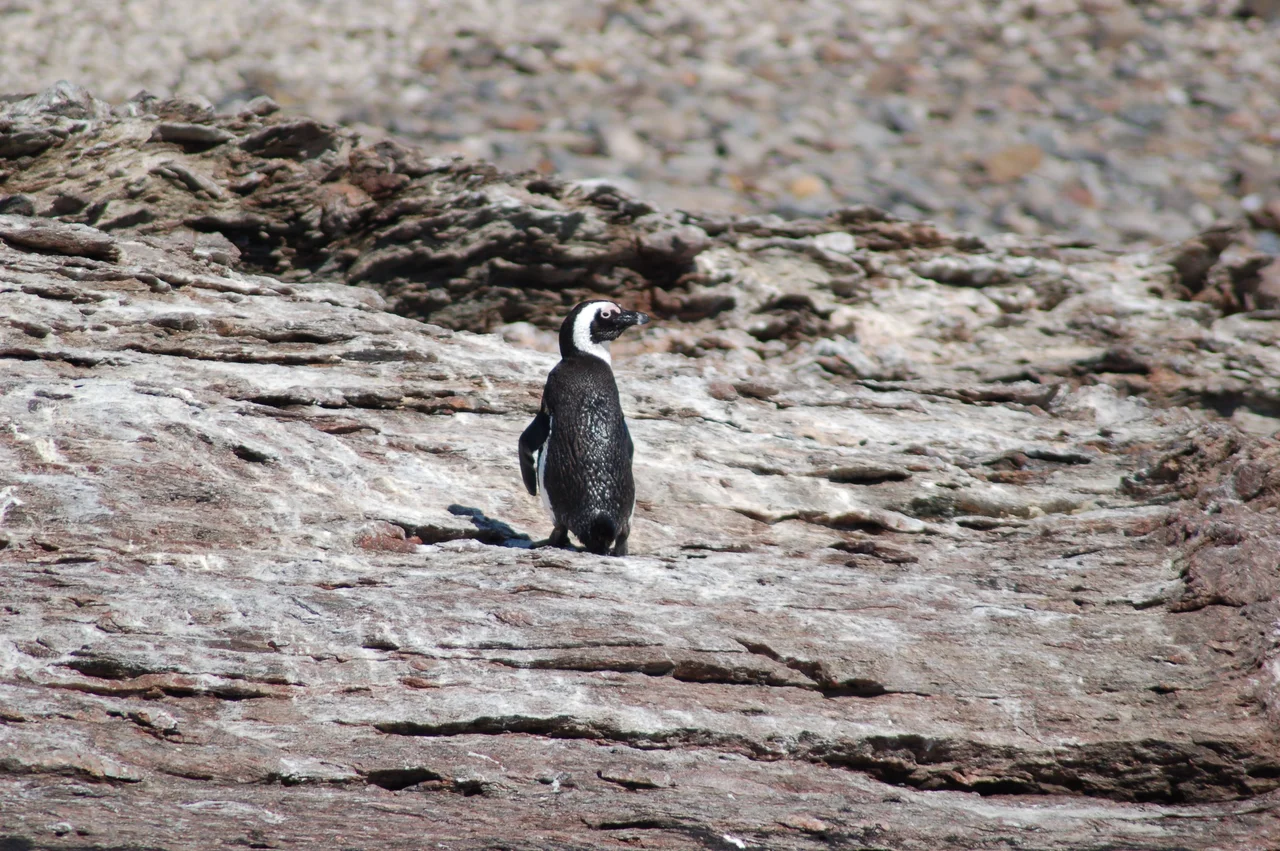
They are barely there at all, twenty-odd specks of rock strung along 355 kilometres of Namibian coast, the whole lot together adding up to less land than a small farm. Yet these flyspecks once mattered enormously, and men once died for them. The Penguin Islands take their name from the African penguins that still waddle ashore here, but their real treasure was something far less charming: guano, the accumulated droppings of countless seabirds, which the nineteenth century prized as the finest fertiliser on Earth. For a few mad years, this desolate coast was one of the most fought-over places in the world.
White Gold
On the rainless islands of the Benguela coast, generations of cormorants, gannets, and penguins had layered the rock with their droppings until the deposits lay metres deep, dried hard and rich with nitrogen. To the farmers of Europe, exhausted soil was a crisis, and guano was the cure, so potent it could double a harvest. Word of the Namibian deposits reached London and the rush was on. The peak came at Ichaboe Island in 1844 and 1845: by some counts 450 ships lay anchored off a single barren rock at once, and roughly six thousand men swarmed its surface, scraping and bagging the foul-smelling fortune by hand under a brutal sun. In just a few seasons they stripped hundreds of thousands of tons from Ichaboe alone.
The Great Guano War
Where there is sudden fortune and no law, there is violence. The men who did the scraping were merchant sailors and labourers crammed onto airless rock with no authority over them, and competition for the richest patches turned murderous. Crews fought crews; men were killed over the right to harvest a strip of droppings. The chaos grew so severe that Britain dispatched two warships to impose order on what became known, with grim accuracy, as the "Great Guano War." It is a strange and human story, men brawling and dying on a stinking rock at the edge of the world, and worth remembering that the labourers who endured those conditions were treated as expendable, their hardship a footnote to other men's profits. Within a couple of years the ancient deposits were gone, scraped down to bare stone, and the ships sailed away.
Pawns of Empire
Even emptied of guano, the islands held strategic value, and so the powers of Europe haggled over them. Britain annexed them between 1861 and 1867, then handed them to the Cape Colony in 1873; the transfer was so legally tangled that Cape Prime Minister John Molteno had to pass a special act in 1874 just to confirm it. The plan was to fold all of South West Africa into the Cape. But British infighting stalled the scheme long enough for Germany to claim the mainland as a protectorate in 1884, in the great European carve-up known as the Scramble for Africa. The islands, oddly, stayed British, leaving them as Cape outposts pressed right up against German colonial territory but never part of it.
Drawing the Last Line
That accident of history outlived the empires that made it. When South West Africa won independence as Namibia in 1990, these scattered rocks remained under the control of South Africa, along with the port of Walvis Bay, a final colonial thread that gave South Africa an economic foothold off another nation's coast. It took four more years of negotiation to undo. At the stroke of midnight on 28 February 1994, the islands and Walvis Bay passed at last to Namibia, completing the country's map. Today the penguins have the rocks largely to themselves again, alongside dense colonies of Cape cormorants and other seabirds. Ichaboe alone shelters tens of thousands of birds, the living descendants of the flocks whose droppings once launched a war.
From the Air
The Penguin Islands are not a single landmass but a chain of small islands and rocks scattered along roughly 355 km of Namibian coast, anchored near Lüderitz Bay around 26.6°S, 15.3°E. Possession Island is the largest at 0.90 square kilometres; Hollam's Bird Island is the northernmost and lies 10.3 km offshore. From the air they appear as tiny dark dots in the cold green Atlantic, often ringed by surf and seabird activity, with the desert coast of the Namib as a stark backdrop. The Benguela current generates frequent coastal fog, so plan coastal passes for clear-weather windows. Nearest airfield is Lüderitz Airport (FYLZ); larger inland options include Keetmanshoop (FYKT). Recommended viewing altitude 2,000 to 5,000 ft AGL along the coastline. The islands are protected as a marine reserve, so treat them as a sensitive wildlife area.
Nearby Stories
- Ichaboe Island 37 km away
- Aus, Namibia 45 km away
- Bogenfels 64 km away
- Roter Kamm Crater 108 km away
- Duwisib Castle 143 km away
- Eduard Bohlen 266 km away
- Sandwich Harbour 364 km away
- Cospatrick 1153 km away