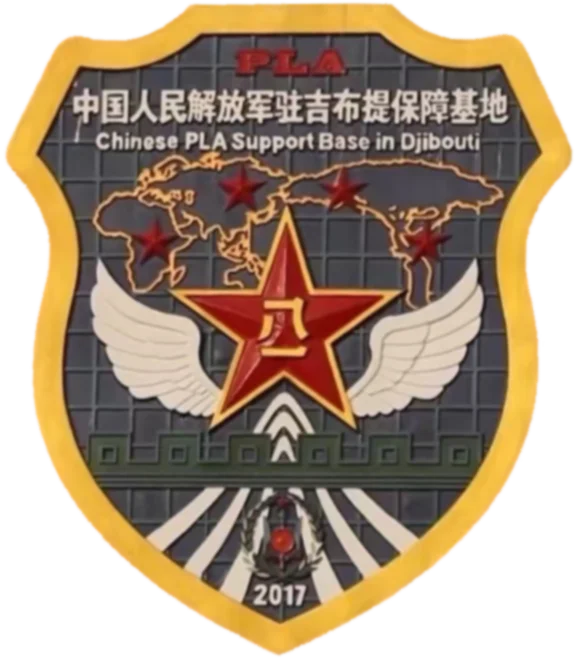

People's Liberation Army Support Base in Djibouti
Djibouti is roughly the size of Slovenia. Its population is under a million. It hosts more foreign military bases per capita than anywhere else on earth - American, French, Japanese, Italian, and, since August 1, 2017, Chinese. The People's Liberation Army Support Base sits on the western edge of Djibouti City near the Chinese-operated Port of Doraleh, 0.5 square kilometers of fortification with an underground space of 23,000 square meters and a pier long enough to berth an aircraft carrier. It is the first overseas base China has ever built, and its neighbors - Camp Lemonnier, Base Aerienne 188, the Japanese self-defense facility - are arrayed to the south of the city like a grid of strategic interests pressed against the Horn of Africa.
Why Djibouti
The base exists because of water - specifically because of the Bab-el-Mandeb, the strait where the Red Sea narrows to 30 kilometers between Africa and Yemen before emptying into the Gulf of Aden. Everything that sails between Europe and Asia by way of the Suez Canal passes here. Djibouti President Ismail Omar Guelleh began negotiating with China around 2015. Consensus was reached in January 2016. Construction began that March. On July 11, 2017, ships from the PLA Navy's South Sea Fleet left Zhanjiang to formally open the facility. The first live-fire exercises followed in September. From the Djiboutian perspective, rent from foreign bases is one of the country's most reliable sources of revenue. From China's perspective, the base serves its 2015 National Security Law clause protecting strategic energy supply channels - the oil that flows through the Bab-el-Mandeb from the Persian Gulf on its way to Chinese factories.
The Pier
In May 2018, construction began on a pier that would ultimately stretch over 330 meters - 1,120 feet. Satellite photos from December 2019 showed it finished. The length is not arbitrary. It can accommodate the PLA Navy's two new aircraft carriers, or at least four nuclear-powered submarines, or any combination of surface combatants China wants to base here. Satellite analysts later observed what appeared to be construction on a second pier. The underground complex is 23,000 square meters, protected by fortifications. Between 1,000 and 2,000 personnel are assigned. What the base officially does - anti-piracy patrols, logistics support, peacekeeping, humanitarian response - is visible. What else it does is the subject of satellite images, think-tank reports, and intelligence assessments. A 2024 report from the Center for Strategic and International Studies identified Djibouti, along with three sites in Cuba, as the locations most likely supporting Chinese intelligence collection against the United States.
Tensions on a Small Coast
In 2017, Japan's Maritime Self-Defence Force allegedly sent divers to approach a Chinese warship at the Djibouti base. The divers were detected and driven off - an episode reported by Chinese state media and denied by Japan. In 2018, the US Department of Defense issued a NOTAM reporting laser attacks against American pilots flying near the Chinese base, with two airmen injured. China denied responsibility. China, in turn, complained about low-flying American aircraft conducting surveillance. All of this happened within a few kilometers of territory belonging to a country with no disputes of its own in the matter, whose President has said simply that no one else offers Djibouti the kind of long-term partnership China does.
Small Country, Large Bet
Chinese investment in Djibouti totaled $853 million between 2005 and 2019. By one estimate, debt to China accounts for roughly 30 percent of Djibouti's foreign debt. The standard-gauge railway China built between 2011 and 2016 replaced the colonial-era French line and terminates at the Port of Doraleh, right beside the naval base. The Addis Ababa to Djibouti railway restored landlocked Ethiopia's rail access to the sea for the first time in years. For Djiboutians, this arrangement is transactional - it produces jobs, infrastructure, and revenue in a country with few natural resources and a challenging climate. Thierry Pairault of the French National Centre for Scientific Research has argued that Chinese investment has limited but positive impact for ordinary Djiboutians, even if the effort is mainly directed outward - toward Chinese strategic interests that reach from the Horn of Africa to the Malacca Strait.
Approach
From altitude the base appears as a dark rectangle on the coast west of Djibouti City, adjacent to the container cranes of the Doraleh port. The runways of Djibouti-Ambouli International - which Camp Lemonnier shares with commercial traffic - lie to the south. The city itself is a tan sprawl against the blue of the Gulf of Tadjoura. Look east and you can see the Bab-el-Mandeb narrowing toward Perim. Look west and the Danakil lowlands stretch toward the Ethiopian highlands. Everything that passes here is watched, by everyone.
From the Air
Located at 11.59°N, 43.06°E on the western approach to Djibouti City. Djibouti-Ambouli International Airport (HDAM/JIB) is the primary aviation facility, shared with Camp Lemonnier. Restricted airspace and military activity surround the area; coordinate carefully with Djibouti ATC. Recommended viewing altitude FL250-350 for strategic overview of the Bab-el-Mandeb corridor. The Port of Doraleh container terminal sits adjacent to the base. Expect haze and high temperatures year-round; visibility often best at dawn.
Nearby Stories
- French Submarine Vengeur 11 km away
- Djibouti 12 km away
- Lake Assal (Djibouti) 20 km away
- Lake Abbe 83 km away
- Berbera 179 km away
- Aden 191 km away
- British Attack on Berbera (1827) 196 km away
- Somaliland 218 km away