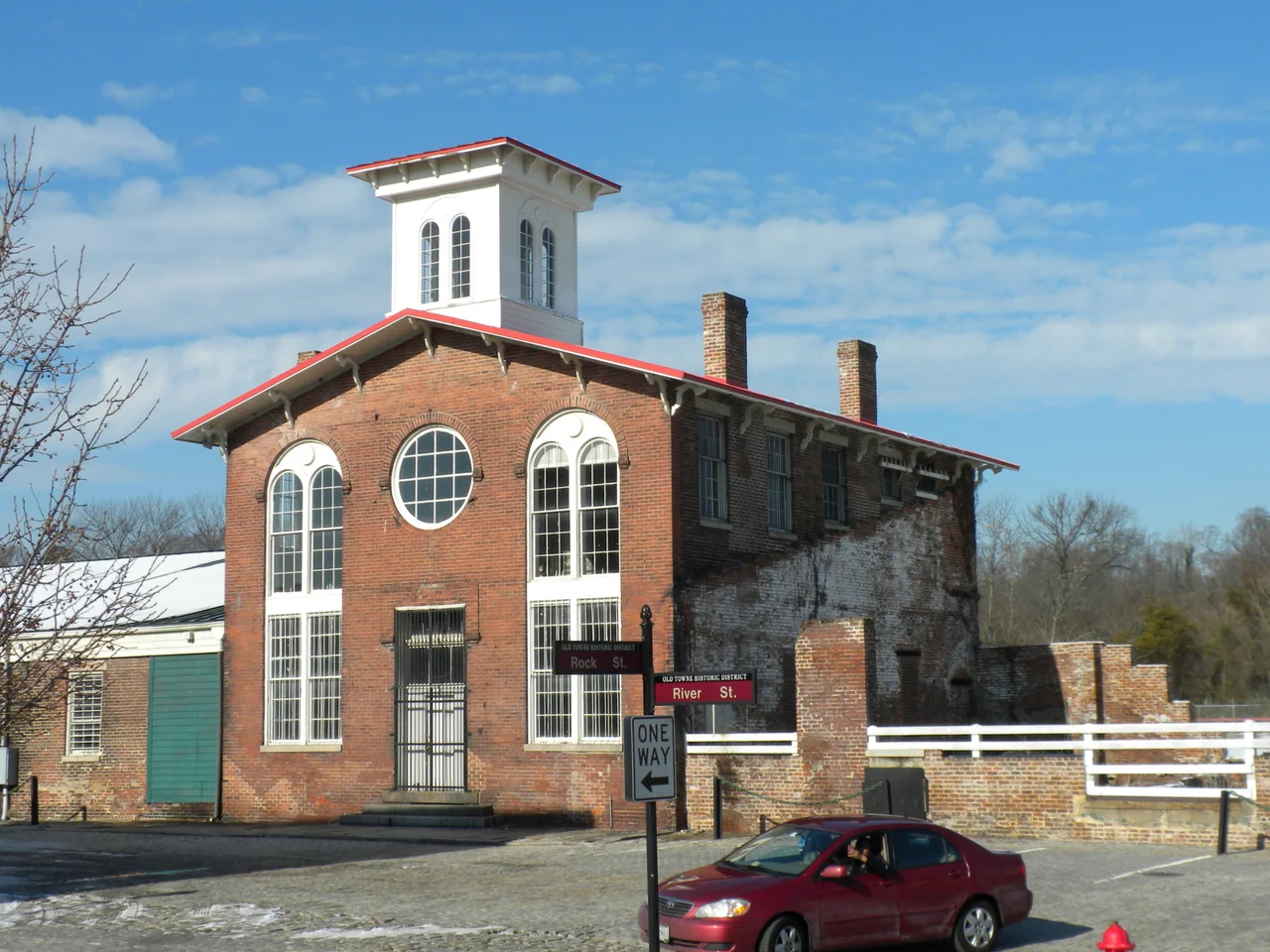

Petersburg, Virginia
Pocahontas Island is not really an island. It is a peninsula on the north shore of the Appomattox River, just above the falls, and people have lived on it for more than eight thousand years. Archaeologists have pulled stone tools from its soil dating to 6,500 BCE. By 1607 it sat in the territory of the Appamatuck, a Powhatan-allied people governed by King Coquonosum and his sister Queen Oppussoquionuske. By the 1800s it had become something rarer: one of the oldest free Black neighborhoods in America, a stop on the Underground Railroad, and a community that would help blueprint the civil rights movement a century later. The city around it grew from a single trading post into the second largest in antebellum Virginia, then nearly burned to the ground in nine months of trench warfare, and has been quietly remaking itself ever since.
Fall Line City
Geography wrote the first chapter. The Appomattox River drops here from the Piedmont's hard bedrock to the sandy coastal plain, and the falls stopped river traffic, demanded portage, and offered free waterpower to anyone who could build a mill. In 1645 Virginia ordered Fort Henry built at the falls, and traders followed. Around 1675, Peter Jones opened a trading post called Peter's Point. In 1733 William Byrd II conceived a city there at the same time he was platting Richmond upstream, and Petersburg was chartered in 1748. By 1860 it was Virginia's second-largest city, the world's second-largest tobacco market behind Richmond alone, with five iron foundries and waterpowered cotton mills lining the river. Four railroads converged on it. That convergence was both its prewar fortune and its wartime curse.
Free Before Freedom
Of the 18,366 people the federal census counted in Petersburg in 1860, 3,244 were free Black Americans. That was nearly twenty-six percent of all free residents, the highest proportion of any city in the South. They had built lives in the cracks of a brutal system. First Baptist Church, organized in 1774, and Gillfield Baptist Church, organized in 1797, are among the oldest Black Baptist congregations in the United States. Free Black men worked as tobacco twisters, foundrymen, boatmen, cabdrivers, masons, blacksmiths. Free Black women stemmed tobacco, took in washing, sewed. Pocahontas Island, on the north bank, became their neighborhood. Refugees from slavery passed through on the Underground Railroad. In April 1861, more than three hundred free Black Petersburg men volunteered to work on the Norfolk fortifications, under their own leader, even as the war that began that month would, eventually, make their freedom universal.
Nine Months in the Trenches
When Grant turned south from Cold Harbor in June 1864 and crossed the James, he was aiming at Petersburg because Petersburg fed Richmond. Cut the railroads here and the Confederate capital starved. On June 9, Baldy Smith's XVIII Corps attacked the Dimmock Line, the ring of earthworks around the city. The 292-day Siege of Petersburg had begun. Lee arrived with the Army of Northern Virginia, both armies dug in, and the war became something new: industrial trench warfare, the prefiguration of the Western Front fifty years later. On July 30, Union miners tunneled under Confederate Elliott's Salient and detonated 8,000 pounds of black powder. The crater they created became a killing pit when the assault collapsed in confusion, and Confederate counterattacks under William Mahone left nearly 3,800 Union casualties in a few hours. The siege ground on through fall, winter, and into a final spring.
April Second
On April 2, 1865, the lines finally broke. Grant's bombardment opened at dawn; the Sixth Corps drove through the Confederate works southwest of town. The Confederate Alamo at Fort Gregg held just long enough to let Lee organize a retreat. By midnight on April 2-3, Lee's army was crossing the Appomattox and heading west, and Jefferson Davis was fleeing Richmond. The Confederate war effectively ended that night. Seven days later Lee surrendered at Appomattox Court House. Petersburg rebuilt its railroads by 1866 but never quite recovered its commercial position. Norfolk took the shipping. Richmond took the banking. Petersburg kept its tobacco mills, its churches, and its memory.
Civil Rights Blueprint
The same churches that had organized free Black life before the war organized the resistance to Jim Crow after it. Dr. Wyatt Tee Walker, pastor of Gillfield Baptist, had met Martin Luther King Jr. at an interseminary gathering in the early 1950s and the two became close allies. In 1957 the two of them, with others, co-founded the Southern Christian Leadership Conference. Walker organized the Petersburg Improvement Association, modeled on Montgomery's. Sit-ins at the bus terminal in 1960 desegregated lunch counters in Petersburg and several other cities. In 1958 the city council had closed Wilcox Lake rather than integrate it; the lake never reopened to swimming. In 1968, after King's assassination, Petersburg became the first American city to designate his birthday a holiday, fifteen years before Congress made it a federal observance. Walker and other associates of King later wrote that what they had built in Petersburg became, in his words, a blueprint.
What Old Towne Holds
The compact historic core has been slowly coming back since the 1990s, when the tobacco company Brown & Williamson shut its cigarette plant here in the mid-1980s and took several thousand jobs with it. Restaurants, bars, coffee shops have taken over restored eighteenth- and nineteenth-century storefronts in Old Towne. Battersea, a Palladian house built in 1767-68 on thirty-seven acres above the river, is preserved on the western edge. Virginia State University, founded in 1882 as one of the first state-supported four-year HBCUs in the country, sits in nearby Ettrick. Pocahontas Island is a National Register historic district. The 1993 tornado that flattened Walmart in Colonial Heights also raked through Petersburg's downtown, damaging restored buildings the city had just finished saving. The city kept rebuilding.
From the Air
Petersburg sits at the fall line of the Appomattox River at 37.21 N, 77.40 W, 21 miles south of Richmond at the junction of I-95 and I-85. From 5,000 feet you can pick out the river falls, the preserved earthworks of Petersburg National Battlefield to the east and south, the Old Towne grid, and Fort Gregg-Adams east of the city. Nearest field is Dinwiddie County Airport (KPTB), 8 miles southwest. Richmond International (KRIC) is 22 miles north.
Nearby Stories
- Francisco's Fight 4.2 km away
- Southside (Richmond, Virginia) 6.5 km away
- Surry County, Virginia 11 km away
- Nat Turner's Rebellion 36 km away
- Suffolk, Virginia 39 km away
- Fork Union Military Academy 40 km away
- Long Grass Plantation 48 km away
- Battle of Gwynn's Island 63 km away