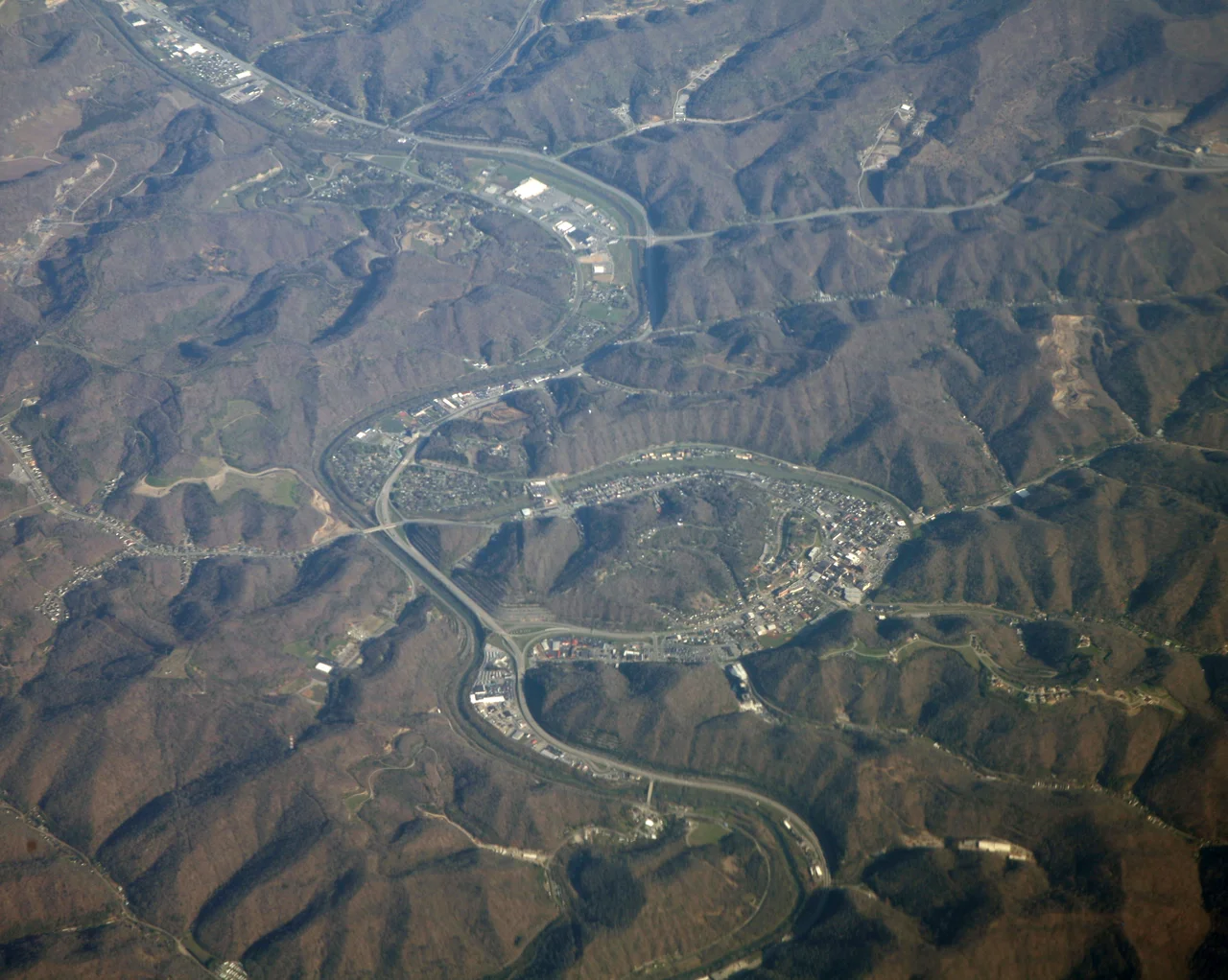

Pikeville, Kentucky
Between 1973 and 1987, the people of Pikeville moved nearly eighteen million cubic yards of rock. They did not move it for ore, or for highway, or because anyone in Washington had told them to. They moved it because their town was drowning every spring and choking on freight train traffic the rest of the year, and the only solution anyone could think of was to cut a new path for the Levisa Fork River straight through Peach Orchard Mountain. The Pikeville Cut-Through, when it was finished, was the second-largest earthmoving project ever undertaken in the Western Hemisphere - second only to the Panama Canal. The county seat of Pike County, Kentucky, had quite literally moved a mountain to save itself.
Hatfield-McCoy Country
Pikeville sits in the heart of the country where Randolph McCoy raised his family and where, through the 1880s, his clan and the Hatfields across the Tug Fork in West Virginia fought the most famous family feud in American history. Both families had fought for the Confederacy during the war that had just ended. Both lived along a river boundary in country so steep and forested that the law could not reach in. What started over a hog and a love affair turned into a decade of killings that drew in newspaper reporters from across the country and eventually the governors of two states. McCoy's house was burned on New Year's night, 1888, with his children inside. He survived, and his patriarch's stone now sits in a Pikeville cemetery. The feud finally exhausted itself, but the country remembered. Pikeville's downtown distillery, Dueling Barrels, opened in 2018, brewing whiskey with storytellers narrating the feud as part of the tour - history packaged as entertainment because, this many generations on, it can finally be both.
Moving the Mountain
The Levisa Fork of the Big Sandy River used to make a tight bend around downtown Pikeville, which sat in the narrow valley the river had cut. Every wet spring, the river jumped its banks. Every day of the week, a freight train rolled through the middle of town. By the early 1970s, a city engineer named William Hambley had had enough. The Cut-Through project blasted a new channel for the river through Peach Orchard Mountain, rerouting the Levisa Fork, the railroad, and U.S. 23 all at once. Crews moved nearly eighteen million cubic yards of rock. Downtown stopped flooding. The trains stopped blocking traffic. Pikeville earned its second All-American City designation and, more importantly, room to grow. Drive in from the north today and you cross a bridge over what looks like a perfectly natural notch in a sandstone ridge. It is not natural. The town cut it.
The University on the Hill
The University of Pikeville sits on a hillside above downtown - a small Presbyterian college founded in 1889 that has, against the odds, become one of three medical schools in Kentucky. The Kentucky College of Osteopathic Medicine opened here in 1997, and in 2016 the university added the Kentucky College of Optometry - the first optometry school in central Appalachia. In a region the rest of America has spent decades writing off, UPIKE quietly trains the doctors who treat eastern Kentucky. Pikeville Medical Center, meanwhile, has grown into a regional powerhouse, joining the Mayo Clinic Care Network and adding an eleven-story clinic in 2014. A coal town that mostly stopped being a coal town built a medical city instead.
Mountain Music and Hillbilly Days
Every April, the Shriners take over downtown Pikeville for Hillbilly Days, a festival that began in 1977 as a hospital fundraiser and is now the second-largest festival in Kentucky. The setup is exactly as advertised: six stages of mountain music, costume contests where people try to out-hillbilly each other, and crowds in the tens of thousands. The festival both honors the heritage of Appalachia and gently mocks the stereotype - a delicate move that locals have learned to pull off. Pikeville produced country singer Patty Loveless, songwriter Dwight Yoakam, and Greg Maddux played his first professional baseball season here for the 1984 Pikeville Cubs, a Rookie League affiliate in the Appalachian League. Long after the Cubs left, the Appalachian Wireless Arena opened downtown in 2005 - seven thousand seats for concerts and basketball, sitting roughly where the freight tracks used to run.
After the Coal
Pike County is still officially the largest coal-producing county in Kentucky, but the mines that built Pikeville no longer employ what they did. The town's bet on medicine, education, and tourism is the bet that small Appalachian cities everywhere are trying to make - and Pikeville, with its university, its medical center, its rerouted river, and its 7,754 stubborn residents as of the 2020 census, is one of the few places where the bet seems to be paying off. The McCoys still rest in their cemetery above town. The river runs through its man-made notch. And on Hillbilly Days, when the music starts and the costumes come out, the country that the rest of America has spent a hundred years misunderstanding shows up to celebrate itself, with proceeds going to children's hospitals. Pikeville has always been a town that did things its own way.
From the Air
Pikeville sits at 37.48 degrees north, 82.53 degrees west in the narrow Levisa Fork valley of eastern Kentucky's coal country. The Pikeville Cut-Through is easy to spot from altitude - a clean rock notch through Peach Orchard Mountain just west of downtown. Best viewed from 3,500-5,000 feet AGL. The nearest field is Pike County Airport (KPBX), about 7 miles southwest. Tri-State Airport (KHTS) provides commercial service 65 nm to the north. Watch for ridge turbulence on windy days - the surrounding mountains run 1,500-2,500 feet AGL.
Nearby Stories
- Aracoma Alma Mine accident 3.2 km away
- Martin County coal slurry spill 18 km away
- Pittston Coal Strike 19 km away
- Welch, West Virginia 31 km away
- Tazewell County, Virginia 35 km away
- The Kentucky Meat Shower: When Flesh Fell From a Clear Sky 78 km away
- Cumberland Gap 97 km away
- Lower Shawneetown 133 km away