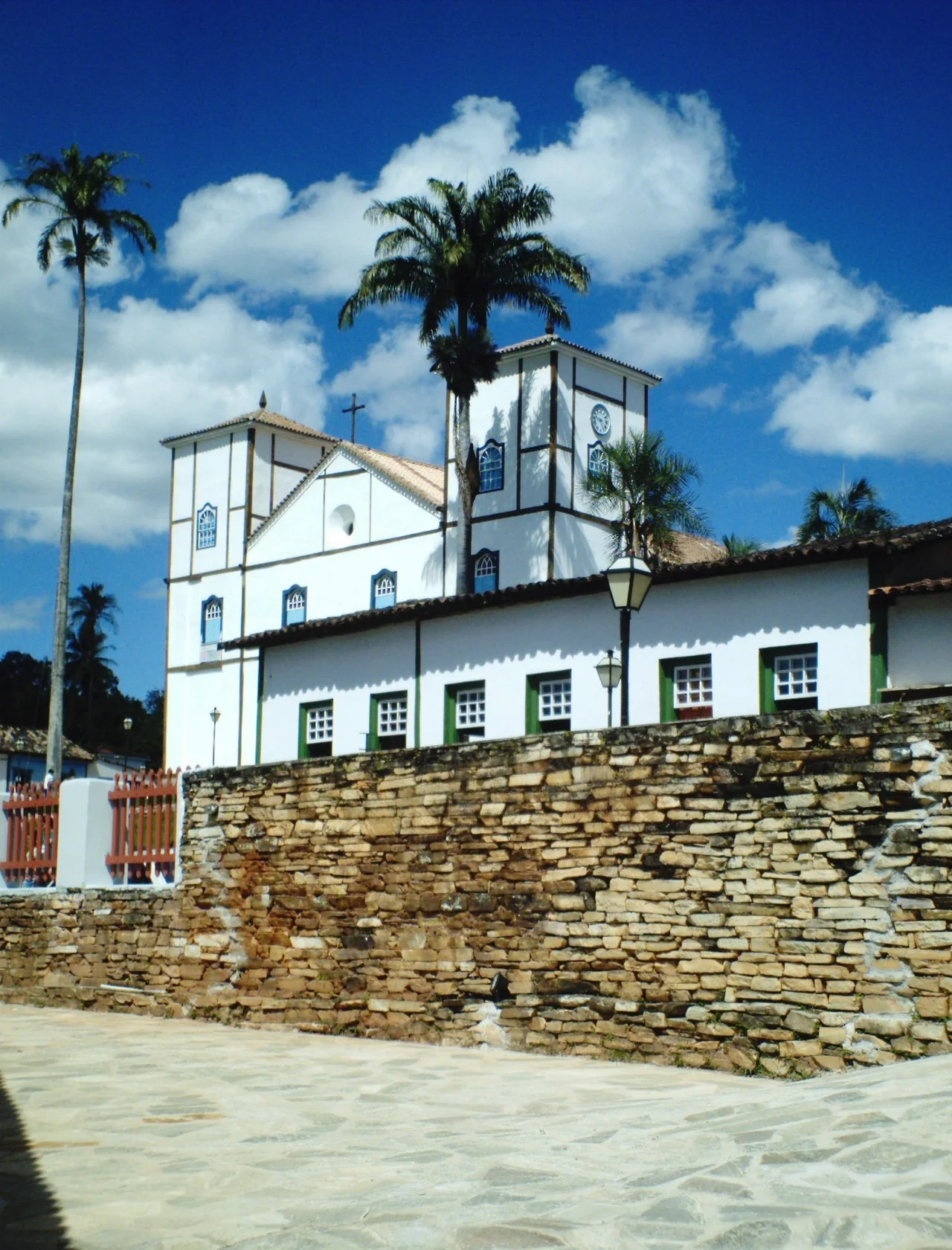

Pirenópolis
The stone-lined streets of Pirenópolis will punish bad shoes. Three centuries of mule hooves, ox carts, and Sunday processions have polished the quartzite blocks until they shine in the rain, and walking here is less strolling than navigating - watching where each foot lands, feeling the small dips where a thousand doorways have worn a path. This is what eighteenth-century Brazil actually looked like, and Pirenópolis kept it because the alternative - tearing it all down - was never affordable once the gold ran out.
A Town Founded on Gold
Exploration for gold in the Serra dos Pireneus began in 1728, one year after prospectors fanned out around the nearby city of Goiás. A bandeirante named Manoel Rodrigues Tomás, working with the famous Bartolomeu Bueno da Silva - called Anhanguera - founded mines he named the Minas de Nossa Senhora do Rosário de Meia-Ponte. Meia-Ponte, half a bridge, because the Almas River had torn away half of the original crossing. The town that grew around those mines became one of the richest urban centers in 18th-century Goiás, famous for gold, then cotton, then for having the province's most important 19th-century newspaper. Churches went up quickly, built by enslaved African laborers whose forced labor paid for every cornice and altar. The oldest of those churches, the Igreja Matriz de Nossa Senhora do Rosário, was constructed in 1728 with funds from gold mining - the oldest Catholic church in the state of Goiás.
When the Gold Ran Out
By the end of the 19th century, the veins were gone. Families left for the new capital at Goiânia, or pushed south to Jataí, Rio Verde, Itumbiara, Catalão. The population shrank. The churches stayed - and because no one had the money to modernize Pirenópolis, no one modernized it. The old houses kept their wooden shutters and red tile roofs. The stone streets stayed stone. Then in 1960 Brasília rose from the cerrado 150 kilometers to the east, and tourists started arriving. Someone in the government made the correct decision: instead of building new Pirenópolis, preserve old Pirenópolis. The electrical wiring went underground. Buildings were restored rather than replaced. The town was reborn as something rare in Brazil - a living 18th-century gold town with running water.
Cavalhadas
Every year, fifty days after Easter on Pentecost, the Festa do Divino Espírito Santo takes over Pirenópolis. The centerpiece is the Cavalhadas - a three-day mock battle between Christians and Moors, performed on horseback by riders in papier-mâché helmets. The Christian knights wear blue. The Moors wear red. They ride through the streets in parade, heralded by bugle fanfares, then clash in the city's bullring before thousands of spectators. The choreography is medieval, the sequence is fixed: the Moors are defeated, they convert to Christianity, the feast continues. Portuguese settlers brought the tradition to the town in 1826 - a reenactment, loosely, of battles from the time of Charlemagne, transplanted to the Brazilian cerrado. It is louder, hotter, and stranger than any description makes it sound.
Churches and Rescued Altars
Three churches anchor the historic center, all built between 1728 and 1755 by enslaved African laborers. The Igreja Matriz was partially destroyed by fire in September 2002; the altar was lost entirely. A separate church, the Matriz dos Pretos, had fallen to ruin with nothing left but its altar. In 2005, someone made the obvious and beautiful decision - the orphaned altar was installed in the altar-less Matriz, and both buildings found completion in each other. The Igreja de Nossa Senhora do Carmo, built in 1750, holds works rescued from other churches that were torn down. The Igreja de Nosso Senhor do Bonfim contains a crucifix carried here from Porto Seguro, Bahia, by a group of enslaved people said to number close to three hundred. These churches are not museums - they are the labor of people whose names were often not written down, preserved by a town that could not afford to lose them.
Waterfalls and a Return
Within fifteen kilometers of the center, more than twenty waterfalls spill off the quartzite of the Serra dos Pireneus. The Cachoeira do Abade drops 22 meters. Others are strings of cascades, plunging through farmland and public parks and the boundaries of the 2,833-hectare Pireneus State Park created in 1987. In the 1980s a different kind of arrival happened: hippies showed up, started communes outside town, set up silver workshops and cooperatives, and added a new layer to Pirenópolis's improbable mix. An ecovillage called IPEC - the Institute of Permaculture and Ecovillage of the Cerrado - teaches sustainable design to visiting students. The town that was built on gold, nearly died when the gold ran out, and came back as a tourist preserve is now, improbably, also a place people come to learn how to live with less.
From the Air
Coordinates 15.85°S, 48.96°W, elevation approximately 740 m. The town sits at the foot of the Serra dos Pireneus, recognizable from above by the compact historic center with red tile roofs and a few tall church towers against the quartzite ridge. Brasília is 150 km east, Goiânia 107 km southwest. Nearest airports: Brasília International (SBBR) 150 km east and Santa Genoveva Airport in Goiânia (SBGO) 107 km southwest. Recommended viewing altitude 6,000-10,000 feet to appreciate the cerrado setting and mountain backdrop.
Nearby Stories
- Alexânia 19 km away
- Anápolis 20 km away
- Ceres, Goiás 38 km away
- Anicuns 53 km away
- Luziânia 61 km away
- Contagem Biological Reserve 69 km away
- Itapuranga 98 km away