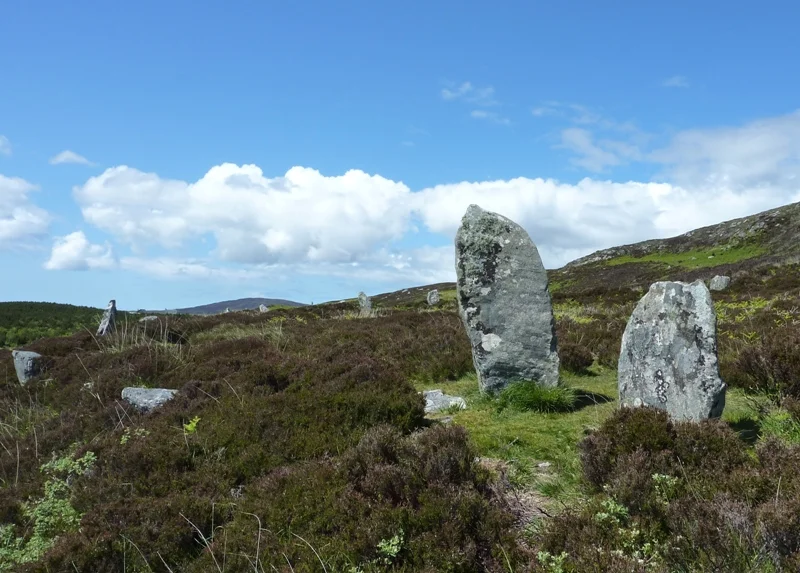

Pobull Fhinn
Fingal had a cauldron. According to the ancient Fenian cycle of Gaelic stories, the legendary hero Fionn mac Cumhaill and his fellow hunters cooked the deer they killed in Coire Fhinn, Fingal's cauldron. Stone circles in Skye, Arran, and here on North Uist all carry names that connect them to that mythical fireplace. The stones at Pobull Fhinn - "Fingal's People" - have stood on the south side of Ben Langass for somewhere around four thousand years, watching the loch below and apparently waiting for someone.
The Shape That Isn't Quite a Circle
Pobull Fhinn is technically an oval rather than a circle, measuring about 120 feet east to west and 93 feet north to south. The builders chose a natural plateau on the hillside and then excavated the north side of the enclosed area by about four feet, making the platform more level. At least two dozen stones can still be counted - around eight on the northern arc and sixteen on the southern - though parts of the ring are now bare. About four feet inside the eastern edge stands a tall single stone. Beyond the western edge, two fallen slabs lie where they apparently came down. The whole monument probably dates from the second millennium BC, contemporary with the late Bronze Age elsewhere in Britain.
What the Name Might Have Meant
Pobull can be spelt pobull, poball, pobul, or in the plural pobuill - and translates variously as Fionn's people, the white or fair people, or Finn's tent. The plural form Pobuill Fhinn is unlikely to be correct, the linguists note primly. The name may be a modern rationalisation of an older phrase, Puball Fhinn, "Fionn's tent," describing the hero's nomadic residence in the old stories. Locally the stones are also called Sornach a' Phobaill, "the fireplace of the People," and Sornach Coir' Fhinn, "the fireplace of Fionn's cauldron." Whichever name you use, all roads lead back to deer being cooked over a mythical fire by a hero who may or may not ever have existed.
The View That Makes It Famous
The jagged shapes of the stones silhouetted against Loch Langass, Loch Eport, and the dark hump of Eaval to the southeast make Pobull Fhinn one of the most visited and most photographed sites on North Uist. The setting matters as much as the monument. From the circle the land falls away into water, water reflects sky, sky carries weather from somewhere far out in the Atlantic. The stones become a foreground for everything else. The footpath up Ben Langass starts near the Langass Lodge Hotel; from the circle, an extension of the path climbs the hill to Barpa Langass, the chambered cairn that may be the older sibling of this circle, built by the same culture in the same landscape with the same patience for stone.
From the Air
Located at 57.56N, 7.28W on the south slope of Ben Langass, central North Uist. From the air the stones are too small to identify directly, but the location can be found by following Loch Langass and looking to the slope rising from its northern shore. The chambered cairn at Barpa Langass is uphill from the circle and may appear as a small darker mound on the hilltop. Nearest airport is Benbecula (EGPL) about 12 nautical miles south. The site is best appreciated from ground level rather than air; from altitude the prehistoric monuments of North Uist disappear into the heath.
Nearby Stories
- Trumpan Church 2.7 km away
- Eilean Glas Lighthouse 3.6 km away
- South Uist 7.8 km away
- Talisker 14 km away
- Amhuinnsuidhe Castle 19 km away
- St Kilda, Scotland 58 km away
- German submarine U-516 155 km away
- The Laki Eruption: The Volcano That Changed World History 893 km away