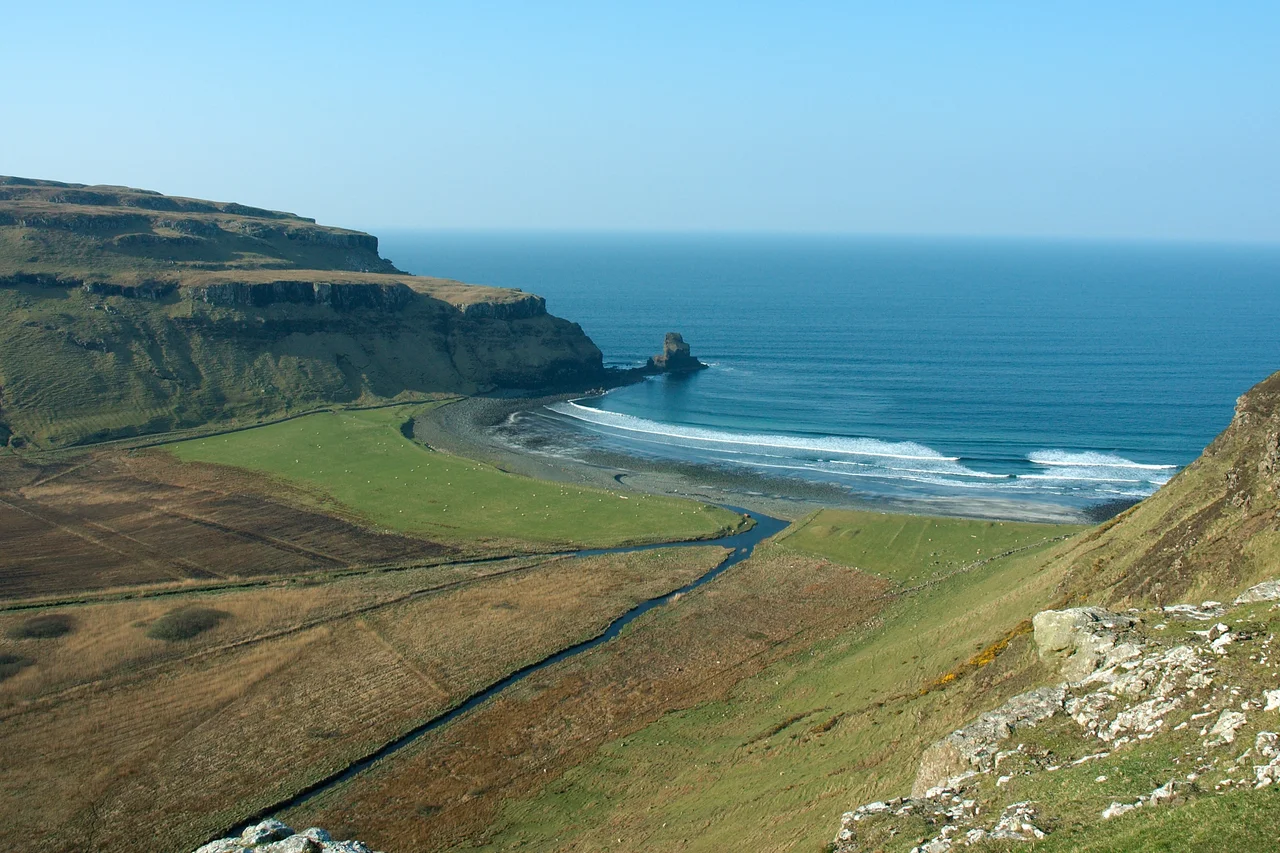

Talisker
Samuel Johnson and James Boswell arrived at Talisker in September 1773, riding the last leg of their notorious tour of the Hebrides. Johnson, who could be charitable about people but rarely about places, recorded that Talisker was "the place beyond all that I have seen, from which the gay and the jovial seem utterly excluded; and where the hermit might expect to grow old in meditation, without possibility of disturbance or interruption." Boswell, gentler, allowed that it was "a better place than one commonly finds in Sky." Two hundred and fifty years on, the small settlement on the western side of the Minginish peninsula has not changed enormously, except that its name is now stamped on bottles drunk around the world.
The Talisker Macleods
Talisker was for centuries a possession of Clan Macleod. A cadet branch of the chiefly line was founded here by Sir Roderick Macleod, 1st of Talisker, who lived from 1606 to 1675 and was knighted in 1661 for his services to the royalist cause during the civil war. He was the second son of Rory Mor Macleod, the chief who built so much of Dunvegan Castle. For nearly two hundred years the Macleods of Talisker held this corner of Skye, marrying daughters of Lord Reay and the Mackinnons, sending sons into the regiments of the Dutch and British service. John Macleod, 2nd of Talisker, who died around 1700, was the subject of an elegy by the blind harpist Ruaidhri Dall MacMhurich - the kind of small detail that says everything about how Gaelic Scotland recorded its own.
Johnson at Talisker
By the time the two English visitors arrived in 1773, the tacksman was John Macleod, 4th of Talisker, a Dutch-service officer permitted long absences in peacetime. Johnson liked him. Johnson liked his wife, who had picked up several languages while following her husband from posting to posting. The house Johnson saw was the predecessor to the present Talisker House, which was begun in 1717 and much extended through the 18th and 19th centuries. Boswell climbed Preshal More, the conical hill above the house, and was struck by its geological strangeness. The dining room of the present house has a plaster ceiling installed in 1865, when the bow window was added. The drawing room ceiling above it is original to about 1780. People still live in the house. It is listed but private.
The Clearance and the Distillery
In 1820 Donald Macleod, 6th of Talisker, sold his interest and emigrated to Van Diemen's Land - the colonial name for Tasmania. He took 36 Highlanders from his connection and a grant of 2000 acres. Five years later, Hugh MacAskill took over the Talisker estate and completed the clearance of the tenants that his predecessor had begun. Their houses came down. Their families were sent to the boats. In 1830 MacAskill founded the Talisker distillery five miles away at Carbost on Loch Harport, where there was peat and clean water. The name travelled with it. The whisky has been made on Skye continuously ever since, and "Talisker" today summons a bottle, not a place. MacAskill gave up his lease of the Talisker lands themselves in 1849, leaving the settlement gradually to its sheep and its quiet.
Preshal More and the Lava
The two hills above Talisker, Preshal More and Preshal Beg, are not ordinary Hebridean hills. They are the remnants of intra-canyon lava flows from a long-vanished volcanic shield that sat above what is now the Cuillin. At their base the Preshal Beg Conglomerate Formation crops out, a sedimentary record of debris flows and alluvial fans that filled a valley before the lava poured in over them. The tholeiitic basalt that caps both summits is chemically distinctive, related to the Cuillin's intrusive rocks. To stand on Preshal More, as Boswell did, is to stand on the surviving tongue of a sixty-million-year-old eruption. NatureScot has designated the whole area a Site of Special Scientific Interest, partly for the geology and partly for the rare burnet moths that fly here, the Talisker burnet and the transparent burnet.
Talisker Bay
The Gaelic poet Sorley MacLean, the greatest Gaelic poet of the 20th century, wrote of standing at Talisker Bay "where the great white mouth opens between two hard jaws," the headlands of Rubha nan Clach to the north and Bioda Ruadh to the south. The beach is a half-mile stretch of stone and sand, the sand mottled black and white where dark basalt has been ground together with paler quartz. The northern cliff carries an impressive waterfall that doubles in volume after rain. The southern is closed by a great sea stack. It is reached by foot from the road, and most visitors who make it down keep the place to themselves, as Johnson predicted they might.
From the Air
Located at 57.28°N, 6.45°W on the Minginish peninsula of the Isle of Skye, with Talisker Bay opening to the Atlantic on the west side. The settlement and Talisker House sit inland at the head of a small valley; Talisker Bay is a half-mile beach about 2km to the southwest. The Talisker distillery is 5 miles northeast at Carbost on Loch Harport. Useful landmarks include the Cuillin ridge (highest summit Sgurr Alasdair 992m) to the east-southeast and Preshal More (271m) directly above the house. Nearest airports are Plockton (EGPP) about 25nm east-northeast, Glenforsa on Mull (EGEL) 50nm south, Inverness (EGPE) 70nm east, and Stornoway (EGPO) 55nm north. Recommended viewing altitude 1500-3000 ft AGL with caution for orographic effects around the Cuillin in any easterly wind.
Nearby Stories
- Skye Marble Railway 2 km away
- Waternish 7.8 km away
- Arisaig 9.4 km away
- Lochmaddy 16 km away
- Loch Torridon 17 km away
- South Uist 18 km away
- Muck 20 km away
- SS Seniority 24 km away