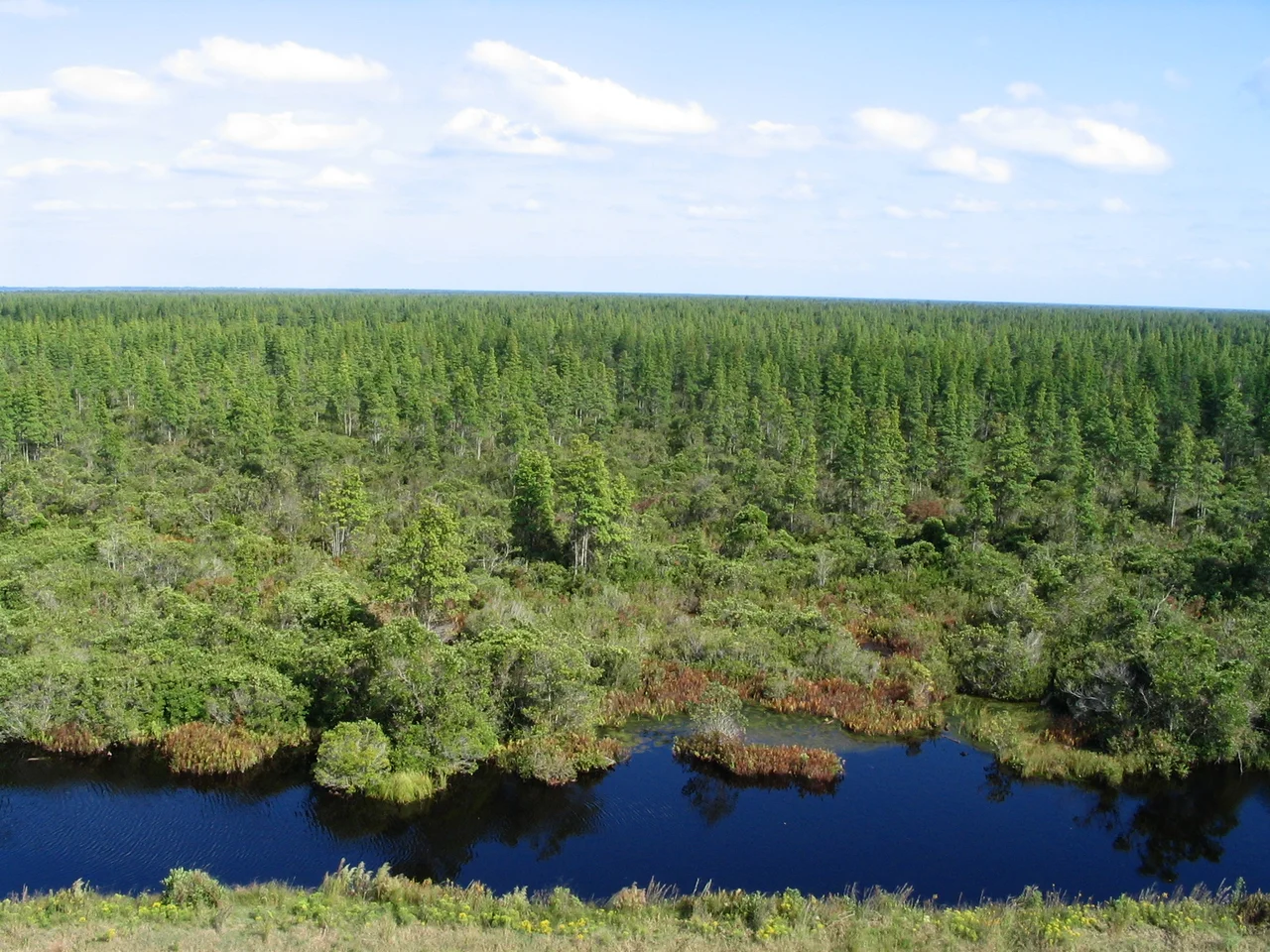

Pocosin Lakes National Wildlife Refuge
On a clear morning in late December, the cornfields at Pungo Lake fill with white. A hundred thousand birds - tundra swans, snow geese, ducks of a dozen species - lift off the water in waves that look from a distance like blowing snow. The sound is overwhelming, a continuous high whirr of wings that does not let up for minutes at a time. They have flown thousands of miles to be here. The Pocosin Lakes National Wildlife Refuge was set aside, in part, to make sure they would have somewhere to land. It is also the place that brought back the red wolf.
Pocosin, Algonquian for Swamp
The word pocosin comes from an Algonquian language spoken by the peoples who lived on the Albemarle-Pamlico Peninsula before European contact, though the exact etymology is uncertain. A pocosin is a freshwater wetland built on peat - decayed organic matter held above the surrounding land like a sponge. The peat soaks up water and releases it slowly, which is what makes pocosin landscapes such productive habitat for wildlife and such tough country for agriculture. Pocosin Lakes refuge was established in 1990, combining the older 12,000-acre Pungo National Wildlife Refuge (set aside in 1963) with a vast 90,000-acre block of donated land. Today the refuge covers 110,106 acres across Hyde, Tyrrell, and Washington Counties. Its headquarters is in the small town of Columbia.
Bringing the Red Wolf Back
By the 1970s the red wolf had been hunted, trapped, and habitat-stripped almost to nothing. Fewer than twenty pure-blooded animals remained, all collected for a captive breeding program. In 1987 federal biologists chose the Albemarle Peninsula as the place to try a release - a remote pocosin landscape with low human population and abundant prey. Pocosin Lakes refuge, established three years later, became part of the recovery zone. The red wolf became, and remains, one of the most challenging and most contested species recoveries in the country. The reintroduced wolves now share the refuge with black bears, alligators, bobcats, coyotes, river otters, mink, beavers, and two species of fox. The Atlantic Flyway threads directly through the refuge, and more than two hundred bird species use it during the year.
Drained by Enslaved Hands
The refuge's land carries a difficult earlier history. Beginning in 1840, the State of North Carolina, through an agency it called the Literary Board, launched a decade-long attempt to drain Pungo Lake and convert the basin to cropland. The 25-foot-wide canal that resulted was dug by enslaved laborers, who worked knee-deep in standing water and were housed in shacks along the canal's edges. The project was a failure on its own terms - the drained land turned out to be unfit for farming - but it dropped the lake's surface level by at least five feet, and the Pungo Lake Canal still runs from the lake to the Pungo River today. Logging companies later cut more canals through the peat by a slow process of burning and dredging, opening interior pocosin to timber removal. Restoring the natural hydrology - undoing two centuries of drainage - is now one of the refuge's major conservation projects.
Fire and Peat
Peat soil burns. That is the consequence of being made of compressed plant matter that has been drying out under the influence of those nineteenth-century canals. In April 1985 the Allen Road Fire ignited in the refuge area, scorching nearly 95,000 acres in about six days before the surface fire was contained - but peat ground-fires smoldered underground for months afterward. The Marines were called in to help extinguish what was left. In June 2008 a lightning strike started the Evans Road Fire, which spread to roughly 40,704 acres before being contained. That fire was not officially declared out until January 9, 2009. The hydrology restoration work now underway aims to rewet the peat across nearly a third of the refuge - both to slow future fires and to restore the wetland ecosystems that depend on standing water. In November the swans come back. In summer the fire risk waits.
From the Air
Pocosin Lakes NWR sits at 35.75 degrees North, 76.51 degrees West, on the Albemarle-Pamlico Peninsula of North Carolina's Inner Banks. From altitude the refuge reads as an enormous patchwork of dark pocosin wetland, agricultural fields, and the open-water surface of Pungo Lake itself. Dare County Regional (KMQI) at Manteo is about 30 miles east; Pitt-Greenville (KPGV) is about 60 miles west; the small Hyde County Airport (W57) is the closest GA field. Recommended viewing altitude is 3,500 to 5,500 feet AGL. In November through January, the Pungo Unit at the southwest corner of the refuge is one of the great wildfowl-viewing destinations in the eastern United States; from above, the lake surface is sometimes solid white with sixty thousand swans.
Nearby Stories
- Hayes Plantation 13 km away
- Hope Plantation 16 km away
- Washington, North Carolina 25 km away
- Lake Mattamuskeet 25 km away
- Roanoke Island Lost Colony 27 km away
- Skylight Inn BBQ 39 km away
- Battle of Hatteras Inlet Batteries 41 km away
- Wash Woods, Virginia 61 km away