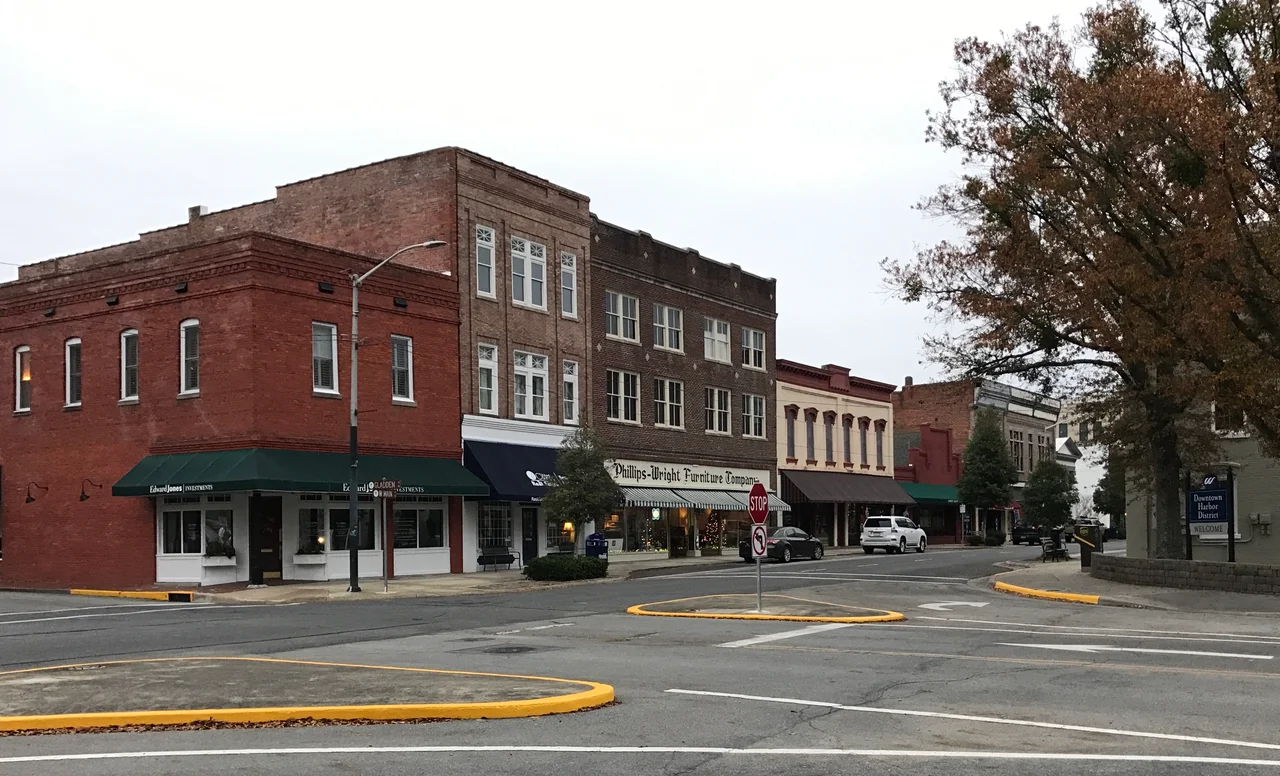

Washington, North Carolina
The town has a chip on its shoulder about its name, and you can hardly blame it. There is, after all, a more famous Washington upriver from the Potomac. But this one came first. In 1776, on a hundred acres donated by Colonel James Bonner along the Pamlico River, the residents of a settlement called Forks of the Tar voted to rename their town in honor of the Continental Army commander. George Washington had not yet won the war. He certainly had not yet been president. The town named for him in eastern North Carolina is the oldest such town in the country - older than the federal capital by fourteen years - which is why locals will, with absolute consistency, call it 'Original Washington' or simply 'Little Washington' if you want to start a conversation.
Forks of the Tar
Before it had a name and a Revolutionary cause, the settlement was just a riverbank with good water access. James Bonner, an English-born planter and Patriot, owned land where the Tar River broadens and becomes the tidal Pamlico, and through the 1770s small wharves and warehouses began to appear on his property. He called it Forks of the Tar. When the Continental Congress was deliberating in Philadelphia, Bonner deeded his hundred acres to the town and the residents renamed it. During the Revolution itself, with the major North Carolina ports of Wilmington and Edenton under threat or blockade, Washington served as a backup supply point for goods bound inland. The river was the road.
Burned and Burned Again
The Civil War was hard on Little Washington. The town changed hands repeatedly. In 1862 a Union gunboat bombarded the courthouse - the original 1824 building burned to the ground from a shell hit - and the Union held the town for most of the war. A cannonball from that period is still on display in a Water Street attorney's office today, embedded in a small glass case. Civil War re-enactors gather outside town each year. The waterfront was a target because the Pamlico River was a logistical asset; whoever held the river held the supply line into the interior. The damage from both wartime bombardment and a series of nineteenth-century fires explains why most of Washington's downtown architecture, though carefully restored, dates from the post-Reconstruction era rather than the colonial period.
A Pulitzer at the Daily News
In 1990 the Washington Daily News, with a circulation under ten thousand, won the Pulitzer Prize for Meritorious Public Service - the smallest daily newspaper in history to win the award. The reporting series investigated local water contamination, and the paper's persistence in the face of municipal denial brought national attention. The Pulitzer is, in some ways, characteristic of Little Washington's self-image: a small place that occasionally punches well above its weight. The town has produced a startling number of nationally known figures - NBA player Dominique Wilkins, MLB player Ryan Zimmerman, Secretary of the Navy Josephus Daniels, the playwright Henry Churchill de Mille (father of director Cecil B. DeMille and grandfather of choreographer Agnes de Mille). NBA player Bam Adebayo grew up in nearby Pinetown in Beaufort County and attended Northside High School before going on to the Miami Heat. Pioneer physician Susan Dimock, one of the first American women to earn a medical degree, was born here in 1847.
Estuarium and Boardwalk
Modern Washington has built much of its identity around the river that defines it. The North Carolina Estuarium, a museum on the waterfront, houses more than two hundred exhibits on the ecology of the state's estuaries and the Tar-Pamlico-Pamlico Sound system. A three-quarter-mile boardwalk runs along the river. The restored Turnage Theatre, a former vaudeville and movie house, reopened in 2014 and hosts live theater downtown. A Farmer's and Artisan's Market draws weekend crowds to the green stretches along the water. Between 1993 and 2017 the town ran a summer music festival called Music in the Streets every third Friday, drawing shoppers and tourists down to the historic district. The population was 9,875 at the 2020 census - small enough to walk across in twenty minutes, large enough to support a town with its own particular history, its own particular Pulitzer, and its own particular insistence on getting credit for being the original Washington.
From the Air
Washington sits at 35.55 degrees North, 77.05 degrees West, on the north bank of the Pamlico River, about twenty miles east of Greenville. From altitude the river is the dominant visual feature - the Tar enters from the west and becomes the broad tidal Pamlico right at the U.S. 17 bridge. Washington-Warren Airport (KOCW) lies just east of downtown and provides the closest GA reference. Pitt-Greenville (KPGV) is about twenty miles west. Recommended viewing altitude is 3,500 to 5,500 feet AGL on clear days for the best view of the riverfront, downtown grid, and the dramatic widening of the river east of town.
Nearby Stories
- La Grange Historic District (North Carolina) 9.2 km away
- Rocky Mount, North Carolina 15 km away
- Battle of Albemarle Sound 16 km away
- 1961 Goldsboro B-52 Crash 19 km away
- Pocosin Lakes National Wildlife Refuge 21 km away
- Craven County, North Carolina 26 km away
- Bertie County, North Carolina 29 km away
- Portsmouth, North Carolina 60 km away