
Ponte City
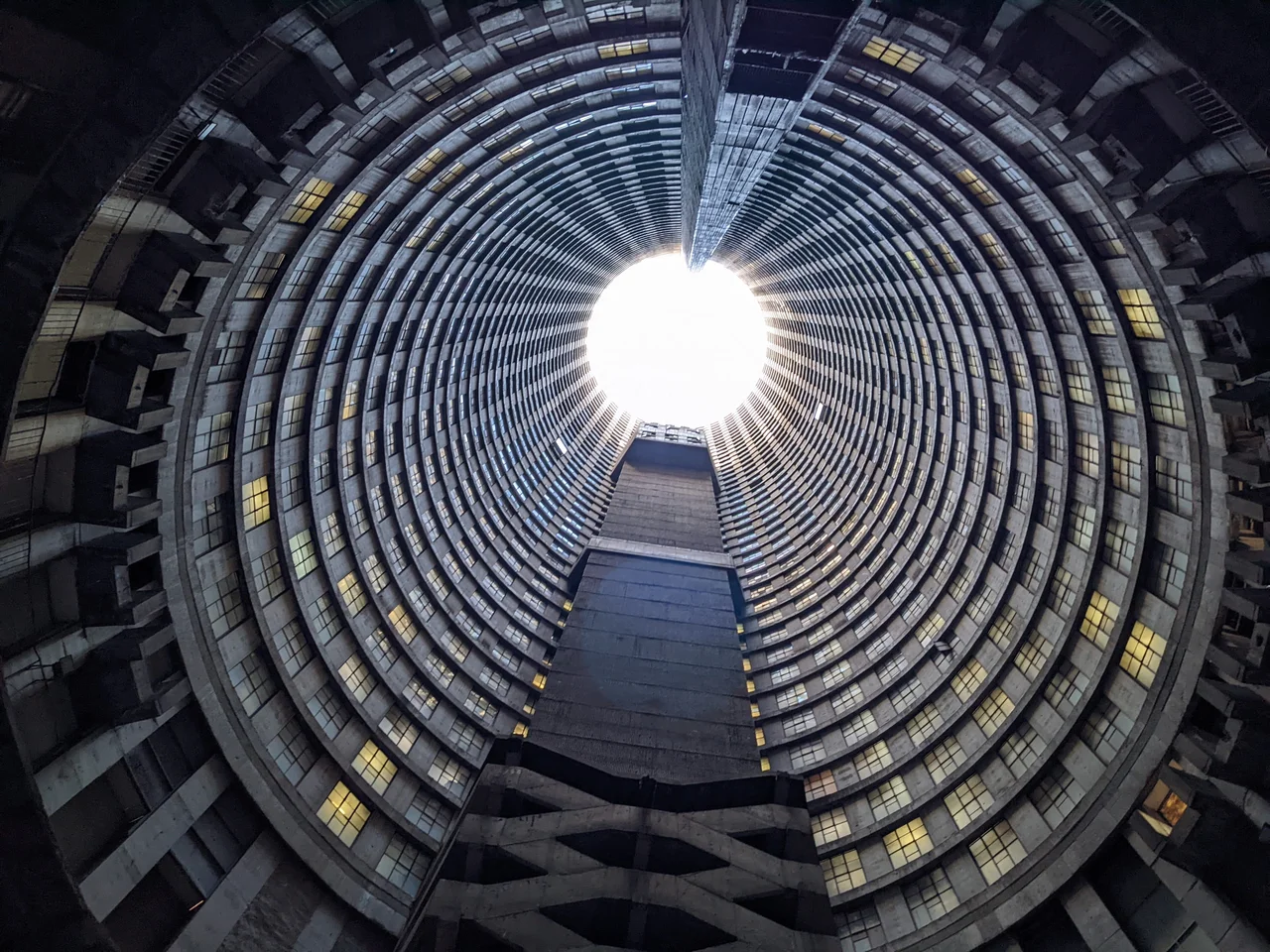
Stand at the bottom of Ponte City and look up, and the building seems to swallow the sky. The tower is a hollow cylinder, fifty-four storeys of apartments wrapped around an open shaft that drops the full height of the structure to a floor of bare, uneven rock. Architects designed it that way for a mundane reason: a Johannesburg bylaw of the 1970s demanded that every kitchen and bathroom have a window, so they turned the building inside out and let daylight pour down the core. The effect is anything but mundane. From below, the core is a vertical canyon of concrete and laundry lines. From the highway, the cylinder rises over the inner-city districts of Berea and Hillbrow like nothing else in Africa, and for forty-eight years it was the tallest residential building on the continent.
A City Turned Inside Out
When Ponte City opened in 1975, it was a marvel and a status symbol. Designed by the architects Rodney Grosskopff, Manfred Hermer and Mannie Feldman, it borrowed its cylindrical form and its all-in-one ambitions from Bertrand Goldberg's Marina City in Chicago, completed a decade earlier. The idea was a city within a city: shops and services at the base, hundreds of wedge-shaped apartments above, and the best views in Johannesburg from the upper floors. At 173 metres, it towered over everything. The neon advertising sign later bolted to its crown became the largest in the Southern Hemisphere, glowing first for Coca-Cola and, after 2000, for the mobile network Vodacom, a beacon visible for miles across the Highveld.
The Fall
Johannesburg's inner city emptied of its wealthier residents in the late 1980s and 1990s as apartheid's controls collapsed and the urban core was abandoned by landlords and authorities alike. Ponte fell with it. Maintenance stopped, crime surged, and the building's open core filled with rubbish, reportedly piling up several storeys deep before anyone cleared it. The tower became shorthand for urban decay, the place outsiders pointed to as proof that the city had failed. Yet through all of it, people kept living there. Thousands of them called Ponte home, riding lifts that one filmmaker spent two and a half years documenting from the inside, because the lifts were where the whole vertical neighbourhood crossed paths.
Concrete Fear, Strange Beauty
The world's cameras could not stay away. The photographer David Goldblatt shot the inner city for decades; Mikhael Subotzky and Patrick Waterhouse spent three years on a portrait of the tower that won a major award at the Arles photography festival. Filmmakers cast Ponte as the future gone wrong. It looms in the final frames of District 9, hosts a battle in Resident Evil: The Final Chapter, and inspired the towering slum-fortress of Dredd. A German novelist who set a book inside it called Ponte a sort of white whale, concrete fear, the tower of Babel, and yet, he wrote, strangely beautiful. He had named the contradiction at the building's heart.
Rising Again
An ambitious redevelopment scheme in 2007 promised to gut and reinvent the tower, but the global financial crisis killed the funding and the plan collapsed. Quieter efforts succeeded where the grand one failed. The core was cleared, security restored, and Ponte was marketed once more as safe and affordable housing for people who wanted to live in the city rather than flee it. In 2023, after nearly half a century, a tower in Egypt's New Administrative Capital finally took its crown as Africa's tallest residential building. Ponte hardly seems to mind. It has been the dream address, the cautionary tale, and the survivor, all in the same shaft of concrete, and it is still standing watch over Johannesburg.
From the Air
Ponte City stands in the Berea district just east of Hillbrow at about 26.19°S, 28.06°E, roughly 1,750 m above sea level. It is unmistakable from the air: a lone concrete cylinder rising 173 m, often topped by a large illuminated ring sign, set among the dense towers of inner-city Johannesburg. The slender Hillbrow Tower stands close by to the northwest, giving two clear vertical landmarks side by side. The nearest major airport is O.R. Tambo International (FAOR), about 22 km east-southeast; Rand Airport (FAGM) lies to the south. Winter skies (May to August) are dry and very clear; summer brings dramatic late-afternoon thunderstorms. A viewing altitude of 1,500 to 3,000 ft above ground best captures the cylinder's profile against the surrounding city grid.
Nearby Stories
- Pelindaba 4.6 km away
- TauTona Mine 6.3 km away
- Zonderwater POW camp 18 km away
- Kweneng' Ruins 25 km away
- Battle of Bronkhorstspruit 40 km away
- Royal Bafokeng Nation 41 km away
- Secunda CTL 72 km away
- Sun City 91 km away