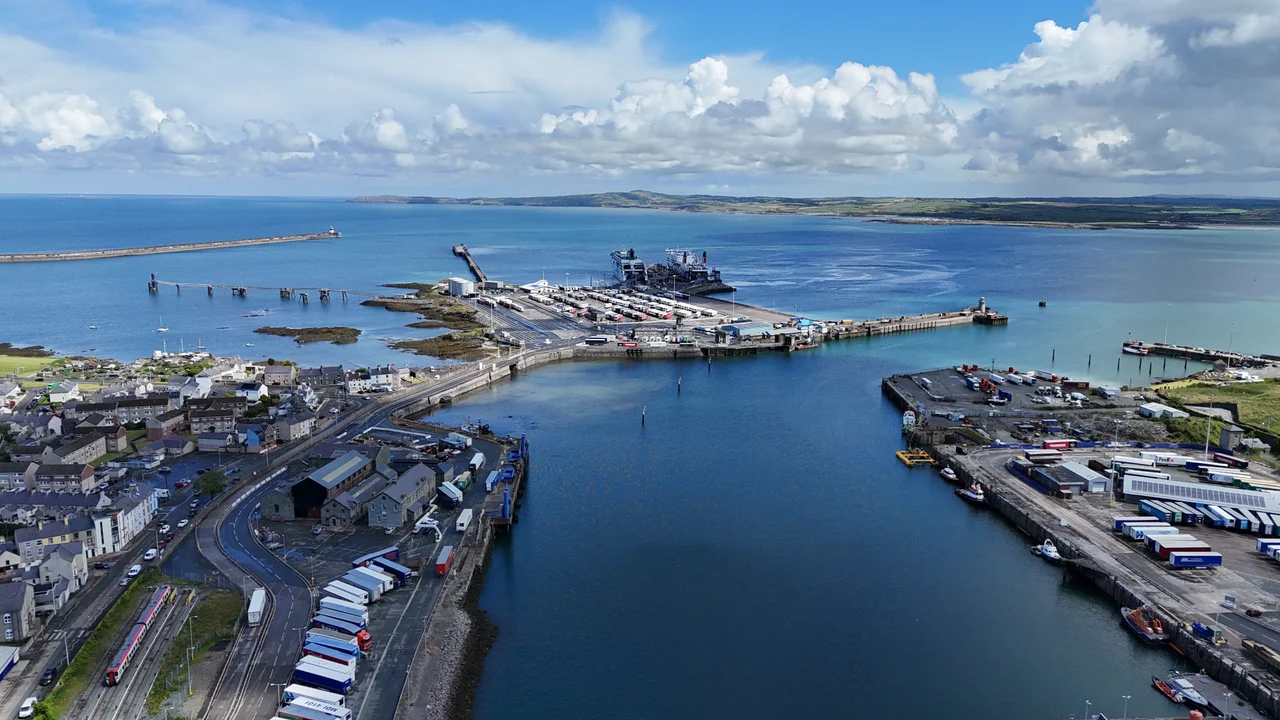

Port of Holyhead
On 6 December 2024, during Storm Darragh, two ferries collided with a berth at the Port of Holyhead. The damage was enough to take the entire port out of service. Holyhead is - or was - the second-busiest roll-on roll-off port in the United Kingdom after Dover, handling more than two million passengers and around 450,000 lorries every year on the Dublin run. With it offline, freight that normally moved through Holyhead had to be rerouted to other ports. The port did not reopen at all until 16 January 2025, and even then only one of the two damaged berths was back in service. Full reopening was repeatedly delayed - first to 1 July, then to 18 July 2025. The whole episode was a sharp reminder that an enormous chunk of British-Irish trade depends on the structural integrity of a small number of piers on the Welsh coast.
Three Harbours, One Long Wall
The port covers 240 hectares and is operated by Stena Line Ports Limited. It is partly on Holy Island and partly on Salt Island, divided by the channel of the original harbour. There are three distinct basins: the Inner Harbour, the Outer Harbour, and the New Harbour, which opened in 1880. All three sit behind the Holyhead Breakwater - 2.7 kilometres of Victorian Holyhead Mountain quartzite, the longest breakwater in the UK, completed in 1873 after twenty-eight years of construction. At the landward end of the Admiralty Pier stands the Admiralty Arch, designed in 1824 by Thomas Harrison to commemorate the visit of George IV to Holyhead in 1821 - the visit when the king ended up sailing to Dublin not on the royal yacht but on the steam packet Lightning because the weather kept the yacht in port.
Why Holyhead Won
Two ports competed in the early nineteenth century to become the main British sea gateway to Ireland: Porthdinllaen on the Llyn Peninsula and Holyhead on Anglesey. In May 1806, a parliamentary bill approved new buildings at Porthdinllaen on the assumption it would be chosen. The Porthdinllaen Harbour Company was formed in 1808. But Thomas Telford's road developments through north Wales made Holyhead more accessible than its rival, and in 1810 the bill to constitute Porthdinllaen as the Irish harbour was rejected. Holyhead won by default. An 1845 Act of Parliament authorised the construction of the new port. The railway station opened in 1851. The breakwater finished in 1873. The Prince of Wales who had formally opened the breakwater as a young man returned in 1880 - by then King Edward VII - to open the New Harbour.
Wartime, Fishguard, and the Fast Ferry
The port was not without rivals. Fishguard, in southwest Wales, began operating ferries to Ireland in 1906 and took some of Holyhead's traffic. During the First World War, in 1916, a naval base was established at Holyhead, and the Irish Sea Hunting Flotilla was set up later in the war to combat U-boats operating against shipping in the Irish Sea. In the late twentieth century, Stena Line introduced a high-speed catamaran service to Dun Laoghaire just south of Dublin, which ran until September 2014 when it was discontinued as passenger numbers fell by 90 percent. That left Irish Ferries operating the fastest conventional service between Holyhead and Dublin. The 2024 storm and 2025 partial closures have been the biggest disruption to the route in decades - bigger, by some operational measures, than COVID.
How You Catch the Boat
Stena Line and Irish Ferries both sail from Holyhead to Dublin Port. The terminal building is integrated with Holyhead railway station - a deliberate design, dating from the original Victorian arrangement and reinforced by later rebuilds. Trains from London Euston, run by Avanti West Coast, terminate inside the same building as the ferries. The walk between train and ferry check-in is less than two minutes from most platforms, or about five from the more remote Platform 1. Vehicle access is via the A5 or the A55, which both feed directly into the port through dedicated roads. Pedestrians from Holyhead town centre use the Celtic Gateway, a stainless steel bridge that opened in 2006 connecting the town to the joint terminal. The largest ferries arrive and depart from the 300-metre Admiralty Pier - the same pier built by John Rennie in the 1810s and 1820s, still doing the job after two hundred years.
From the Air
The Port of Holyhead covers 240 hectares at 53.31N, 4.63W, with the long curve of the Holyhead Breakwater (2.7 km) defining its northern boundary and Salt Island and Holy Island forming the western and southern shores. From the air the three harbour basins are clearly visible inside the breakwater. The railway station and ferry terminal share a building at the southern end of the Inner Harbour. The Celtic Gateway pedestrian bridge connects town to terminal. Nearest airfields: RAF Valley (EGOV) 6nm southeast, Caernarfon (EGCK) 20nm southeast. Best viewed at 2,000-3,500ft AGL. Ferry movements are scheduled in and out throughout the day.
Nearby Stories
- Snowdon Mountain Railway 8 km away
- German submarine U-1051 8.3 km away
- German submarine U-246 11 km away
- Trwyn Du Lighthouse 13 km away
- Irish Sea Bridge 20 km away
- HMS Manners (K568) 34 km away
- HMS Tyler 47 km away
- Birkdale Palace Hotel 79 km away